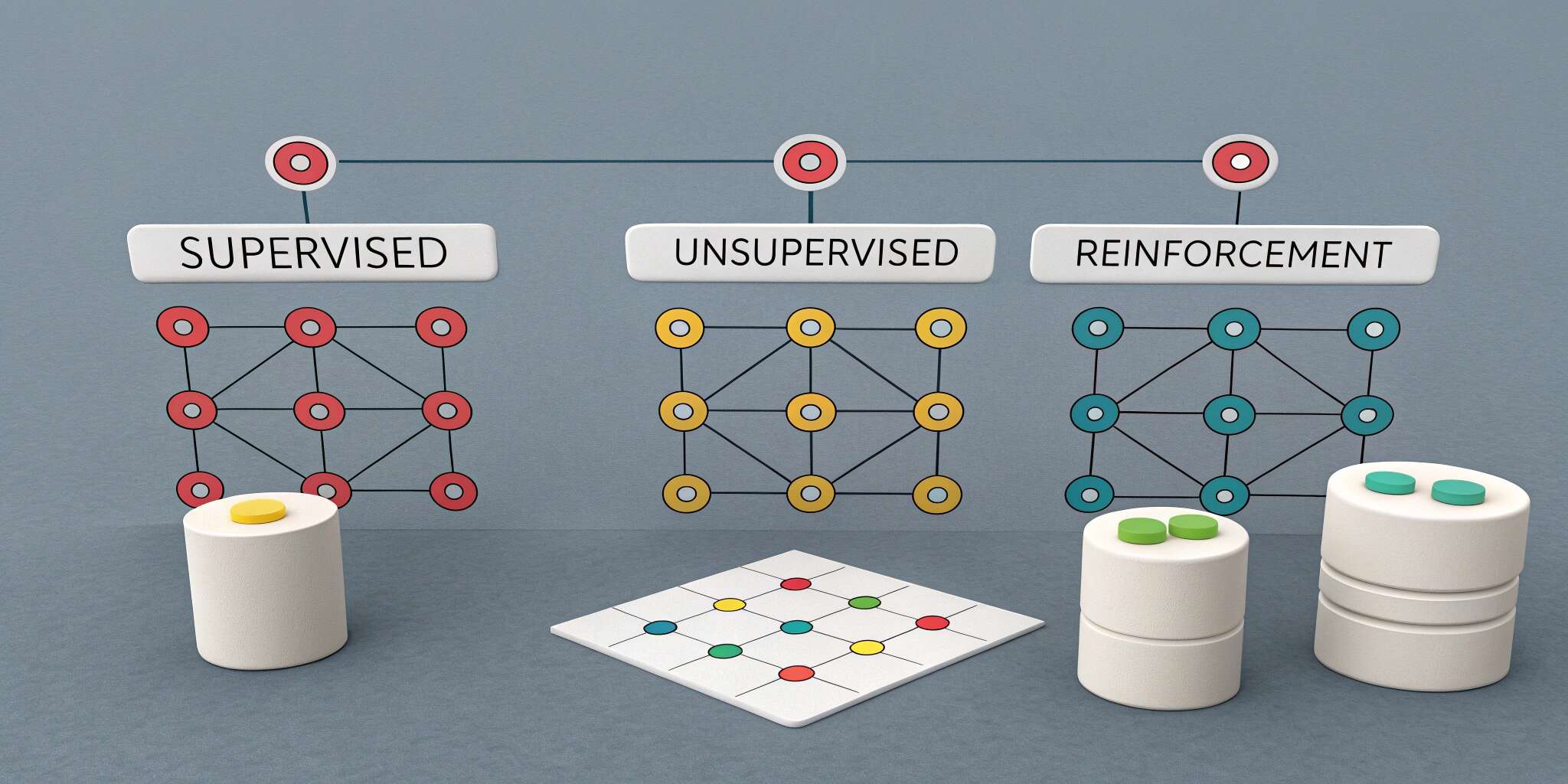
Machine Learning (ML) is a branch of Artificial Intelligence (AI) that empowers systems to learn and make decisions based on data. At the heart of ML are three primary learning types: Supervised, Unsupervised, and Reinforcement Learning. Each has unique characteristics, learning techniques, and applications. Understanding these types is essential for anyone entering the field of AI or data science.
1. Supervised Learning
Definition:
Supervised learning involves training a model on a labeled dataset, meaning each input has a corresponding correct output. The model learns to predict outcomes based on these examples.
Key Characteristics:
- Requires labeled data.
- Ideal for prediction and classification problems.
- The model is guided (supervised) during training.
Examples:
- Email spam detection
- Stock price prediction
- Image recognition (e.g., classifying animals)
Pros:
- High accuracy when trained on good quality data.
- Easy to understand and implement.
Cons:
- Needs a large amount of labeled data.
- Less flexible to new or unseen scenarios.
2. Unsupervised Learning
Definition:
Unsupervised learning uses input data without labeled responses. The system tries to learn the patterns and structure from the data itself.
Key Characteristics:
- No labeled output.
- Used mainly for clustering and association tasks.
- Helps in finding hidden patterns or intrinsic structures.
Examples:
- Customer segmentation
- Market basket analysis
- Anomaly detection (e.g., fraud detection)
Pros:
- Works with unlabeled data (easy to collect).
- Can uncover hidden insights.
Cons:
- More difficult to evaluate performance.
- Results can be less interpretable.
3. Reinforcement Learning
Definition:
Reinforcement learning is inspired by behavioral psychology. An agent learns to take actions in an environment to maximize a reward over time through trial and error.
Key Characteristics:
- Learns through feedback and interaction.
- Ideal for dynamic environments and decision-making.
- Uses concepts like reward, penalty, and policy.
Examples:
- Game AI (e.g., AlphaGo)
- Autonomous vehicles
- Robotics and industrial automation
Pros:
- Learns optimal actions over time.
- Excellent for sequential decision-making.
Cons:
- Complex to train.
- Requires substantial computational power and data.
Conclusion
Each type of machine learning—supervised, unsupervised, and reinforcement—serves a different purpose and excels in specific scenarios. Choosing the right type depends on your data availability, problem type, and desired outcome. As AI and ML continue to evolve, understanding these foundational concepts is crucial for developing smart, data-driven solutions.