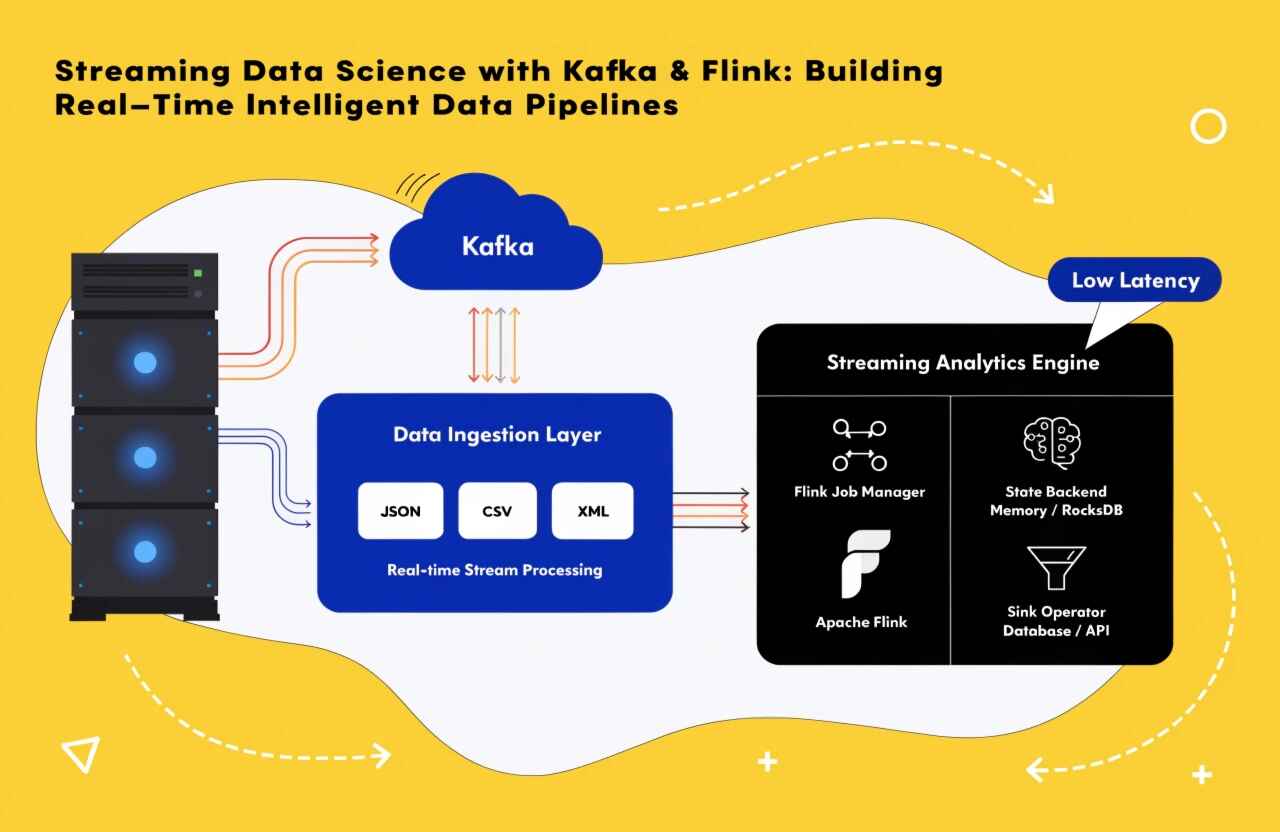
Kafka and Flink enable organizations to build real-time data science pipelines by combining reliable event streaming with powerful stream processing. Together, they support real-time analytics, machine learning, anomaly detection, personalization, and intelligent business applications.
Introduction
Modern businesses generate enormous amounts of data every second. Customer interactions, application events, IoT devices, financial transactions, website activity, and social media interactions continuously produce valuable information. Traditional batch processing systems often analyze this information hours or days after it is generated. For many modern applications, that delay is no longer acceptable.
Streaming data science addresses this challenge by processing information continuously as it arrives. Apache Kafka and Apache Flink are two powerful technologies commonly used to create real-time data pipelines. Kafka provides a reliable platform for collecting and distributing event streams, while Flink processes those streams with low latency and advanced analytical capabilities.
Together, Kafka and Flink can help organizations transform raw real-time events into actionable insights.
What Is Streaming Data Science?
Streaming data science involves applying data engineering, analytics, and machine learning techniques to continuously arriving data. Instead of collecting data into large batches and processing it later, streaming systems analyze information while it is being generated.
For example, an e-commerce platform can analyze customer clicks and purchases in real time. A financial organization can monitor transactions for suspicious activity immediately. Similarly, an IoT platform can process sensor readings continuously to identify equipment problems.
The objective is to reduce the time between data generation and decision-making.
The Role of Apache Kafka
Apache Kafka is a distributed event-streaming platform designed to handle high volumes of data reliably. Applications can publish events to Kafka topics, while other applications or services consume those events.
A typical Kafka architecture includes producers, brokers, topics, partitions, and consumers.
For example, an online shopping application may generate events such as:
- Product viewed
- Product added to cart
- Order created
- Payment completed
- Product shipped
These events can be published to Kafka topics. Multiple downstream applications can then consume the same streams for analytics, monitoring, recommendation systems, or machine learning.
Kafka's distributed architecture makes it suitable for applications that require scalability, fault tolerance, and continuous event processing.
The Role of Apache Flink
Apache Flink is a distributed stream-processing framework designed to process data continuously and at scale. It can consume streaming data from Kafka, perform transformations and calculations, and send processed results to databases, dashboards, applications, or other systems.
Flink supports operations such as filtering, aggregation, joins, event-time processing, and complex event processing.
One of its important capabilities is stateful stream processing. Flink can maintain information about previous events and use that state to make decisions about incoming data.
For example, a fraud detection system could monitor a customer's transactions over a specific time window and identify unusual behavior based on transaction frequency, location, and value.
Kafka and Flink Together
Kafka and Flink complement each other effectively.
Kafka acts as the real-time event backbone, while Flink acts as the stream-processing engine.
A simplified architecture looks like this:
Data Sources → Kafka → Flink → Analytics/ML → Applications
Data sources can include web applications, mobile applications, IoT devices, databases, APIs, and enterprise systems. Kafka collects and distributes the events. Flink consumes these events and performs real-time processing.
The resulting data can then be delivered to data warehouses, dashboards, alerting systems, recommendation engines, or machine learning services.
Real-Time Machine Learning
One of the most valuable applications of Kafka and Flink is real-time machine learning.
Traditional machine learning workflows often depend on historical datasets. Streaming architectures allow models and prediction systems to work with continuously changing information.
For example, a recommendation platform can receive user activity through Kafka. Flink can process the activity, calculate relevant features, and send those features to a machine learning model. The model can then generate recommendations based on the user's latest behavior.
This architecture can support applications such as:
- Fraud detection
- Customer churn prediction
- Product recommendations
- Real-time personalization
- Predictive maintenance
- Credit risk monitoring
- Cybersecurity monitoring
Real-Time Analytics
Organizations can use Flink to calculate real-time metrics from Kafka streams. Instead of waiting for a nightly batch job, businesses can monitor important indicators continuously.
For example, a company can track website traffic, conversion rates, transaction volumes, application errors, and customer activity in near real time.
Windowing is particularly useful for this purpose. Flink can analyze events over time windows such as the last minute, five minutes, or hour.
This allows businesses to identify trends and respond quickly when unusual activity occurs.
Anomaly and Fraud Detection
Financial systems generate large numbers of transactions that need to be monitored continuously. A Kafka and Flink architecture can process transactions as they happen.
Flink can evaluate transaction patterns, customer behavior, geographical information, and historical context. If a transaction meets certain risk conditions, the system can generate an alert immediately.
The same approach can be applied to cybersecurity. Streaming systems can analyze login attempts, network activity, API requests, and system events to identify suspicious patterns.
Benefits of Kafka and Flink
Using Kafka and Flink together provides several advantages:
Low-latency processing: Data can be processed shortly after it is generated.
Scalability: Both technologies are designed for distributed environments and can handle large data volumes.
Fault tolerance: Distributed architectures help systems recover from failures.
Real-time decision-making: Businesses can react to events without waiting for batch processing.
Flexible architecture: Kafka can distribute the same event streams to multiple downstream applications.
Advanced stream processing: Flink provides stateful processing, event-time operations, and window-based analytics.
Best Practices
When building a streaming data science architecture, organizations should carefully design their Kafka topics and partitioning strategy. Event schemas should be standardized to prevent compatibility problems between producers and consumers.
Flink jobs should also be monitored for processing delays, failures, state growth, and resource consumption.
Data quality is equally important. Invalid, duplicate, or incomplete events can negatively affect analytics and machine learning results.
Organizations should also consider security by implementing appropriate authentication, authorization, encryption, and access controls.
Conclusion
Streaming data science is becoming increasingly important as businesses demand faster insights and real-time intelligence. Apache Kafka provides a scalable event-streaming foundation, while Apache Flink enables sophisticated processing and analytics on continuously arriving data.
By combining Kafka and Flink, organizations can build real-time pipelines capable of supporting analytics, machine learning, fraud detection, personalization, anomaly detection, and intelligent applications.
As data volumes and real-time requirements continue to grow, Kafka and Flink offer a powerful foundation for creating responsive, scalable, and data-driven digital systems.
We build scalable web, mobile, and game products for clients worldwide — combining modern frameworks, cloud infrastructure, and best engineering practices.
.jpg)
.jpg)
.jpg)