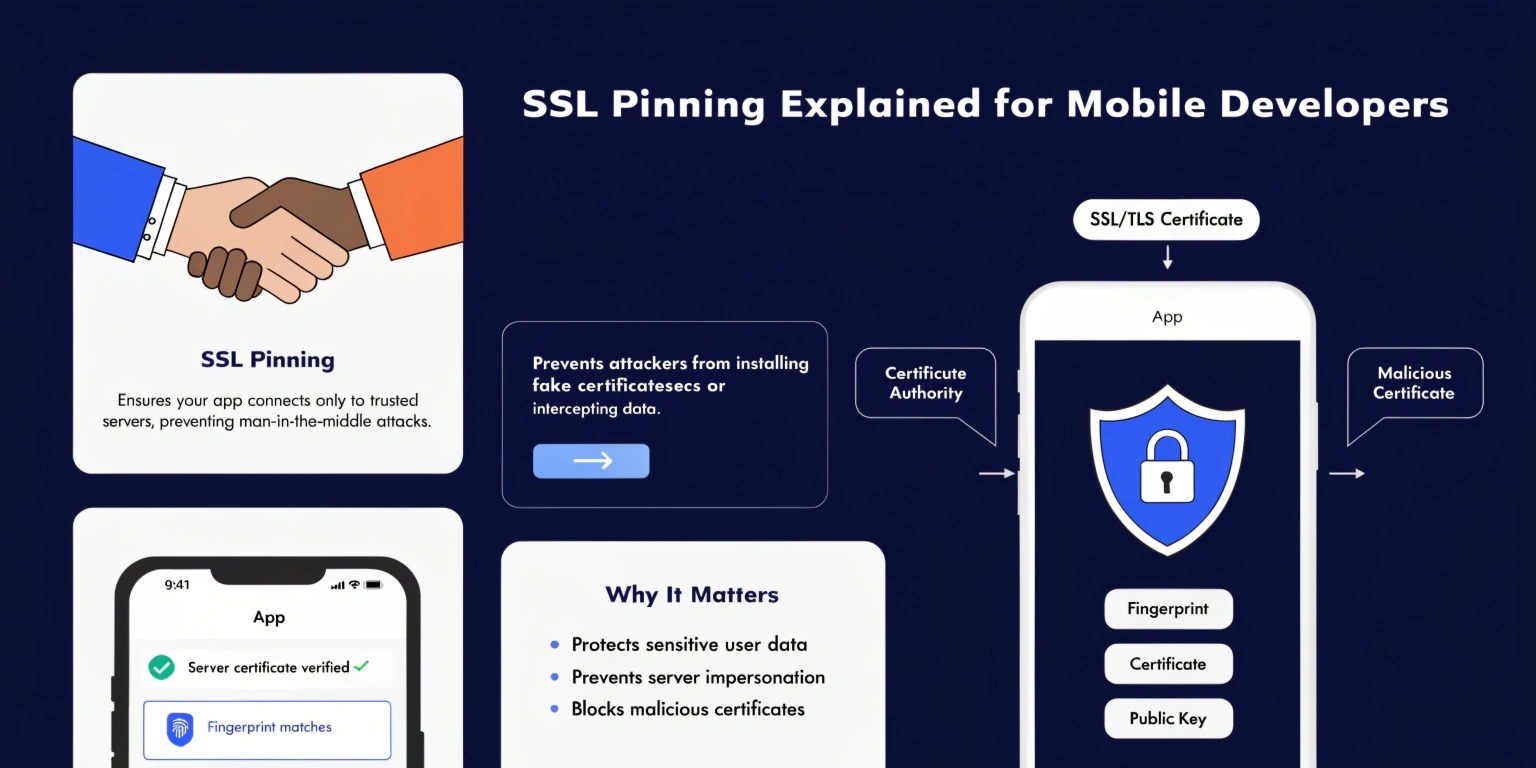
In today’s mobile-first world, securing data transmission between apps and servers is critical. While HTTPS provides encryption, it is not always enough to protect against advanced attacks. This is where SSL pinning comes into play.
SSL pinning is a powerful security technique that helps mobile developers safeguard applications from man-in-the-middle (MITM) attacks and unauthorized interception of data.
What is SSL Pinning?
SSL pinning is the process of associating a host with its expected SSL/TLS certificate or public key. When a mobile app connects to a server, it verifies that the server’s certificate matches the pinned certificate stored within the app.
This ensures that even if a malicious certificate is trusted by the device, the connection will be rejected unless it matches the pinned version.
Understanding the Risk: MITM Attacks
A Man-in-the-Middle attack occurs when an attacker intercepts communication between a user and a server. Even with HTTPS, attackers can exploit compromised certificate authorities or trick devices into trusting malicious certificates.
Without SSL pinning, your app may unknowingly communicate with an attacker’s server.
How SSL Pinning Works
When SSL pinning is implemented:
- The app stores a copy of the server’s certificate or public key
- During connection, the app compares the server’s certificate with the pinned version
- If they match, the connection proceeds
- If not, the connection is blocked
This adds an extra layer of trust verification beyond standard HTTPS.
Types of SSL Pinning
1. Certificate Pinning
The app stores the entire certificate and validates it during the handshake.
Pros:
- Strong security
- Simple to implement
Cons:
- Breaks if the certificate is renewed
2. Public Key Pinning
Instead of the full certificate, only the public key is pinned.
Pros:
- More flexible during certificate renewal
- Easier maintenance
Cons:
- Slightly more complex setup
Why SSL Pinning is Important
- Prevents MITM attacks
- Protects sensitive user data
- Enhances API security
- Builds user trust
For apps handling financial transactions, personal data, or authentication, SSL pinning is highly recommended.
Implementation in Mobile Apps
Android Implementation
On Android, SSL pinning can be implemented using libraries like OkHttp.
Example approach:
- Define certificate pins in the network security configuration
- Validate certificates during API calls
iOS Implementation
On iOS, SSL pinning is typically implemented using URLSession or third-party libraries like Alamofire.
Steps:
- Bundle the certificate in the app
- Validate server trust in delegate methods
Best Practices for SSL Pinning
- Use Public Key Pinning: Allows smoother certificate updates
- Backup Pins: Include multiple valid certificates
- Graceful Error Handling: Inform users without exposing technical details
- Regular Updates: Keep certificates and keys updated
- Combine with HTTPS: SSL pinning is an enhancement, not a replacement
Challenges of SSL Pinning
While powerful, SSL pinning comes with challenges:
- Maintenance Overhead: Certificate updates can break apps
- Development Complexity: Requires careful implementation
- Testing Difficulties: Debugging network issues becomes harder
- Incompatibility with Proxies: Tools like debuggers may not work easily
Developers must plan for these challenges to avoid disruptions.
Common Mistakes to Avoid
- Hardcoding a single certificate without backup
- Not updating pins before certificate expiration
- Disabling SSL validation in production
- Exposing sensitive error messages
Avoiding these mistakes ensures robust security.
When Should You Use SSL Pinning?
SSL pinning is ideal for:
- Banking and fintech apps
- Healthcare applications
- E-commerce platforms
- Apps handling sensitive user data
For less critical apps, standard HTTPS may be sufficient, but pinning still adds an extra security layer.
Future of Mobile App Security
As cyber threats evolve, mobile security practices like SSL pinning will become increasingly important. Developers must adopt proactive strategies to protect user data and ensure secure communication.
Emerging technologies and stricter regulations will further push the adoption of advanced security techniques.
Conclusion
SSL pinning is a crucial technique for mobile developers aiming to secure their applications against sophisticated attacks. By validating server identity beyond traditional HTTPS, it significantly reduces the risk of data interception.
Implementing SSL pinning may require effort, but the security benefits far outweigh the challenges, making it a must-have for modern mobile applications.