In modern application development, managing data effectively is just as important as building features. One critical aspect of data management is how records are deleted. Two commonly used strategies—soft delete and hard delete—play a major role in shaping data lifecycle, system performance, and compliance.
Understanding the difference between these approaches can help developers, product managers, and businesses make informed decisions about their data strategy.
What is Hard Delete?
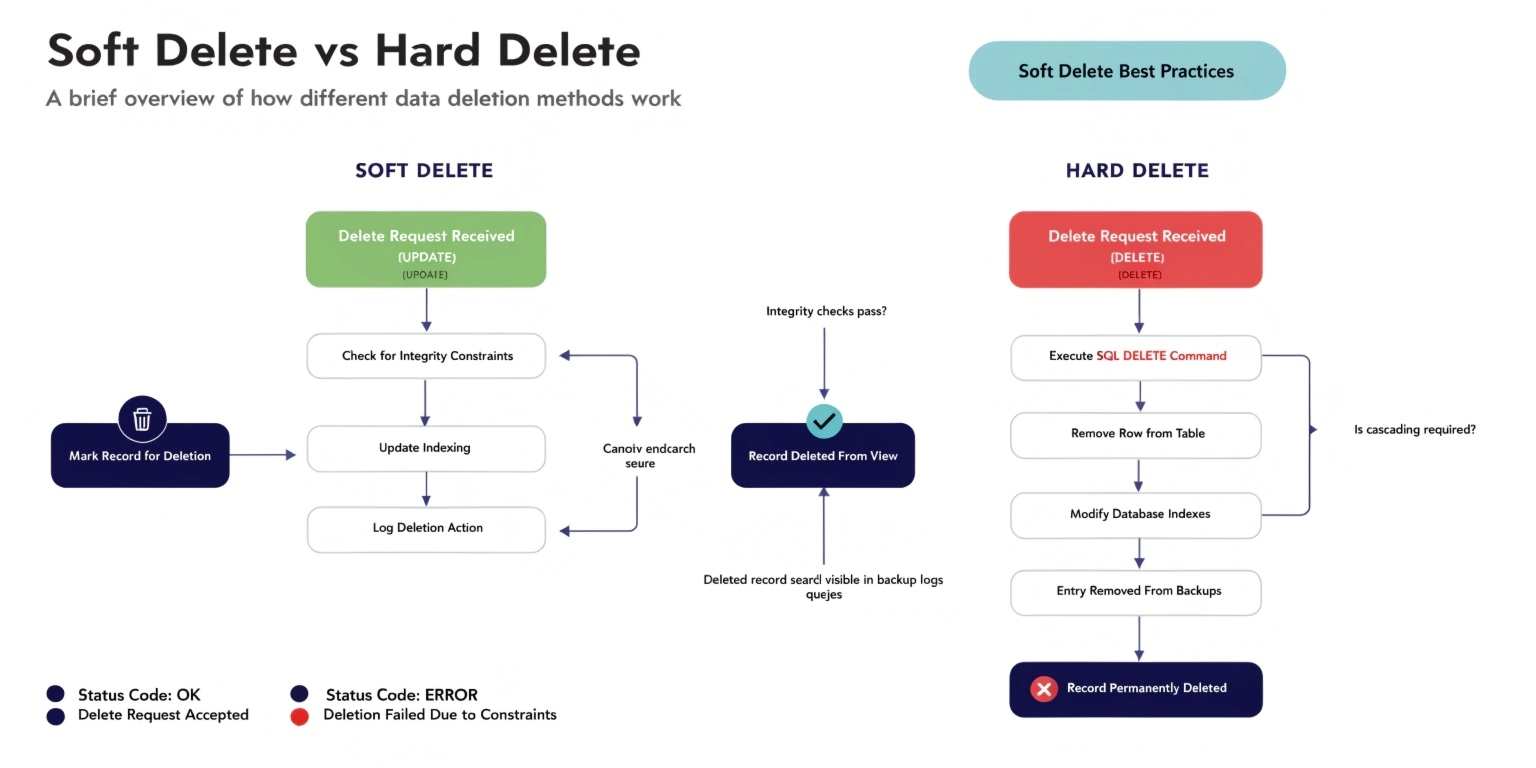
Hard delete refers to the permanent removal of data from a database. Once a record is deleted using this method, it is completely erased and cannot be recovered unless backups are available.
For example, when a user deletes their account and all associated data is permanently removed from the system, that is a hard delete.
Advantages of Hard Delete:
- Frees up storage space immediately
- Improves database performance by reducing data volume
- Ensures sensitive data is permanently removed
Disadvantages of Hard Delete:
- No possibility of recovery once deleted
- Risk of accidental data loss
- Can complicate auditing and compliance tracking
What is Soft Delete?
Soft delete, on the other hand, does not physically remove data from the database. Instead, it marks the record as deleted using a flag (e.g., is_deleted = true) or a timestamp (e.g., deleted_at).
The data still exists in the system but is hidden from normal queries and user interfaces.
Advantages of Soft Delete:
- Enables data recovery and restoration
- Supports audit trails and historical tracking
- Reduces risk of accidental data loss
Disadvantages of Soft Delete:
- Increases database size over time
- Requires additional query logic to filter out deleted records
- May impact performance if not managed properly
Key Differences Between Soft Delete and Hard Delete
FeatureSoft DeleteHard DeleteData RemovalLogical (flag/timestamp)Physical (permanent deletion)RecoveryPossibleNot possibleStorage UsageIncreases over timeOptimizedPerformanceSlightly slower queriesFaster queriesAudit CapabilityStrongLimited
When to Use Soft Delete
Soft delete is ideal in scenarios where data recovery and traceability are important. Common use cases include:
- User accounts and profiles
- Users may accidentally delete accounts and request restoration.
- E-commerce orders
- Order history is valuable for analytics and customer service.
- Financial systems
- Audit trails are essential for compliance and reporting.
- Content management systems
- Deleted content may need to be restored or reviewed later.
When to Use Hard Delete
Hard delete is suitable when data must be permanently removed or when storage and performance are critical:
- Sensitive personal data
- Compliance regulations may require permanent deletion upon request.
- Temporary or cache data
- No need to retain data once it becomes irrelevant.
- Logs with retention policies
- Old logs may be deleted permanently after a certain period.
Best Practices for Implementing Soft Delete
- Use Clear Flags or Timestamps
- Implement fields like is_deleted or deleted_at for better tracking.
- Index Deleted Fields
- Indexing helps maintain query performance when filtering records.
- Update Queries Carefully
- Ensure all queries exclude soft-deleted records unless explicitly needed.
- Implement Data Cleanup Policies
- Periodically archive or permanently delete old soft-deleted records.
Best Practices for Hard Delete
- Use Backups
- Always maintain backups to prevent irreversible data loss.
- Confirm Deletion Actions
- Add confirmation prompts or multi-step deletion processes.
- Log Deletion Events
- Keep logs for auditing even if the data is removed.
- Follow Compliance Requirements
- Ensure deletion aligns with legal and regulatory standards.
Soft Delete + Hard Delete: A Hybrid Approach
Many modern systems use a hybrid approach. Data is first soft-deleted, allowing recovery within a grace period. After a defined time, it is permanently removed using hard delete.
This approach balances flexibility, safety, and performance.
Conclusion
Choosing between soft delete and hard delete is not just a technical decision—it’s a strategic one. While soft delete offers flexibility and safety, hard delete ensures efficiency and compliance.
The right choice depends on your application’s requirements, data sensitivity, and business goals. In many cases, combining both strategies provides the best of both worlds, enabling robust and scalable data management.