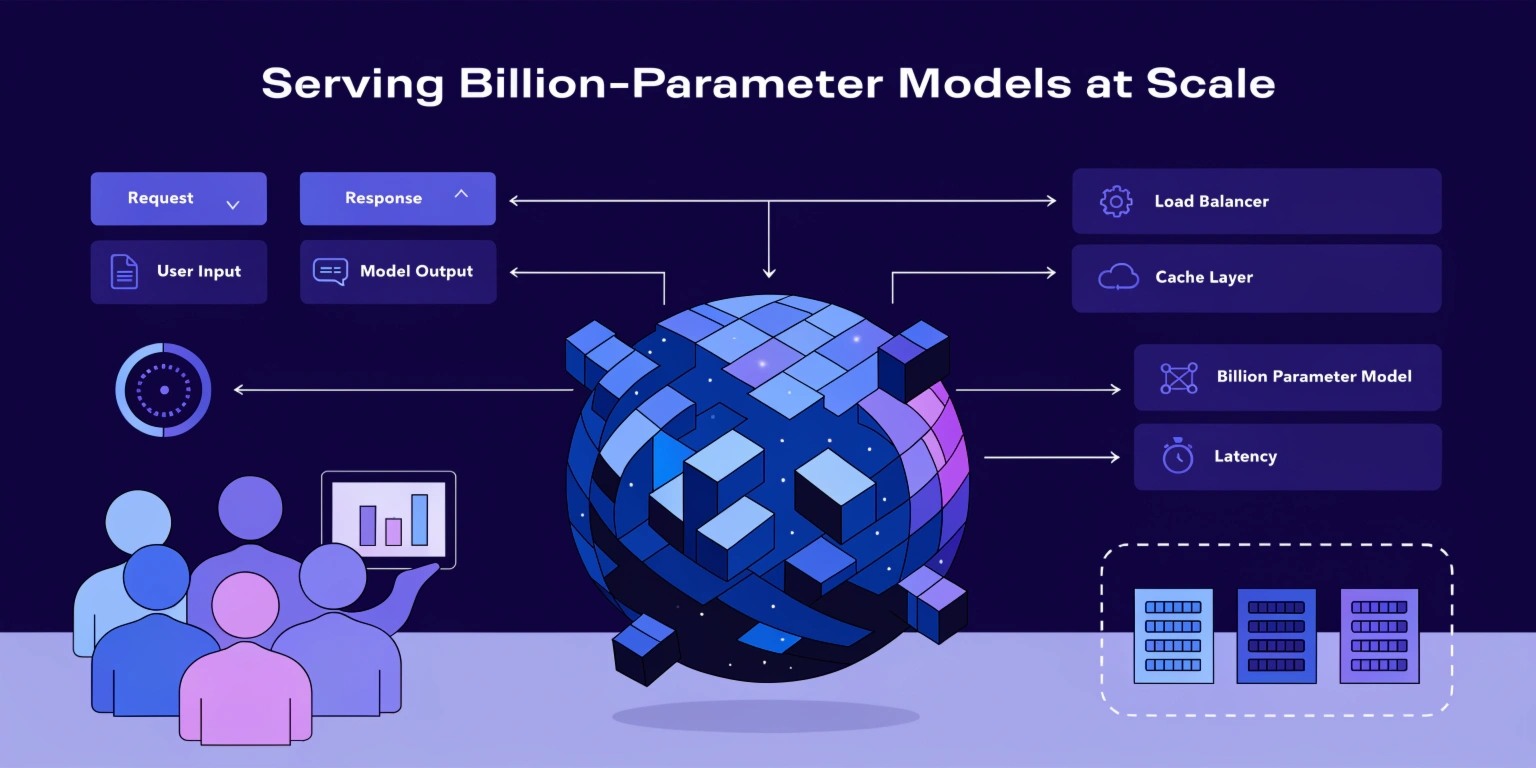
The rise of Large Language Models (LLMs) and foundation models has transformed the artificial intelligence landscape. Models containing billions—or even trillions—of parameters are now powering conversational AI, recommendation engines, code assistants, healthcare systems, and enterprise automation platforms. While training these massive models attracts significant attention, serving them efficiently in production presents an equally complex challenge.
Deploying billion-parameter models at scale requires organizations to balance performance, latency, reliability, infrastructure costs, and user experience. As demand grows, efficient inference systems become critical for business success.
Understanding the Scale Challenge
A billion-parameter model contains enormous computational complexity. During inference, the model processes incoming requests through billions of mathematical operations. Even a moderately sized 7-billion-parameter model may require several gigabytes of GPU memory simply to load its weights.
When millions of users access AI-powered services simultaneously, organizations must solve multiple problems:
- High memory requirements
- GPU resource allocation
- Low-latency response expectations
- Request concurrency management
- Cost-efficient infrastructure utilization
- Reliability and fault tolerance
Without optimization, serving large models can quickly become financially unsustainable.
Distributed Inference Architectures
Modern AI systems rely heavily on distributed inference architectures. Instead of running a model on a single machine, model computation is distributed across multiple GPUs or servers.
Tensor Parallelism
Tensor parallelism divides model computations across multiple GPUs. Each GPU handles a portion of matrix operations, enabling larger models to fit into available hardware.
Benefits include:
- Increased throughput
- Support for larger models
- Better GPU memory utilization
Pipeline Parallelism
Pipeline parallelism splits model layers across multiple devices. Different GPUs process different stages of the neural network, creating an assembly-line approach to inference.
Advantages include:
- Reduced memory pressure
- Improved scalability
- Better resource allocation
Data Parallelism
Multiple model replicas process independent requests simultaneously. This approach significantly increases throughput and supports large user bases.
Model Sharding Strategies
Model sharding is a critical technique for serving billion-parameter models.
Instead of storing an entire model on one GPU, model weights are partitioned across several devices. During inference, shards collaborate to generate predictions.
Common sharding approaches include:
- Layer-based sharding
- Tensor-based sharding
- Expert-based sharding
- Hybrid sharding architectures
Sharding enables deployment of models that exceed the memory capacity of individual accelerators.
Quantization for Efficient Inference
Quantization reduces the precision of model weights from higher precision formats such as FP32 to lower precision representations like FP16, INT8, or INT4.
Benefits include:
- Reduced memory usage
- Faster inference speed
- Lower hardware costs
- Increased throughput
Many production systems achieve significant performance gains through quantization while maintaining acceptable accuracy levels.
Modern frameworks often combine quantization with advanced optimization techniques to maximize efficiency.
Dynamic Batching
One of the most effective methods for improving inference efficiency is dynamic batching.
Instead of processing requests individually, multiple user requests are grouped into batches and executed together on GPUs.
Advantages include:
- Higher GPU utilization
- Increased throughput
- Lower operational costs
- Better resource efficiency
Serving platforms automatically create batches based on incoming traffic patterns while ensuring latency remains within acceptable thresholds.
Caching Mechanisms
Caching significantly improves performance for repetitive workloads.
Prompt Caching
Frequently used prompts can be cached to avoid repeated computation.
KV Cache Optimization
Transformer models maintain Key-Value (KV) caches during token generation. Efficient KV cache management dramatically reduces computational overhead during long conversations.
Benefits include:
- Faster response generation
- Reduced GPU workload
- Improved user experience
Large-scale AI platforms heavily rely on sophisticated caching layers to handle millions of requests efficiently.
GPU Resource Management
GPUs represent one of the most expensive components of AI infrastructure.
Effective GPU management includes:
- Workload scheduling
- Resource sharing
- Load balancing
- Auto-scaling
- Capacity planning
Organizations often deploy orchestration systems that automatically allocate GPU resources based on demand.
Container technologies and Kubernetes-based environments enable flexible resource management and rapid scaling.
Reducing Latency in Production
Users expect near-instant AI responses. Latency optimization therefore becomes a top priority.
Key strategies include:
Speculative Decoding
A smaller model predicts likely outputs before the primary model completes processing. This reduces response time significantly.
Continuous Batching
Requests arriving at different times are continuously merged into active batches, maximizing GPU efficiency.
Edge Inference
Deploying models closer to users reduces network latency and improves responsiveness.
These techniques collectively improve the end-user experience while reducing infrastructure costs.
Monitoring and Observability
Serving billion-parameter models requires extensive monitoring.
Important metrics include:
- Request latency
- GPU utilization
- Memory consumption
- Throughput
- Error rates
- Token generation speed
Real-time observability helps engineering teams detect bottlenecks, optimize performance, and maintain service reliability.
Advanced monitoring systems also support predictive scaling and anomaly detection.
Future Trends
The future of large-scale model serving will focus on greater efficiency and automation.
Emerging innovations include:
- Mixture-of-Experts (MoE) architectures
- AI-specific inference chips
- Adaptive model routing
- Serverless AI infrastructure
- Advanced quantization methods
- Energy-efficient inference systems
As AI adoption expands, organizations will increasingly prioritize cost-effective deployment strategies that deliver high-quality results without excessive hardware requirements.
Conclusion
Serving billion-parameter models at scale is one of the most demanding challenges in modern AI engineering. Success requires a combination of distributed architectures, model sharding, quantization, dynamic batching, GPU optimization, and intelligent infrastructure management.
Organizations that master these techniques can deliver fast, reliable, and cost-efficient AI experiences to millions of users worldwide. As model sizes continue to grow, scalable inference systems will remain a critical foundation of the next generation of AI-powered applications.