Self-Supervised Learning at Scale: The Future of AI Model Training
Artificial Intelligence has evolved rapidly over the past decade, largely due to the availability of massive datasets and improvements in computing infrastructure. Traditional machine learning systems relied heavily on labeled data, where humans manually categorized images, text, audio, or other information before models could learn from them.
However, manual labeling is expensive, time-consuming, and difficult to scale. As AI systems grew larger and more complex, researchers needed new methods to train models efficiently using the enormous amounts of unlabeled data available on the internet.
This challenge led to the rise of self-supervised learning (SSL), one of the most important breakthroughs in modern AI research. Today, many advanced AI systems—including large language models, vision models, and multimodal systems—depend heavily on self-supervised learning at scale.
In this blog, we will explore what self-supervised learning is, how it works, why it matters, and how it powers modern AI systems.
What Is Self-Supervised Learning?
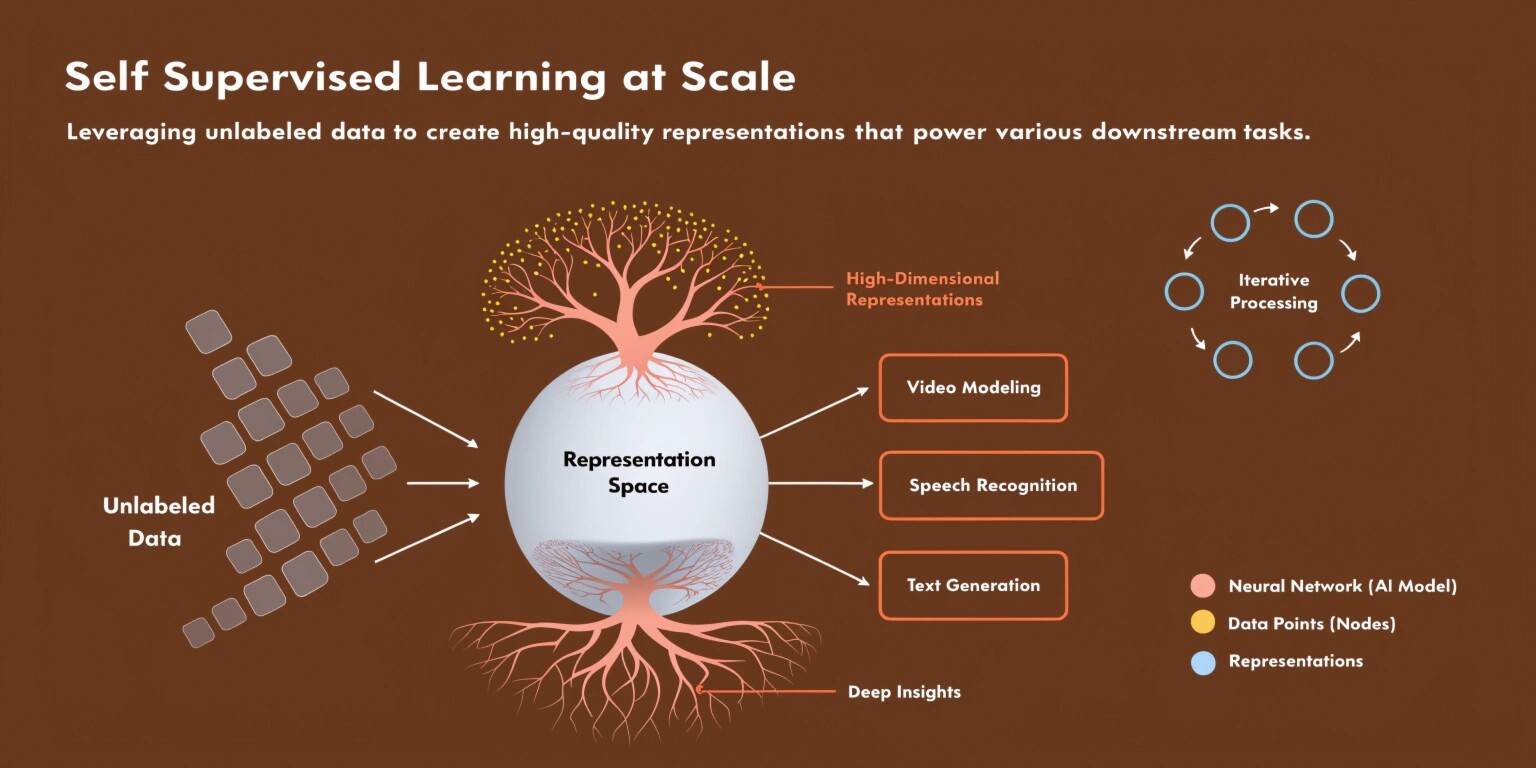
Self-supervised learning is a machine learning approach where models generate their own supervision signals from unlabeled data.
Instead of relying on human-created labels, the system creates prediction tasks automatically.
For example:
- Predicting missing words in a sentence
- Predicting hidden parts of an image
- Learning relationships between video frames
- Understanding audio patterns
The model learns by solving these generated tasks repeatedly across massive datasets.
This allows AI systems to learn:
- Language structure
- Visual patterns
- Contextual relationships
- Semantic understanding
without requiring extensive manual labeling.
Difference Between Supervised and Self-Supervised Learning
Supervised Learning
In supervised learning:
- Data must be labeled manually.
- Models learn from input-output pairs.
Example:
- Image → “Cat”
- Email → “Spam”
Although effective, supervised learning faces major scalability limitations because labeled datasets are expensive to create.
Self-Supervised Learning
In self-supervised learning:
- The model creates its own labels automatically.
- Training data can come from raw internet-scale datasets.
This dramatically increases scalability because the internet contains enormous volumes of:
- Text
- Images
- Videos
- Audio
- Documents
SSL enables AI systems to learn from virtually unlimited information sources.
Why Self-Supervised Learning Matters
Modern AI models require massive amounts of data to achieve high intelligence and generalization capabilities.
Labeling billions of data samples manually is impossible at scale.
Self-supervised learning solves this problem by enabling models to:
- Learn autonomously
- Scale efficiently
- Reduce dependency on labeled datasets
- Generalize across tasks
This has become foundational for:
- Large Language Models (LLMs)
- Computer vision systems
- Generative AI
- Multimodal AI architectures
Without SSL, modern foundation models would not be feasible.
Self-Supervised Learning in Language Models
One of the most famous SSL techniques is next-token prediction used in large language models.
The model learns by predicting the next word in a sequence.
For example:
“The future of AI is ______.”
The model gradually learns:
- Grammar
- Reasoning
- Context
- Facts
- Language structure
by processing enormous text datasets repeatedly.
This simple training objective has enabled modern language models to achieve remarkable capabilities in:
- Content generation
- Coding
- Translation
- Summarization
- Conversational AI
Large-scale language models rely almost entirely on self-supervised learning during pretraining.
Self-Supervised Learning in Computer Vision
SSL is also transforming computer vision.
Traditional image classification required millions of manually labeled images.
Modern SSL vision systems instead learn by:
- Predicting masked image regions
- Matching image augmentations
- Understanding spatial relationships
- Learning visual representations
These techniques allow models to learn rich visual features without requiring extensive human labeling.
Applications include:
- Autonomous vehicles
- Medical imaging
- Facial recognition
- Industrial inspection
- Robotics
Self-supervised vision systems continue improving rapidly.
Scaling Self-Supervised Learning
Training SSL systems at scale requires enormous infrastructure.
Modern AI training involves:
- Distributed GPU clusters
- High-speed networking
- Massive storage systems
- Parallel processing architectures
Foundation models may train on:
- Trillions of tokens
- Billions of images
- Multi-petabyte datasets
This scale enables models to learn increasingly general capabilities.
Large-scale AI infrastructure has become one of the most important competitive advantages for AI companies globally.
Foundation Models and SSL
Self-supervised learning is the backbone of foundation models.
Foundation models are large pretrained systems that can adapt to many downstream tasks with minimal fine-tuning.
Examples include:
- Language generation
- Image understanding
- Audio processing
- Video analysis
- Robotics control
Instead of training separate models for every task, organizations can train one massive model and reuse it across multiple applications.
This dramatically reduces development costs and accelerates AI deployment.
Challenges of Self-Supervised Learning
Despite its advantages, SSL introduces several challenges.
Enormous Computational Costs
Training large-scale models requires:
- Expensive GPU infrastructure
- High energy consumption
- Advanced distributed systems
Only a limited number of organizations currently possess such infrastructure capabilities.
Data Quality Issues
Internet-scale datasets may contain:
- Biases
- Misinformation
- Toxic content
- Low-quality data
Models can unintentionally learn harmful or inaccurate behaviors.
Alignment and Safety
Self-supervised models learn statistical patterns but may not inherently understand:
- Ethics
- Truthfulness
- Human values
Additional alignment techniques are required to make models safer and more reliable.
The Future of Self-Supervised Learning
The future of SSL is moving toward:
- Multimodal learning
- Autonomous AI agents
- Real-world robotics
- Continuous learning systems
- General-purpose AI architectures
Researchers are exploring models that can learn from:
- Text
- Images
- Video
- Audio
- Sensor data
simultaneously.
This may lead to increasingly intelligent systems capable of broader reasoning and real-world interaction.
Impact on Industries
Self-supervised learning is already transforming industries such as:
- Healthcare
- Finance
- Manufacturing
- Autonomous transportation
- Cybersecurity
- Education
Organizations using SSL-powered AI systems can automate processes, improve predictions, and build more adaptive intelligent systems.
The economic and technological impact of SSL is expected to grow significantly over the next decade.
Conclusion
Self-supervised learning at scale represents one of the most important advancements in modern Artificial Intelligence. By allowing AI systems to learn from massive unlabeled datasets, SSL has enabled the development of powerful foundation models that drive today’s generative AI revolution.
From language understanding and computer vision to robotics and multimodal intelligence, self-supervised learning is becoming the core training paradigm behind scalable AI systems.
As infrastructure, algorithms, and AI architectures continue evolving, self-supervised learning will remain central to the future of intelligent automation and advanced machine learning research.