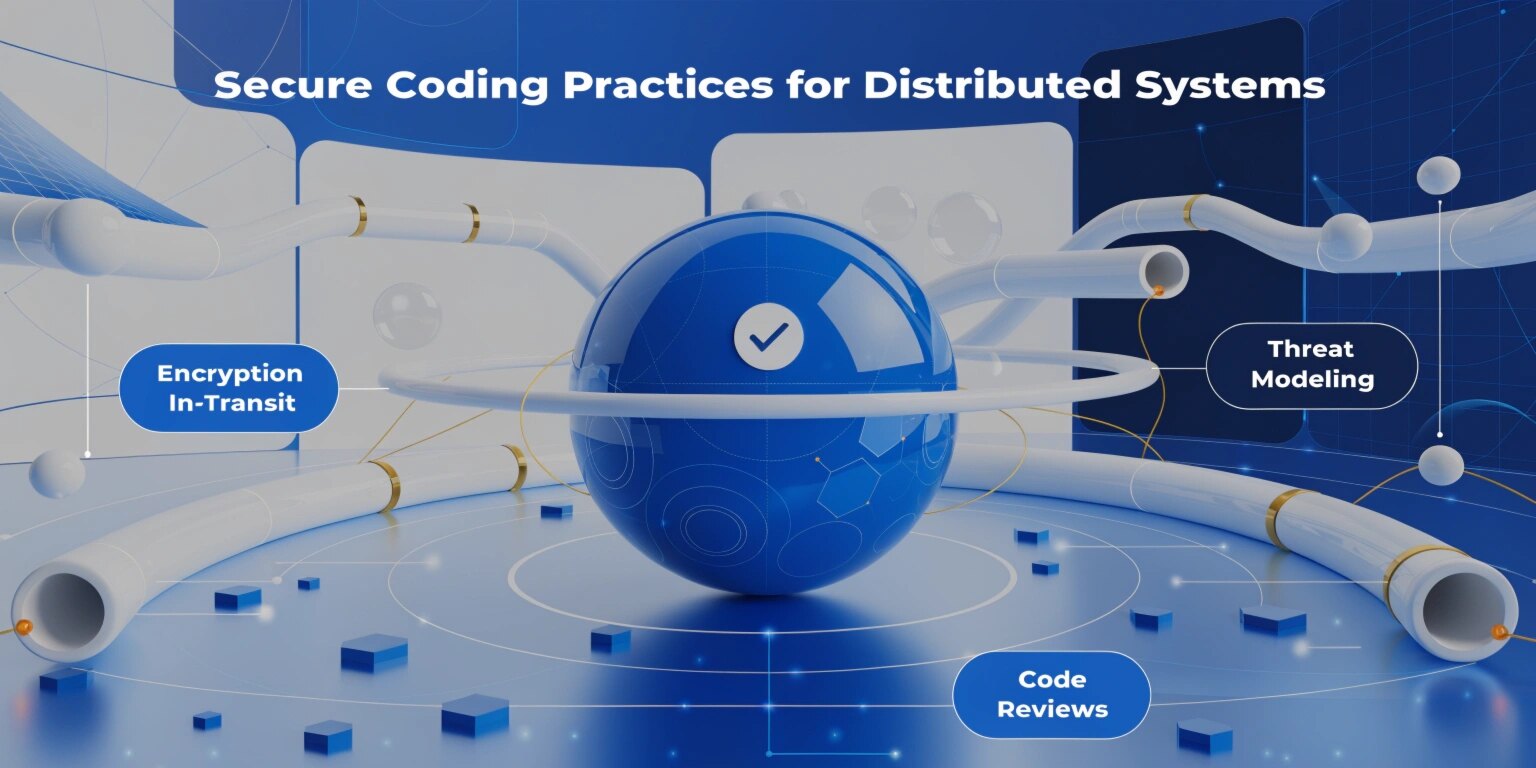
Distributed systems have become the backbone of modern software architecture. Cloud-native applications, microservices platforms, and globally distributed services enable scalability and resilience that monolithic systems cannot easily achieve.
However, this architectural shift introduces a major challenge: security complexity.
Each service, API, message queue, and network interaction creates a new potential attack surface. Without strong secure coding practices, distributed systems become highly vulnerable to data breaches, service compromise, and cascading failures.
Organizations such as OWASP and NIST emphasize that secure software design must begin during development—not after deployment.
Understanding how to build security directly into distributed applications is essential for modern engineering teams.
Why Distributed Systems Increase Security Risks
Unlike monolithic applications, distributed architectures involve many independent components communicating over networks.
Common characteristics include:
- Multiple microservices
- API gateways
- Message brokers
- Service-to-service communication
- Cloud infrastructure layers
Each layer introduces vulnerabilities such as:
- Unauthorized access
- Data interception
- Misconfigured services
- Broken authentication flows
Traditional perimeter-based security models are insufficient in such environments. Instead, developers must adopt security-first coding practices.
Implement Strong Authentication and Authorization
In distributed systems, authentication must occur across multiple services. Simply verifying users at a single entry point is not enough.
Modern systems often rely on token-based authentication frameworks such as OAuth 2.0 and OpenID Connect to validate users and services.
Key practices include:
- Using short-lived access tokens
- Validating tokens in every service
- Applying role-based access control (RBAC)
- Enforcing least-privilege access
Every service must verify identity rather than trusting upstream components blindly.
Secure Service-to-Service Communication
Microservices constantly exchange data. Without encryption, attackers could intercept sensitive information.
Use secure communication protocols such as Transport Layer Security to encrypt traffic between services.
Additional security layers include:
- Mutual TLS authentication
- Network segmentation
- Service identity verification
These measures prevent unauthorized services from joining the system.
Validate All Inputs and Outputs
Input validation is one of the most fundamental secure coding practices.
Distributed systems often accept input from multiple sources:
- External APIs
- Client applications
- Message queues
- Other services
Every input must be validated to prevent vulnerabilities such as:
- Injection attacks
- Data corruption
- Logic manipulation
Developers should implement strict validation rules and sanitize incoming data before processing it.
Protect APIs with Secure Design
APIs are the primary communication interface in distributed architectures. Poor API design can expose internal services to attackers.
Secure API practices include:
- Rate limiting requests
- Enforcing authentication for every endpoint
- Avoiding sensitive data in URLs
- Logging suspicious access patterns
API gateways can help enforce security policies centrally while services focus on business logic.
Manage Secrets Securely
Distributed systems require numerous credentials:
- Database passwords
- API keys
- Encryption certificates
- Cloud access tokens
Hardcoding secrets in application code is a critical security flaw.
Instead, use secure secret management systems and environment-based configuration. Access to secrets should be tightly controlled and monitored.
Regular rotation of credentials reduces the impact of potential leaks.
Implement Zero Trust Principles
The traditional security model assumed that anything inside the network was trustworthy.
Modern distributed architectures follow the Zero Trust principle: never trust, always verify.
This means:
- Every request must be authenticated
- Every service interaction must be authorized
- Network boundaries cannot guarantee security
Adopting Zero Trust architecture significantly reduces the risk of internal attacks and compromised services.
Secure the Software Supply Chain
Distributed systems depend heavily on third-party libraries and container images. Vulnerabilities in these dependencies can compromise the entire application.
Secure development teams should:
- Scan dependencies for vulnerabilities
- Use verified container images
- Monitor open-source components
- Apply regular security updates
Supply chain attacks have become one of the fastest-growing cybersecurity threats.
Implement Logging and Observability
Security incidents often remain undetected because of poor monitoring.
Distributed systems require centralized logging and observability tools to track system behavior.
Effective monitoring should include:
- Authentication events
- API access patterns
- Suspicious traffic anomalies
- Failed authorization attempts
Real-time visibility helps detect breaches early and respond quickly.
Automate Security in the Development Pipeline
Security should be integrated into the development workflow rather than treated as a separate phase.
Modern DevSecOps pipelines include automated tools that scan code, configurations, and dependencies for vulnerabilities before deployment.
Automated security testing ensures that vulnerabilities are caught early when they are easier and cheaper to fix.
Final Thoughts
Distributed systems offer remarkable scalability and resilience, but they also introduce complex security challenges.
Secure coding practices must address:
- Authentication and authorization
- Secure communication
- API protection
- Secret management
- Dependency security
Security is not a single feature—it is a continuous process embedded throughout the software lifecycle.
When developers build security directly into distributed systems, they create applications that are not only scalable but also resilient against the evolving landscape of cyber threats.
In modern software engineering, secure architecture is reliable architecture.