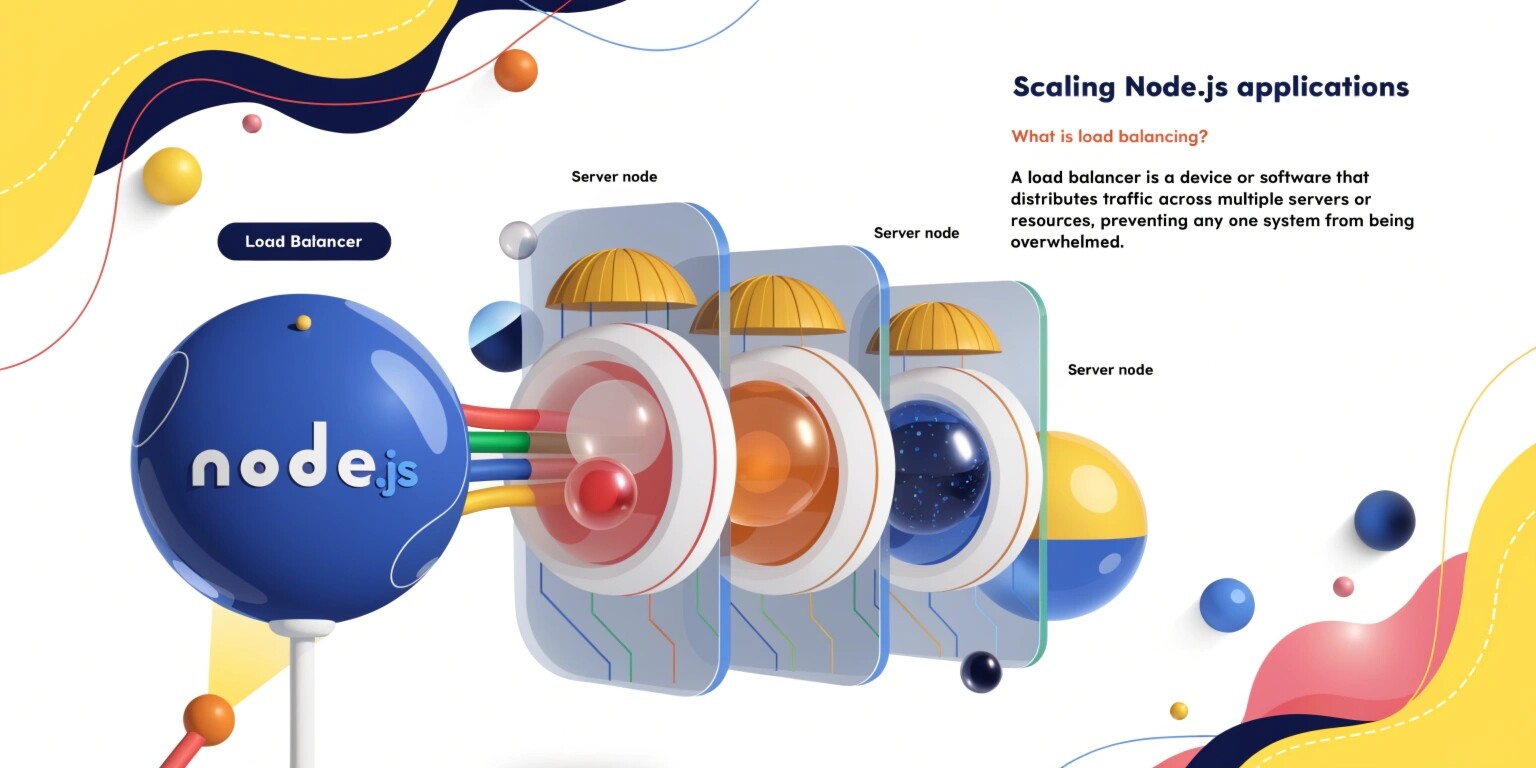
As modern applications grow in user base and complexity, scalability becomes a fundamental requirement. In the context of Node.js applications, scaling is not just about increasing server capacity—it is about designing systems that can handle growth efficiently, reliably, and sustainably. Load balancing plays a central role in this architecture by enabling the distribution of incoming requests across multiple computing resources.
This article focuses purely on the theoretical concepts behind scaling Node.js applications using load balancers, without diving into implementation or code.
Understanding Scalability
Scalability refers to a system’s ability to handle increasing workloads while maintaining performance. It ensures that an application can grow without degradation in response time or reliability.
There are two primary forms of scalability:
- Vertical Scalability (Scaling Up): Enhancing the capacity of a single machine by adding more CPU, memory, or storage.
- Horizontal Scalability (Scaling Out): Expanding the system by adding more machines or instances, distributing the workload among them.
From a theoretical standpoint, horizontal scaling is more flexible and resilient, as it reduces dependency on a single point of failure.
Node.js and Its Architectural Constraints
Node.js operates on a single-threaded, event-driven model. This architecture is highly efficient for handling asynchronous operations, such as I/O tasks, but it introduces limitations when dealing with CPU-bound operations or extremely high concurrent traffic on a single instance.
Theoretically, this constraint necessitates distributing workloads across multiple instances rather than relying on a single process. This is where scaling strategies and load balancing become essential.
Concept of Load Balancing
A load balancer is an intermediary that distributes incoming network traffic across multiple servers. The primary objective is to optimize resource utilization, maximize throughput, minimize response time, and prevent overload on any single server.
In theory, a load balancer abstracts the complexity of multiple backend servers into a single access point for clients. This abstraction ensures that the system appears unified while operating in a distributed manner.
Traffic Distribution Principles
Load balancing relies on algorithms that determine how incoming requests are allocated. These algorithms are based on different theoretical approaches:
- Uniform Distribution: Requests are distributed evenly across all servers, assuming equal capacity.
- Dynamic Distribution: Allocation is based on real-time server conditions, such as current load or active connections.
- Deterministic Distribution: Requests are assigned based on predefined rules, such as client identity or session information.
Each approach reflects a trade-off between fairness, efficiency, and complexity.
High Availability and Fault Tolerance
A key theoretical goal of scaling is achieving high availability. This means the system remains operational even when individual components fail.
Load balancers contribute to this by:
- Detecting failed servers
- Redirecting traffic to healthy instances
- Ensuring uninterrupted service
Fault tolerance is closely related and refers to the system’s ability to continue functioning despite failures. In a distributed Node.js architecture, redundancy (multiple instances) ensures that no single failure disrupts the entire system.
Statelessness in Distributed Systems
One of the fundamental principles in scalable system design is statelessness. A stateless system does not retain client-specific data between requests. Each request is independent and contains all the information needed to process it.
From a theoretical perspective, statelessness simplifies load balancing because any request can be handled by any server. It eliminates the need for request routing based on session data and enhances scalability.
Consistency and Synchronization Challenges
When multiple instances are involved, maintaining consistency becomes a theoretical challenge. Data must remain synchronized across all nodes to ensure a uniform user experience.
This introduces concepts such as:
- Data consistency models (strong vs eventual consistency)
- Distributed state management
- Concurrency control
Balancing consistency with performance is a key design consideration in scalable architectures.
Latency and Network Considerations
In a distributed system, communication between components introduces latency. Load balancers must minimize this delay while efficiently routing traffic.
Theoretically, the placement of load balancers and servers, as well as the network topology, significantly impacts system performance. Optimizing these factors is essential for achieving low-latency responses.
Scalability Trade-offs
Scaling with load balancers introduces trade-offs:
- Complexity vs Performance: Distributed systems are more complex to design and manage.
- Cost vs Availability: More servers increase reliability but also cost.
- Consistency vs Scalability: Strong consistency may limit scalability in distributed systems.
Understanding these trade-offs is crucial for making informed architectural decisions.
Conclusion
Scaling Node.js applications using load balancers is fundamentally about designing systems that can grow gracefully under increasing demand. The theoretical concepts—such as horizontal scaling, traffic distribution, statelessness, and fault tolerance—form the foundation of modern distributed architectures.
By understanding these principles, developers and system architects can build applications that are not only performant but also resilient and future-ready.