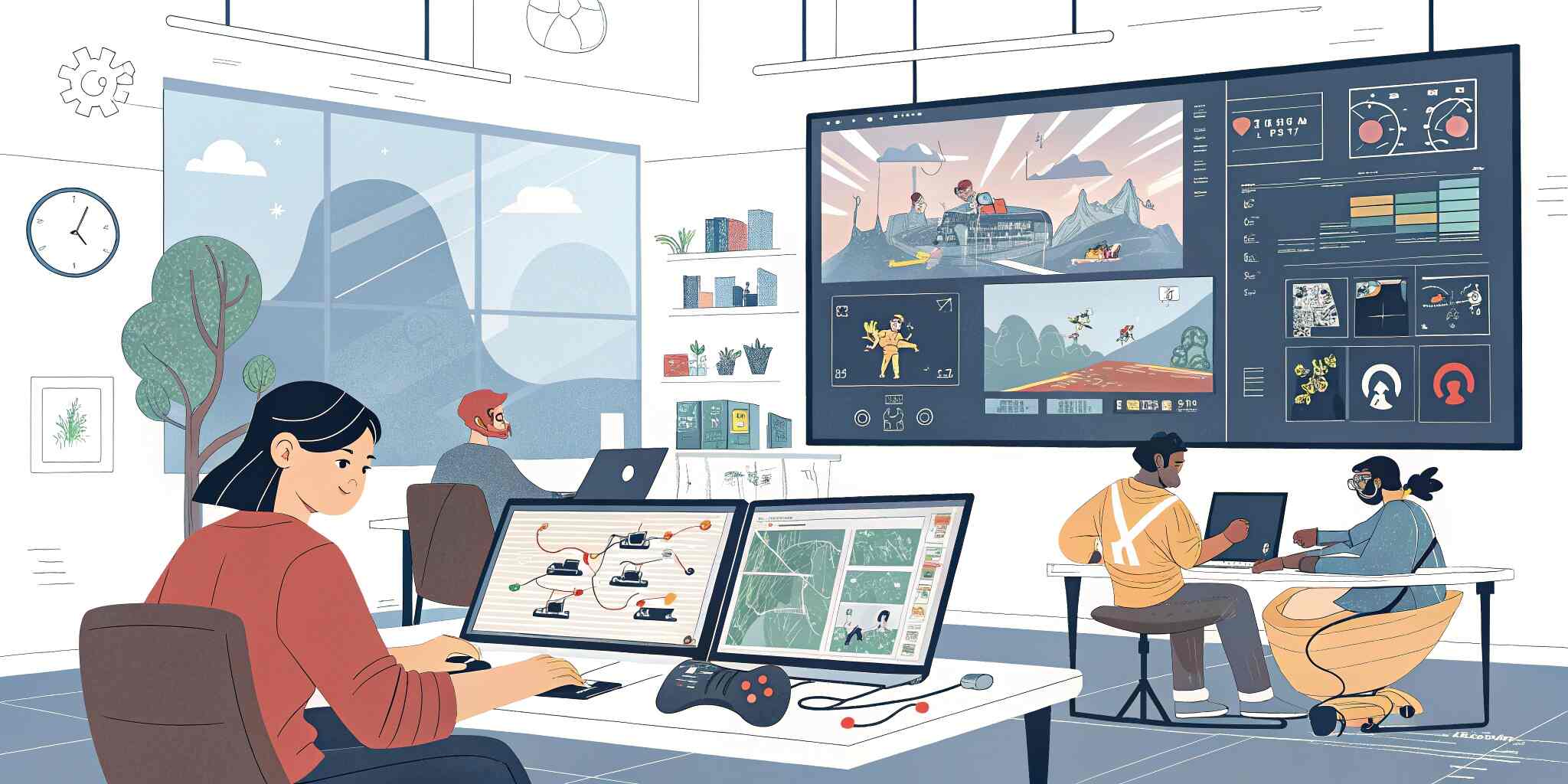
Video games are no longer static experiences. Traditionally, developers designed levels, enemies, and quests in advance, and every player encountered the same world. Modern game design is shifting toward adaptive experiences where the game world changes based on how each individual plays. This concept is known as runtime world mutation — a system where the game environment dynamically evolves using player behavior models.
Rather than reacting only to scripted triggers, the game studies the player’s habits, preferences, and skill level. The world then adjusts itself in real time to create a personalized experience.
What Is Runtime World Mutation?
Runtime world mutation refers to dynamic changes in a game’s environment, rules, or events while the game is running. These changes are not pre-written cutscenes or fixed difficulty levels. Instead, they are system-driven adjustments based on data.
For example:
- If a player avoids combat, the game may generate stealth-based missions.
- If a player struggles with bosses, enemy AI may subtly reduce aggression.
- If a player explores frequently, the game may unlock hidden locations and side quests.
The world is not just reacting — it is learning.
Player Behavior Models
At the core of runtime mutation is player behavior modeling. Games collect telemetry data such as:
- Movement patterns
- Combat accuracy
- Death frequency
- Time spent exploring
- Weapon usage
- Economy spending habits
- Quest completion rates
Using this data, the game classifies players into behavioral types. Common categories include:
Explorers – enjoy discovering hidden areas
Achievers – focus on progress and rewards
Combat Players – prefer action and challenges
Social Players – interact with other players or NPCs
Once the system understands the player type, it can adapt the world accordingly.
Dynamic Difficulty Adjustment
One of the earliest uses of behavior modeling was dynamic difficulty adjustment (DDA). Instead of selecting “Easy, Normal, or Hard,” the game continuously tunes itself.
If the player dies repeatedly, the game might:
- Reduce enemy accuracy
- Increase health pickups
- Adjust checkpoint placement
If the player performs extremely well:
- Enemies become smarter
- Boss mechanics become more complex
- Rare enemies appear more often
The player feels challenged but not frustrated.
Procedural Content Adaptation
Procedural generation becomes far more powerful when combined with behavior models. Instead of generating random content, the system generates relevant content.
For example:
- A stealth player gets darker environments and cover-based level layouts.
- A combat player encounters larger arenas and aggressive enemies.
- A crafting-focused player finds more resource nodes and blueprints.
This turns procedural generation into intelligent generation.
AI and Machine Learning in Games
Modern systems increasingly use machine learning to predict future player actions. Rather than reacting after behavior occurs, the game anticipates it.
Predictive models can estimate:
- When a player is about to quit
- When a player becomes bored
- When a player is ready for a major challenge
If churn risk increases, the game might introduce:
- Story events
- Rewards
- New abilities
- Surprise encounters
This directly improves player retention.
NPC Behavior Mutation
Runtime mutation also affects non-player characters. NPCs can adapt personalities and behavior based on player interaction.
Examples include:
- Merchants adjusting prices based on trading habits
- Companions trusting or distrusting the player
- Enemies learning player strategies and countering them
This creates emergent storytelling. Each player’s story becomes unique.
Technical Implementation
Implementing runtime mutation requires multiple systems working together:
- Telemetry collection system
- Data processing pipeline
- Behavior classification model
- Decision system (rule-based or ML-driven)
- Procedural content generator
- Runtime environment modifier
The engine continuously loops:
Observe → Analyze → Predict → Adapt
All of this must occur efficiently without interrupting gameplay.
Benefits for Developers
Runtime world mutation offers several advantages:
Higher retention: Players stay longer when the game feels personal.
Balanced difficulty: The game remains fair across skill levels.
Replayability: Multiple playthroughs feel different.
Reduced manual design workload: Systems generate content automatically.
Developers no longer need to perfectly predict player behavior beforehand.
Design Challenges
However, adaptive systems must be subtle. If players notice the game “helping” them too much, immersion breaks. Similarly, excessive difficulty scaling can feel unfair.
The key design principle is invisible adaptation. Players should feel naturally engaged without realizing the world is adjusting.
The Future of Adaptive Worlds
The future of game design lies in intelligent simulation. Instead of handcrafted worlds or purely procedural ones, games are moving toward responsive ecosystems.
Imagine cities that grow depending on player economy activity, factions that react politically to decisions, or ecosystems where animals migrate because of player hunting patterns.
Games will not just respond to players — they will coexist with them.
Conclusion
Runtime world mutation using player behavior models represents one of the biggest shifts in modern game design. By combining telemetry, procedural systems, and machine learning, developers can create worlds that adapt to each individual player.
The result is a more engaging, personalized, and immersive experience. Instead of playing a fixed story, players influence a living world that changes with them — making every playthrough unique and memorable.