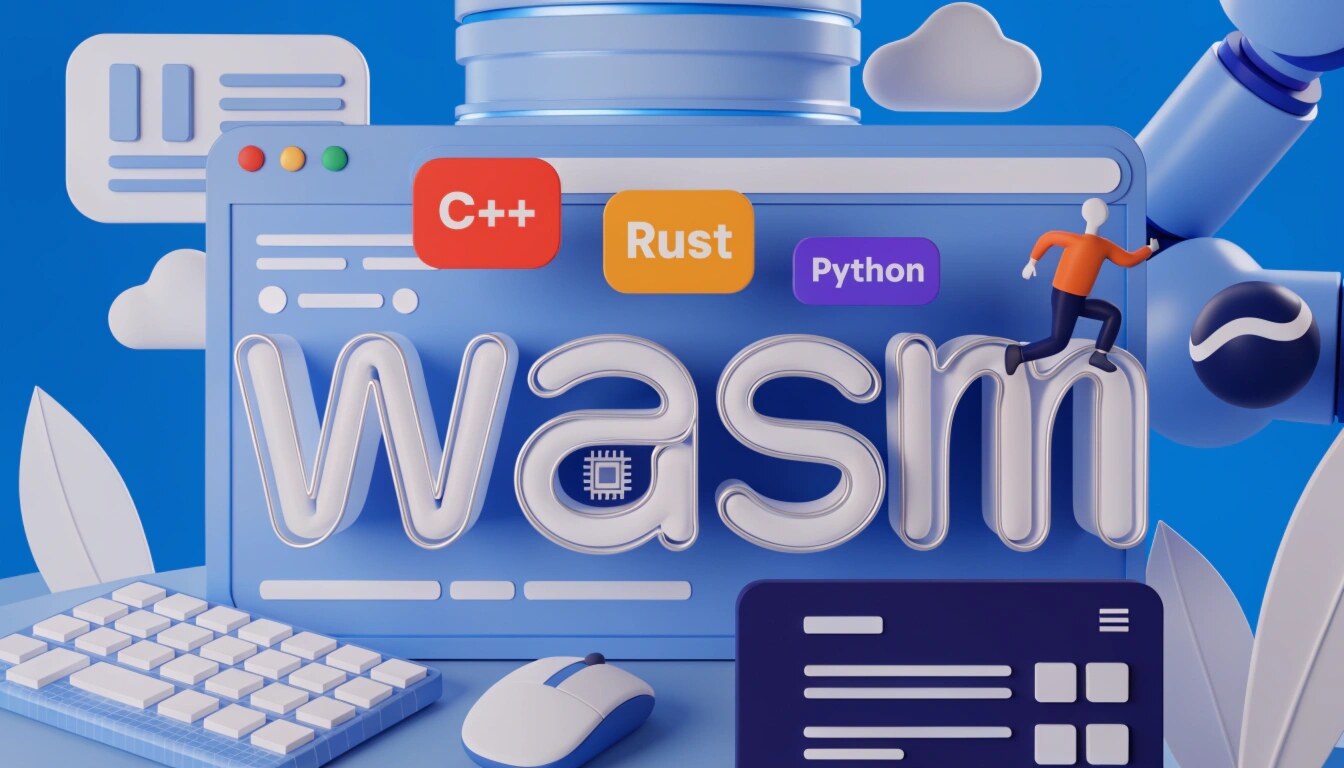
Modern browsers are no longer limited to JavaScript. Thanks to WebAssembly (WASM), developers can run C++, Rust, and even Python directly inside browsers with near-native performance. This technology is transforming web development by enabling faster applications, code reuse, enhanced security, and cross-platform compatibility. Learn how WebAssembly is shaping the future of web applications and developer productivity.
Introduction
For years, JavaScript has been the dominant language for browser-based applications. While JavaScript remains essential, modern web technologies have introduced new possibilities that allow developers to run languages such as C++, Rust, and Python directly within web browsers.
The key technology driving this transformation is WebAssembly (WASM), a low-level binary instruction format designed to execute code at near-native speeds inside browsers. WebAssembly enables developers to build highly performant web applications while leveraging existing codebases written in multiple programming languages.
As web applications become increasingly sophisticated, the ability to run different programming languages in the browser is revolutionizing web development.
What is WebAssembly?
WebAssembly (WASM) is an open standard supported by all major browsers, including Chrome, Firefox, Safari, and Edge. It allows code written in languages such as C++, Rust, and Python to be compiled into a binary format that browsers can execute efficiently.
Unlike JavaScript, which is interpreted or just-in-time compiled, WebAssembly is designed for speed, portability, and security. It works alongside JavaScript rather than replacing it, enabling developers to combine the strengths of both technologies.
Key advantages include:
- Near-native execution speed
- Cross-browser compatibility
- Improved application performance
- Secure sandboxed execution
- Code reuse from existing software projects
Running C++ in the Browser
C++ has long been used for performance-intensive applications such as game engines, simulations, and graphics software. Using tools like Emscripten, developers can compile C++ code into WebAssembly and execute it within browsers.
Popular use cases include:
- Browser-based games
- CAD and design software
- Image and video processing tools
- Scientific simulations
- 3D rendering applications
Companies are increasingly leveraging WebAssembly to bring desktop-grade performance to web applications without requiring software installation.
Running Rust in the Browser
Rust has gained immense popularity because of its memory safety, speed, and reliability. WebAssembly and Rust form a particularly powerful combination.
Rust's benefits for browser execution include:
- Memory-safe programming
- High performance
- Smaller binary sizes
- Reduced security vulnerabilities
- Efficient resource management
Many modern web applications use Rust to handle computationally intensive tasks such as encryption, compression, data visualization, and machine learning inference directly in the browser.
Frameworks such as wasm-bindgen and Yew make it easier than ever to integrate Rust-powered functionality into web projects.
Running Python in the Browser
Python is one of the world's most popular programming languages, especially in data science, AI, and education. Traditionally, Python required server-side execution. However, technologies like Pyodide now enable Python code to run directly within browsers using WebAssembly.
Benefits of browser-based Python include:
- Interactive coding environments
- Online data analysis tools
- Educational platforms
- AI and machine learning demos
- Scientific computing applications
Developers can create browser-based notebooks and coding playgrounds without requiring users to install Python locally.
Real-World Applications
The ability to run multiple programming languages in browsers opens exciting possibilities across industries.
Online Development Environments
Platforms can provide fully functional coding environments directly within the browser, allowing users to write, compile, and execute code without local setup.
High-Performance Web Applications
Applications that previously required desktop software can now be delivered through browsers while maintaining exceptional performance.
Gaming and Interactive Experiences
Modern game engines can leverage WebAssembly to provide richer graphics and smoother gameplay experiences.
AI and Machine Learning
Machine learning models can run locally in browsers, improving privacy, reducing server costs, and delivering faster responses.
Enterprise Applications
Organizations can reuse existing C++ and Rust codebases for browser-based solutions, reducing development costs and accelerating digital transformation.
Challenges and Limitations
Despite its advantages, running non-JavaScript languages in browsers presents several challenges:
- Larger application bundle sizes
- Limited direct access to operating system resources
- Debugging complexity
- Startup loading overhead
- Browser compatibility considerations for advanced features
However, ongoing improvements in WebAssembly standards continue to address these limitations.
The Future of Browser-Based Computing
The future of web development is moving toward a language-agnostic ecosystem where developers can choose the best language for specific tasks while still delivering applications through browsers.
Emerging technologies such as WebAssembly System Interface (WASI) are expanding capabilities beyond browser environments, creating opportunities for truly portable applications.
As browser performance continues to improve, we can expect to see more sophisticated software traditionally associated with desktop environments running seamlessly on the web.
Conclusion
Running C++, Rust, and Python directly in browsers represents one of the most significant advancements in modern web development. Through WebAssembly, developers can achieve exceptional performance, reuse existing codebases, and build powerful cross-platform applications that run anywhere.
As adoption grows, WebAssembly will continue to reshape how applications are built, deployed, and experienced. Organizations that embrace these technologies today will be better positioned to create faster, more scalable, and more innovative digital solutions in the future.
We build scalable web, mobile, and game products for clients worldwide — combining modern frameworks, cloud infrastructure, and best engineering practices.
.jpg)
.jpg)
.jpg)