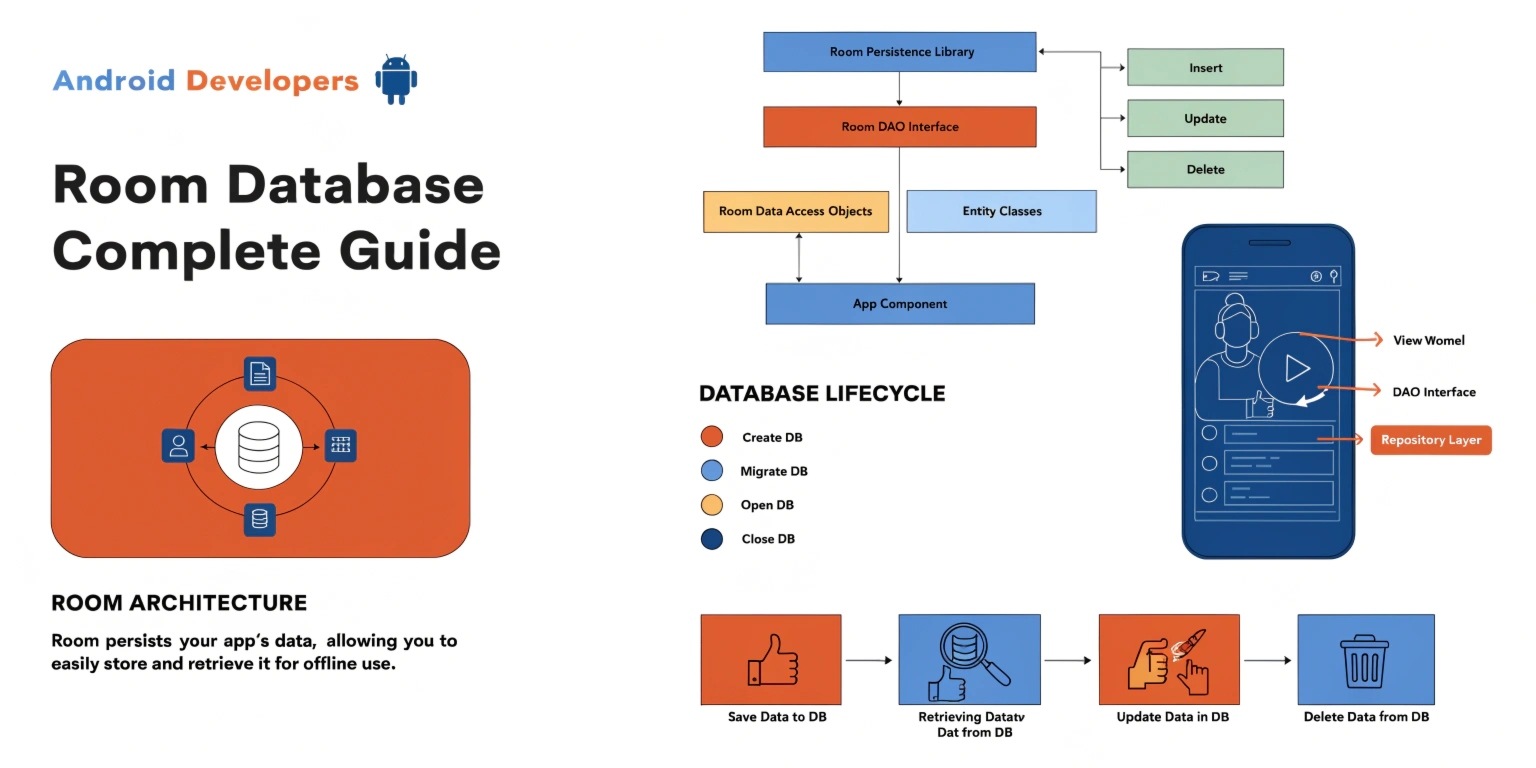
In Android development, managing local data efficiently is a key factor in building high-performing and user-friendly applications. While traditional database systems like SQLite have been widely used, they often involve complex queries and boilerplate code that can slow down development. To address these challenges, modern Android development introduced Room Database, a powerful persistence library that simplifies data handling and improves overall code quality.
Room Database acts as an abstraction layer over SQLite, allowing developers to interact with the database using structured and organized components rather than writing raw queries. This not only reduces the chances of runtime errors but also ensures better maintainability of the application. By enforcing compile-time validation, Room helps developers catch issues early in the development cycle, making applications more robust and reliable.
At its core, Room Database is built around three essential components that work together seamlessly. The first is the entity, which represents the structure of data stored in the database. It defines how data is organized and stored in tables. The second component is the data access layer, which acts as a bridge between the application and the database. It defines how data is retrieved, inserted, updated, or deleted. The third component is the database itself, which serves as the main access point and manages the connection between different parts of the system.
One of the biggest advantages of Room Database is its integration with modern Android development tools and architecture components. It works smoothly with lifecycle-aware components, enabling applications to update the user interface automatically when data changes. This creates a more dynamic and responsive user experience, as users can see real-time updates without needing to refresh or reload screens manually.
Another significant benefit of using Room is its support for asynchronous operations. In mobile applications, performing database operations on the main thread can lead to performance issues and unresponsive interfaces. Room encourages developers to handle such operations in the background, ensuring smooth and seamless performance. This is especially important for applications that deal with large datasets or frequent data updates.
As applications grow, managing changes in the database structure becomes crucial. Room provides a structured approach to handle database migrations, allowing developers to update the schema without losing existing data. This ensures that users can continue using the app without disruptions, even after updates. Proper migration strategies help maintain data integrity and prevent crashes caused by mismatched database versions.
Room Database also promotes better architectural practices. It fits well within modern design patterns such as layered architecture, where responsibilities are clearly separated. This makes the codebase cleaner, easier to understand, and more scalable. Developers can manage data logic independently from user interface logic, leading to improved maintainability and collaboration within teams.
Despite its many advantages, Room does come with certain challenges. Developers who are new to database management may initially find it difficult to understand its structure and concepts. Additionally, handling complex data relationships and migrations in large-scale applications can require careful planning and expertise. However, once these challenges are addressed, Room proves to be a highly efficient and reliable solution.
Another important aspect to consider is performance optimization. While Room simplifies database operations, developers still need to ensure that queries are efficient and data is managed properly. Without proper optimization, even the best tools can lead to performance bottlenecks. Therefore, understanding how data flows within the application and making informed decisions is essential.
In today’s mobile-first world, users expect applications to work seamlessly even without an internet connection. Room Database plays a vital role in enabling offline functionality by storing data locally on the device. This ensures that users can continue interacting with the app regardless of network availability, enhancing overall user satisfaction and engagement.
In conclusion, Room Database has become an essential tool for Android developers aiming to build modern, scalable, and efficient applications. By simplifying database interactions, improving code quality, and supporting advanced features like lifecycle awareness and migrations, it addresses many of the limitations of traditional database systems. Although it requires some learning and planning, the long-term benefits make it a valuable addition to any Android developer’s toolkit.