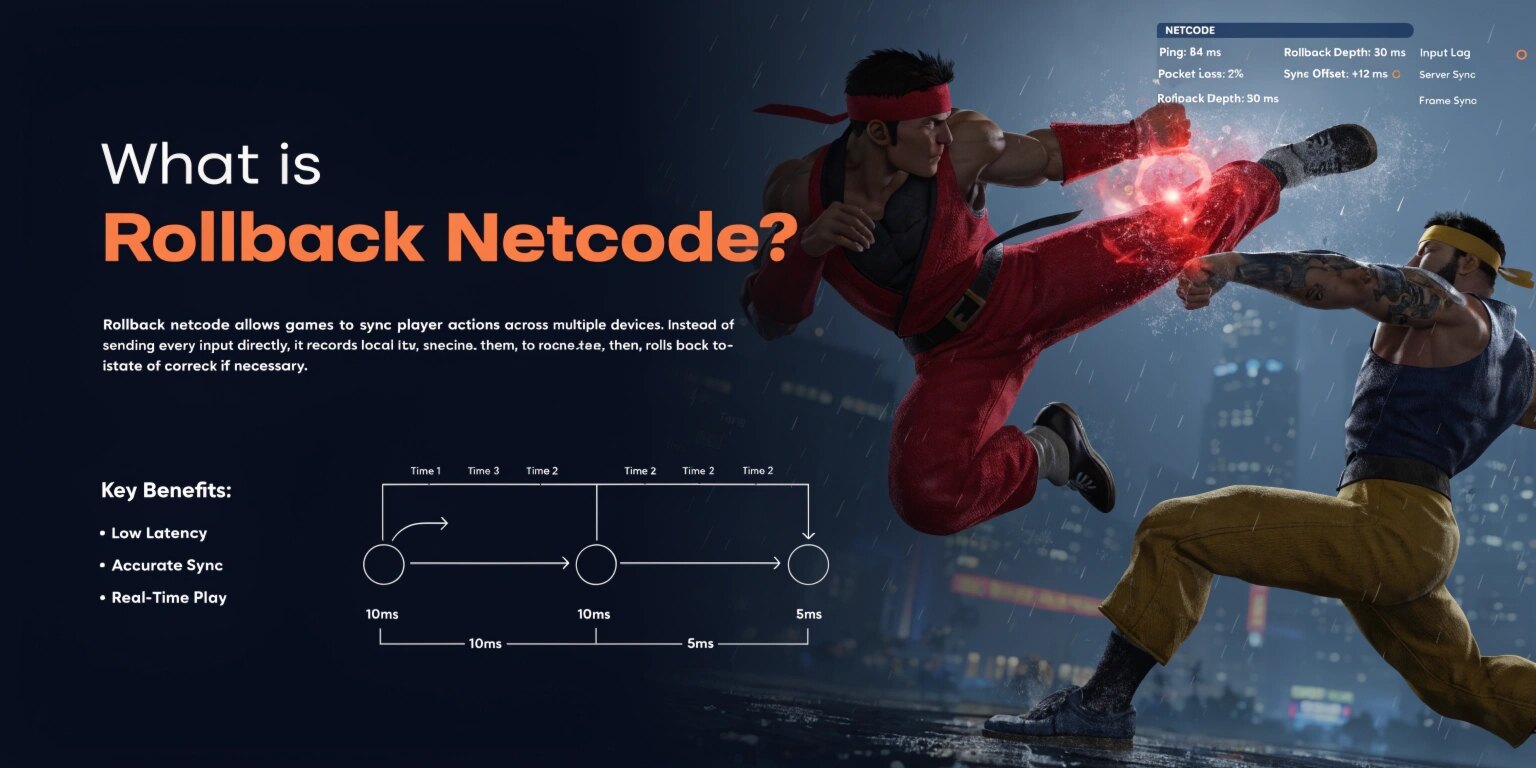
Online multiplayer has become a defining feature of modern gaming, especially in competitive genres like fighting games. However, delivering a smooth and responsive experience over unpredictable network conditions is a major challenge. This is where rollback netcode comes into play—a powerful networking technique popularized by games like Street Fighter V.
Rollback netcode has revolutionized how fighting games handle latency, offering a near offline-quality experience even in online matches. In this blog, we’ll break down how rollback netcode works, why it matters, and how developers can implement it.
The Problem with Traditional Netcode
Before rollback netcode, many games relied on delay-based netcode. In this approach, the game waits for inputs from all players before processing the next frame.
While simple to implement, delay-based systems introduce noticeable input lag, especially when network latency is high. This results in sluggish controls, making fast-paced games like fighting titles frustrating to play.
What is Rollback Netcode?
Rollback netcode is a technique that minimizes perceived latency by predicting player inputs instead of waiting for them.
Instead of delaying the game, the system:
- Predicts what the remote player will do
- Continues the game simulation immediately
- Corrects mistakes later if predictions were wrong
This creates a smooth and responsive experience, even under poor network conditions.
How Rollback Netcode Works
1. Input Prediction
When a player inputs a command, it is instantly processed locally. For remote players, the system predicts their input based on previous actions (e.g., continuing movement in the same direction).
2. Game Simulation
The game continues running using predicted inputs, ensuring there is no delay in gameplay.
3. State Saving (Snapshots)
The system constantly saves game states (frames) in memory, allowing it to revert if needed.
4. Rollback and Correction
When the actual input arrives and differs from the prediction:
- The game rolls back to the correct frame
- Re-simulates frames using the correct input
- Updates the current state seamlessly
This entire process happens in milliseconds, often unnoticed by players.
Why Rollback Netcode is Superior
- Low Input Latency: Immediate response to player actions
- Smooth Gameplay: Minimal lag even with unstable connections
- Better Competitive Integrity: Accurate and fair gameplay
- Global Playability: Players can compete across long distances
These advantages make rollback netcode the preferred choice for modern fighting games.
Challenges in Implementing Rollback Netcode
Despite its benefits, rollback netcode is complex to implement:
1. Deterministic Game Engine
The game must produce the same results when re-simulated with identical inputs. Any randomness must be controlled.
2. State Management
Efficiently saving and restoring game states is memory-intensive and technically challenging.
3. Visual Artifacts
Frequent corrections can cause visual glitches, such as character snapping or teleporting.
4. CPU Overhead
Re-simulating multiple frames quickly requires additional processing power.
Best Practices for Developers
- Keep Simulations Lightweight: Optimize game logic for fast re-simulation
- Limit Rollback Frames: Typically 6–8 frames to balance performance and accuracy
- Use Input Buffers: Smooth out rapid input changes
- Design for Determinism: Avoid non-deterministic systems like uncontrolled physics
- Optimize Networking: Use UDP for faster communication
Rollback vs Delay-Based Netcode
FeatureDelay-Based NetcodeRollback NetcodeInput LagHighLowResponsivenessPoorExcellentComplexitySimpleComplexPlayer ExperienceInconsistentSmooth
Rollback netcode clearly outperforms delay-based systems in competitive scenarios.
Real-World Implementations
Beyond Street Fighter V, rollback netcode is widely used in modern fighting games and is heavily inspired by middleware like GGPO, which pioneered the concept.
Many developers now adopt rollback as a standard for online multiplayer in fast-paced games.
Future of Multiplayer Networking
As internet infrastructure improves and competitive gaming grows, rollback netcode will continue to evolve. Combined with advancements in cloud computing and edge servers, future systems may further reduce latency and improve synchronization.
Game engines are also starting to integrate rollback-friendly architectures, making it easier for developers to adopt this technique.
Conclusion
Rollback netcode is a game-changing innovation in multiplayer networking. By predicting inputs and correcting errors in real time, it delivers smooth, responsive gameplay that closely mimics offline experiences.
For developers building competitive multiplayer games, especially in genres like fighting or fast-action titles, implementing rollback netcode is no longer optional—it’s essential.
By mastering rollback techniques, developers can create engaging, fair, and globally accessible gaming experiences that meet the expectations of modern players.