As mobile applications grow in complexity, managing data becomes one of the biggest challenges for developers. A typical mobile app today interacts with multiple data sources — REST APIs, local databases, cache storage, and sometimes even Bluetooth or device sensors.
If the UI directly handles these data sources, the code quickly becomes messy, fragile, and difficult to maintain.
This is why modern mobile architectures rely on the Repository Pattern.
It acts as a clean bridge between your app’s business logic and data sources, making your code scalable, testable, and maintainable.
Let’s understand it step by step.
The Problem Without Repository Pattern
Imagine a simple app showing a list of products.
The ViewModel (or Presenter) might:
- call the API
- parse JSON
- store data in SQLite/Room/CoreData
- fetch cached data
- handle network failures
Now your UI layer contains networking logic, caching logic, and database queries. This violates separation of concerns and creates tight coupling.
Problems that occur:
- difficult debugging
- repeated code
- hard unit testing
- difficult API replacement
- crashes during offline usage
This is exactly what the Repository Pattern solves.
What is the Repository Pattern?
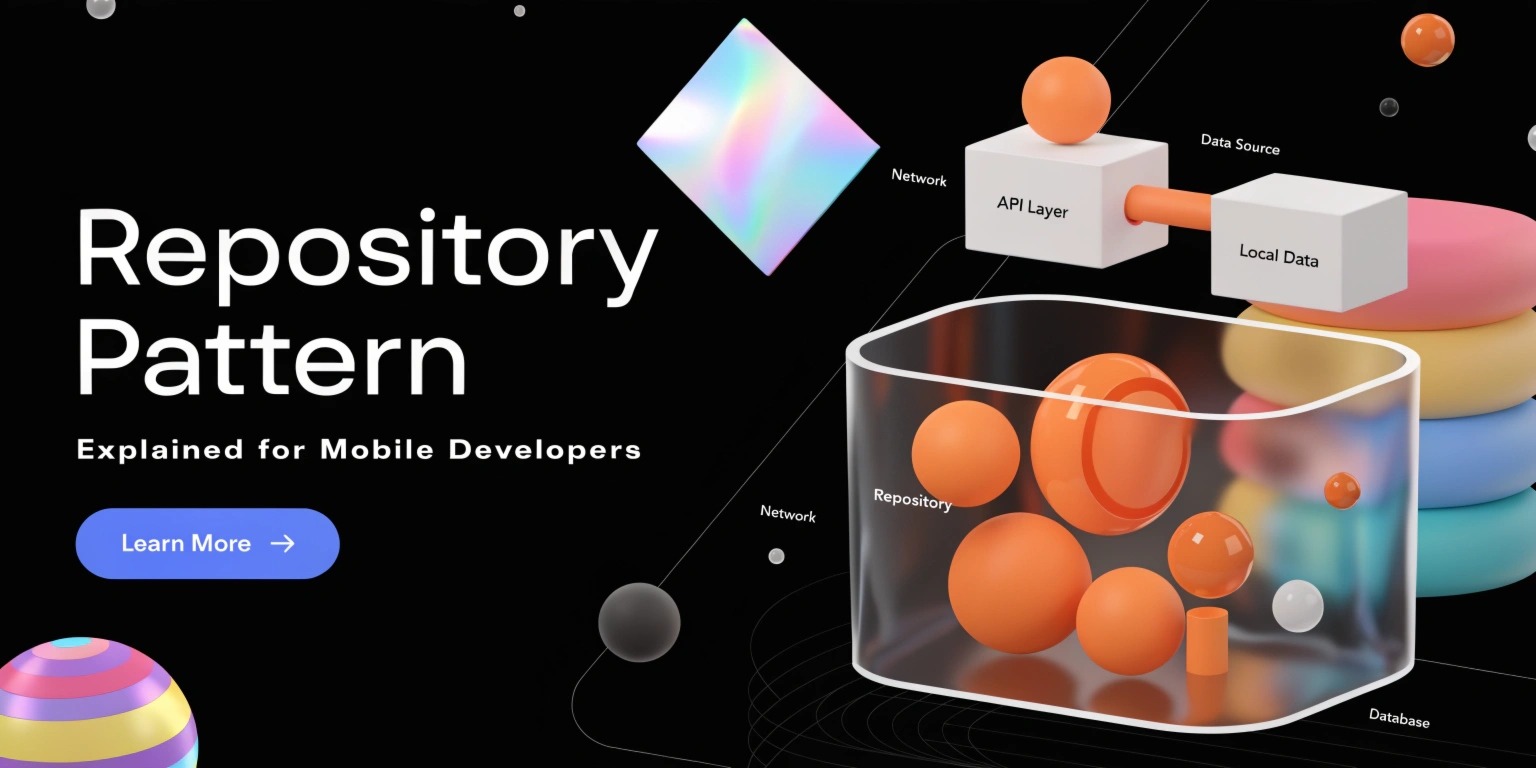
The Repository Pattern introduces a single data access layer between the app’s logic and its data sources.
Instead of:
UI/ViewModel → API / Database / Cache
You get:
UI/ViewModel → Repository → Data Sources
The repository decides:
- where data should come from
- when to fetch from network
- when to read from cache
- when to store locally
The UI no longer cares about implementation details.
Key Responsibility of a Repository
A repository:
- abstracts data sources
- provides clean methods to the app
- handles caching
- manages synchronization
- centralizes data logic
The UI simply calls:
getProducts()
It does not know if data came from:
- server
- local DB
- memory cache
This flexibility is extremely powerful.
Real Mobile Example
Suppose you open a shopping app.
First Launch:
- App fetches products from API
- Stores them locally
Next Launch (No Internet):
- App loads products from local database
The ViewModel only calls:
repository.getProducts()
The repository internally decides:
If internet available → API
Else → local database
The UI remains unaffected.
Repository in MVVM Architecture
In modern mobile development, MVVM is widely used.
Architecture becomes:
View → ViewModel → Repository → Data Sources
Benefits:
- ViewModel stays clean
- No networking code in UI
- Easy to test ViewModel
- Easy to change backend later
This also fits perfectly with Clean Architecture.
Data Sources Inside Repository
A repository typically manages multiple sources:
1. Remote Source
REST API / GraphQL
2. Local Source
Room (Android) / CoreData (iOS)
3. Cache Source
Memory cache / SharedPreferences / Keychain
The repository coordinates all three.
Example Flow
User opens profile screen:
- Repository checks cache.
- If cache valid → return instantly.
- If expired → fetch from API.
- Save to database.
- Update UI.
This creates:
- faster loading
- offline support
- better UX
Advantages of Repository Pattern
1. Separation of Concerns
UI focuses only on displaying data.
2. Testability
You can mock repository in unit tests.
3. Maintainability
Change API without touching UI code.
4. Offline Support
Local storage integration becomes easy.
5. Scalability
Works well for large apps with multiple modules.
When You Should Use It
Use Repository Pattern when:
- app consumes APIs
- offline caching is required
- project is medium or large scale
- multiple data sources exist
- team collaboration is involved
Avoid it only for very small demo apps.
Common Mistakes
- Putting business logic inside repository
- Making repository call UI components
- Not separating local and remote data sources
- Returning raw API responses instead of models
The repository should only manage data — not UI behavior.
Repository vs DAO vs Service
ComponentRoleDAODatabase queriesService/APINetwork callsRepositoryCoordinates both
The repository sits above them and provides a clean interface.
Final Thoughts
The Repository Pattern is one of the most important architectural patterns for modern mobile development. It protects your UI from backend changes, enables offline capabilities, and significantly improves code quality.
As apps evolve, data handling complexity increases. Without a repository layer, maintenance cost grows exponentially.
By introducing a repository, you build applications that are not only functional today but sustainable for future updates, new APIs, and platform changes.
In professional mobile development, the repository is not optional — it is foundational.