As artificial intelligence continues to evolve, autonomous AI agents are becoming increasingly capable of handling complex tasks without human intervention. From virtual assistants to advanced robotics, these agents rely on sophisticated mechanisms to operate effectively. Among the most critical components of intelligent behavior are reflection and planning—two processes that enable AI systems to learn, adapt, and make better decisions over time.
Understanding Autonomous AI Agents
Autonomous AI agents are systems designed to perceive their environment, make decisions, and act independently to achieve specific goals. Unlike traditional rule-based systems, these agents can adapt to changing conditions and improve their performance through experience.
These agents are widely used in areas such as robotics, recommendation systems, and customer service automation. Their effectiveness depends on their ability to evaluate past actions and plan future ones—this is where reflection and planning come into play.
What is Reflection in AI?
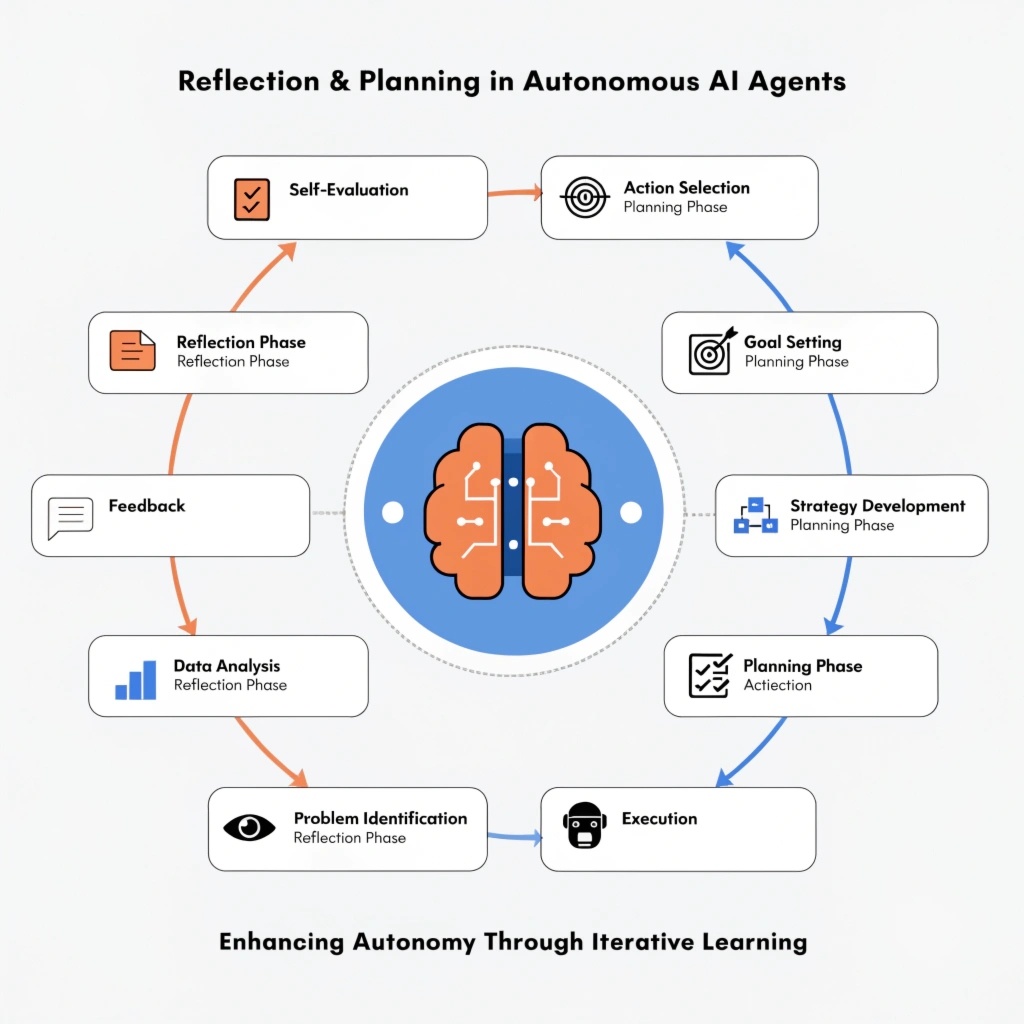
Reflection refers to an agent’s ability to analyze its past actions, outcomes, and decisions to improve future performance. It acts as a feedback loop, allowing the system to identify what worked, what didn’t, and why.
For example, if an AI agent fails to complete a task efficiently, reflection helps it understand the cause of failure. It can then adjust its strategy to avoid repeating the same mistake.
Reflection often involves:
- Storing past experiences in memory
- Evaluating performance metrics
- Learning from errors and successes
- Updating internal models
This process is similar to how humans learn from experience, making AI systems more robust and adaptive.
What is Planning in AI?
Planning is the process of determining a sequence of actions required to achieve a specific goal. In autonomous agents, planning involves predicting possible outcomes and selecting the best course of action.
Planning can be simple or complex depending on the task. For instance:
- A navigation system planning the shortest route
- A chatbot deciding how to respond to user queries
- A robotic system organizing tasks in a warehouse
Effective planning requires understanding the environment, defining goals, and evaluating multiple possible strategies.
The Role of Reflection in Improving Planning
Reflection and planning are deeply interconnected. Reflection provides insights that improve future planning decisions. When an AI agent reflects on past outcomes, it can refine its planning strategies.
For example, if a plan consistently leads to suboptimal results, reflection enables the agent to modify its approach. Over time, this iterative process leads to more efficient and accurate decision-making.
This combination creates a learning loop:
- Execute a plan
- Observe the outcome
- Reflect on performance
- Adjust future plans
This cycle allows AI agents to continuously improve without explicit reprogramming.
Techniques Used in Reflection & Planning
Modern AI systems use several techniques to implement these capabilities:
- Reinforcement Learning (RL): Agents learn by receiving rewards or penalties based on their actions
- Memory-Augmented Models: Systems store past experiences for future reference
- Tree Search Algorithms: Evaluate multiple possible action paths
- Chain-of-Thought Reasoning: Break down complex problems into smaller steps
These techniques enable agents to handle dynamic and uncertain environments effectively.
Real-World Applications
Reflection and planning are used across various industries:
- Autonomous Vehicles: Plan routes and adapt to traffic conditions
- Healthcare AI: Assist in diagnosis and treatment planning
- Customer Support Bots: Improve responses based on past interactions
- Robotics: Optimize task execution in manufacturing
In each case, the ability to learn from experience and plan ahead is crucial for success.
Challenges in Implementation
Despite their benefits, implementing reflection and planning in AI systems comes with challenges:
- Computational Complexity: Planning algorithms can be resource-intensive
- Memory Management: Storing and retrieving past experiences efficiently
- Uncertainty Handling: Dealing with incomplete or noisy data
- Scalability: Ensuring performance remains consistent as tasks grow in complexity
Developers must carefully design systems to balance performance and efficiency.
Future of Autonomous AI Agents
The future of AI lies in creating agents that can think, learn, and adapt like humans. Reflection and planning will play a central role in this evolution.
Advancements in machine learning, neural networks, and cognitive architectures are making it possible to build more sophisticated agents. These systems will not only execute tasks but also understand context, anticipate outcomes, and improve over time.
As AI continues to integrate into everyday life, the demand for intelligent, autonomous systems will only increase.
Conclusion
Reflection and planning are fundamental to the success of autonomous AI agents. Together, they enable systems to learn from experience, make informed decisions, and adapt to changing environments.
By leveraging these capabilities, developers can create smarter, more efficient AI solutions that deliver real-world value. As technology advances, the integration of reflection and planning will become a defining feature of next-generation AI systems.