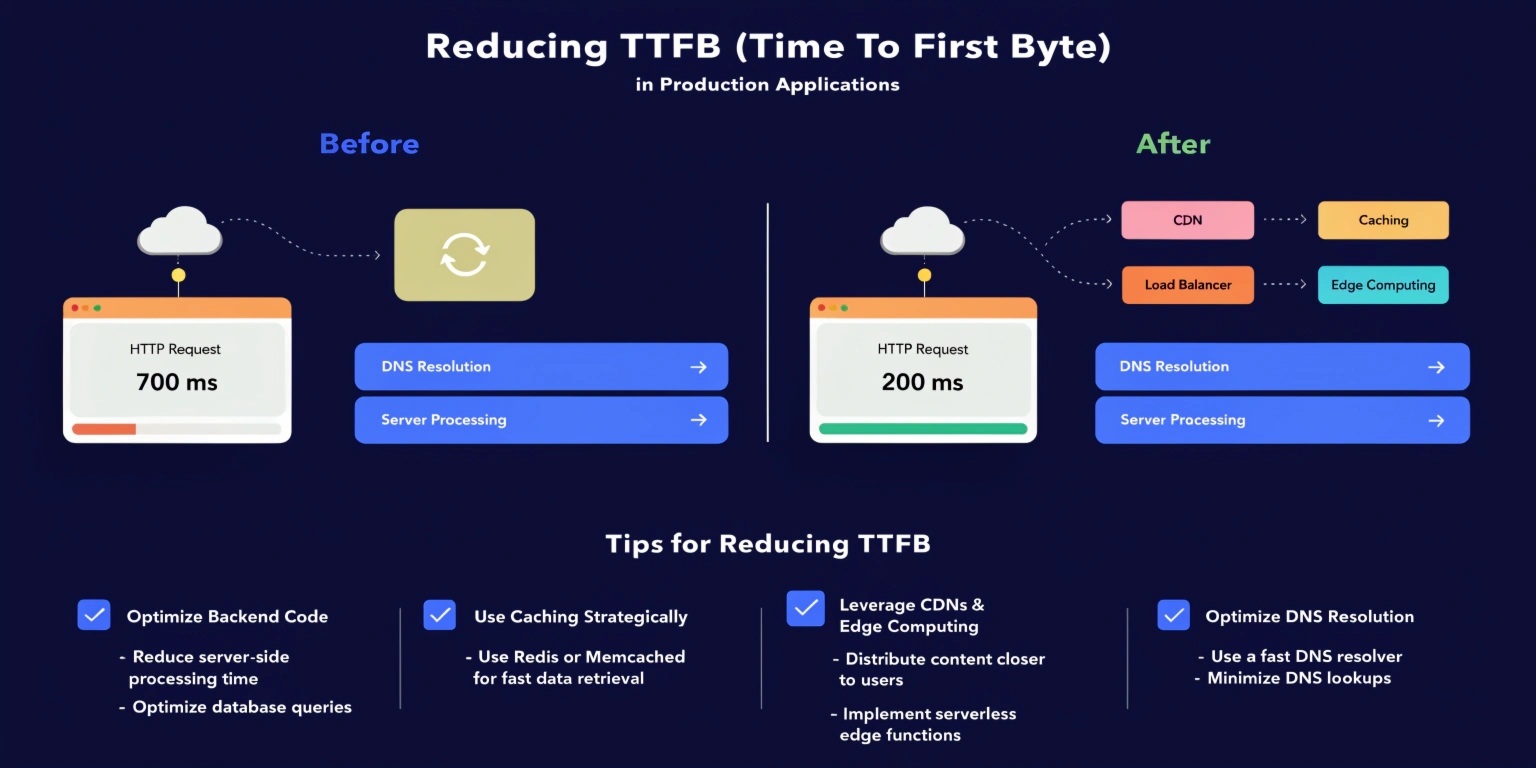
Reducing TTFB improves speed, SEO, and user experience. Learn how to optimize servers, databases, caching, and CDNs to achieve faster response times in production applications.
Introduction
Time To First Byte (TTFB) is one of the most important performance metrics in modern web applications. It measures the time between a user's request and the first byte of data received from the server. A high TTFB often indicates backend inefficiencies and can significantly affect user experience, SEO rankings, and overall application performance.
In production environments, reducing TTFB is not just an optimization—it’s a necessity.
What Causes High TTFB?
Before reducing TTFB, it's important to understand what contributes to it:
- Slow server processing
- Network latency
- Inefficient database queries
- Lack of caching
- Poor hosting infrastructure
- Blocking operations in backend code
Each of these factors adds delay before the server starts sending data.
1. Optimize Server Performance
The first step in reducing TTFB is ensuring your server is fast and efficient.
- Use high-performance servers (NGINX instead of Apache where possible)
- Optimize application runtime (Node.js, PHP, Python)
- Reduce middleware overhead
- Enable HTTP/2 or HTTP/3
Upgrading server hardware or moving to better cloud infrastructure can significantly reduce response time.
2. Implement Effective Caching
Caching is one of the most powerful ways to reduce TTFB.
- Page caching: Serve pre-rendered HTML
- Object caching: Cache database query results
- Opcode caching: Use tools like OPcache for PHP
- Browser caching: Reduce repeated requests
Using tools like Redis or Memcached can dramatically cut down server processing time.
3. Use a Content Delivery Network (CDN)
A CDN distributes your content across multiple global servers, reducing latency.
Benefits include:
- Faster delivery from nearest server
- Reduced load on origin server
- Improved scalability
Popular CDNs like Cloudflare or AWS CloudFront help reduce TTFB for global users.
4. Optimize Database Queries
Slow database queries are a major contributor to high TTFB.
Best practices:
- Use proper indexing
- Avoid N+1 query problems
- Optimize joins and subqueries
- Use query caching
- Limit unnecessary data fetching
Profiling your queries can reveal hidden bottlenecks.
5. Reduce Backend Processing Time
Heavy backend logic delays the server response.
- Move non-critical tasks to background jobs
- Use queues (RabbitMQ, Kafka)
- Optimize algorithms and logic
- Avoid synchronous blocking operations
The faster your backend processes a request, the lower your TTFB.
6. Enable Compression and Keep-Alive
While compression mainly affects content delivery, it indirectly improves performance.
- Enable GZIP or Brotli compression
- Use persistent connections (Keep-Alive)
- Reduce handshake overhead
These improvements help streamline communication between client and server.
7. Choose the Right Hosting Infrastructure
Your hosting environment plays a huge role.
- Use SSD-based servers
- Prefer cloud providers with low latency
- Use auto-scaling to handle traffic spikes
- Deploy closer to your users (region-based hosting)
A poorly configured server can bottleneck even optimized applications.
8. Monitor and Measure Continuously
Optimization is an ongoing process.
Tools to monitor TTFB:
- Google PageSpeed Insights
- GTmetrix
- WebPageTest
- New Relic or Datadog
Track performance regularly and fix regressions quickly.
Conclusion
Reducing TTFB in production applications requires a combination of server optimization, efficient coding practices, caching strategies, and infrastructure improvements. Even small enhancements can lead to significant gains in performance, user experience, and SEO rankings.
By systematically identifying bottlenecks and applying the strategies discussed above, developers can ensure faster, more reliable applications that meet modern performance standards.
We build scalable web, mobile, and game products for clients worldwide — combining modern frameworks, cloud infrastructure, and best engineering practices.
.jpg)
.jpg)
.jpg)