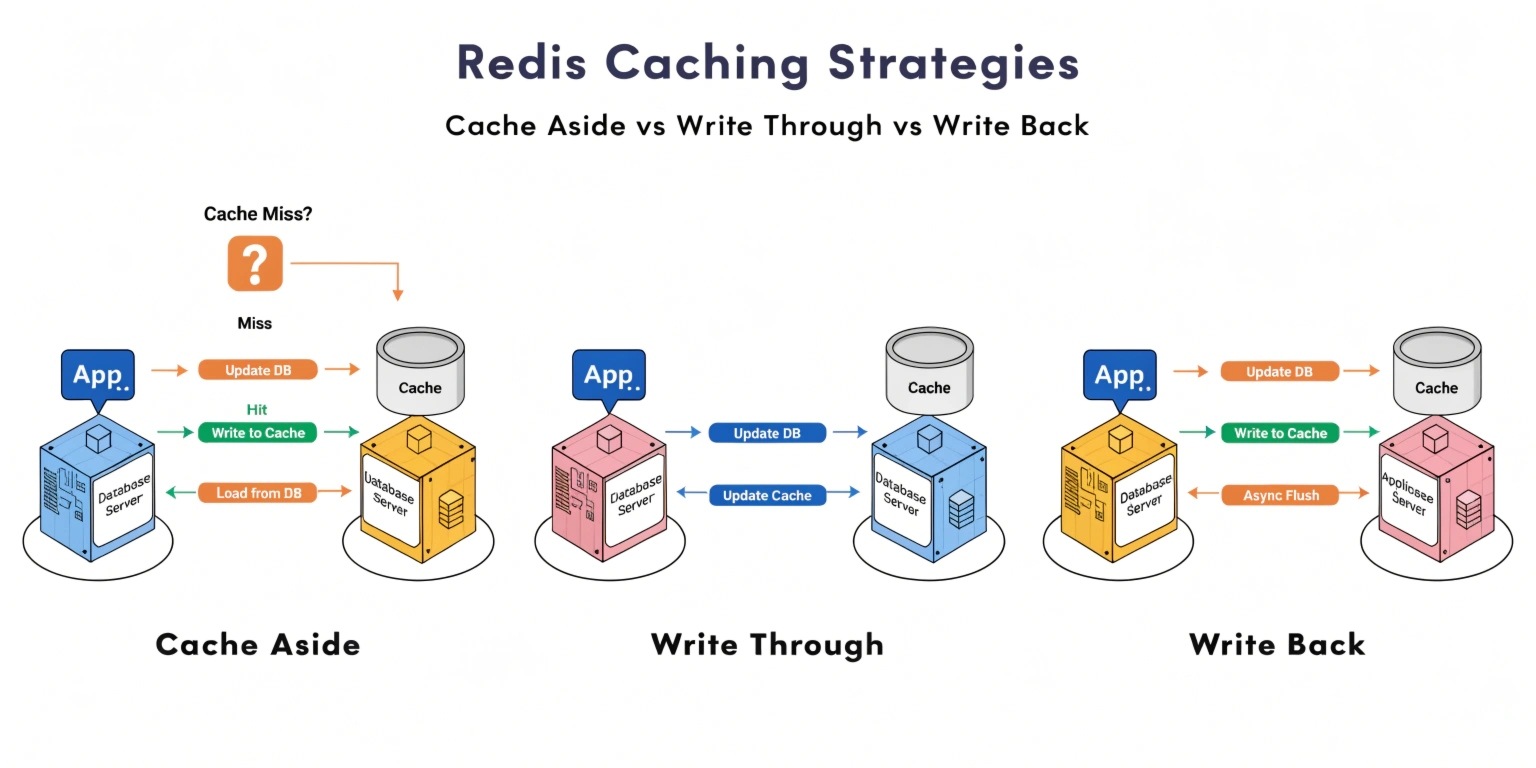
Learn how Cache Aside, Write Through, and Write Back strategies in Redis improve application performance and scalability. This guide explains their differences, benefits, and when to use each for efficient caching.
In modern application development, performance and scalability are critical. As applications grow, frequent database queries can become a bottleneck, leading to slower response times and increased infrastructure costs. This is where caching comes into play, and Redis has become one of the most popular tools for implementing high-speed caching solutions.
However, simply adding caching is not enough. Choosing the right caching strategy is essential for achieving optimal performance and data consistency. In this blog, we will explore three widely used Redis caching strategies: Cache Aside, Write Through, and Write Back.
What is Redis?
Redis is an open-source, in-memory data store used as a database, cache, and message broker. Its ability to store data in memory makes it extremely fast, making it ideal for real-time applications.
Why Caching Matters
Caching reduces the need to repeatedly fetch data from a database. By storing frequently accessed data in memory, applications can:
- Improve response times
- Reduce database load
- Enhance user experience
- Scale more efficiently
1. Cache Aside (Lazy Loading)
How It Works
In the Cache Aside pattern, the application is responsible for managing the cache.
Flow:
- Application checks cache for data
- If data is missing (cache miss), fetch from database
- Store data in cache
- Return data to user
Advantages
- Simple to implement
- Only caches frequently accessed data
- Reduces unnecessary cache usage
Disadvantages
- Initial requests are slower (cache miss)
- Risk of stale data if not invalidated properly
Best Use Cases
- Read-heavy applications
- Data that does not change frequently
- Systems where occasional stale data is acceptable
2. Write Through Cache
How It Works
In Write Through, data is written to both the cache and the database simultaneously.
Flow:
- Application writes data to cache
- Cache writes data to database
- Cache always stays updated
Advantages
- Strong data consistency
- Cache always contains fresh data
- Simplifies read operations
Disadvantages
- Higher write latency
- Unnecessary caching of rarely used data
Best Use Cases
- Systems requiring high consistency
- Financial or transactional applications
- Frequently updated data
3. Write Back (Write Behind)
How It Works
In Write Back, data is first written to the cache and then asynchronously written to the database.
Flow:
- Application writes data to cache
- Cache acknowledges immediately
- Data is written to database later
Advantages
- Very fast write performance
- Reduced database load
- Ideal for high-throughput systems
Disadvantages
- Risk of data loss if cache fails
- Complex implementation
- Eventual consistency instead of immediate consistency
Best Use Cases
- High-write applications
- Logging systems
- Analytics platforms
Cache Aside vs Write Through vs Write Back
FeatureCache AsideWrite ThroughWrite BackRead PerformanceHigh after cache warm-upHighHighWrite PerformanceModerateSlowerVery FastData ConsistencyMediumHighEventualComplexityLowMediumHigh
Choosing the Right Strategy
The choice of caching strategy depends on your application requirements:
- Use Cache Aside when you want simplicity and control over cached data
- Use Write Through when consistency is critical
- Use Write Back when performance and scalability are top priorities
In many real-world applications, a hybrid approach is used to balance performance and consistency.
Best Practices for Redis Caching
- Set Expiration Policies (TTL): Prevent stale data
- Use Cache Invalidation: Update or remove outdated entries
- Monitor Cache Performance: Track hit/miss ratios
- Avoid Over-Caching: Cache only necessary data
- Implement Fallback Mechanisms: Handle cache failures gracefully
Conclusion
Redis caching strategies play a crucial role in optimizing application performance and scalability. Cache Aside, Write Through, and Write Back each offer unique benefits and trade-offs.
By understanding these strategies and applying them appropriately, developers can design systems that are fast, reliable, and efficient. Whether you're building a high-traffic web app or a real-time analytics platform, mastering Redis caching strategies is essential for modern backend development.
We build scalable web, mobile, and game products for clients worldwide — combining modern frameworks, cloud infrastructure, and best engineering practices.
.jpg)
.jpg)
.jpg)