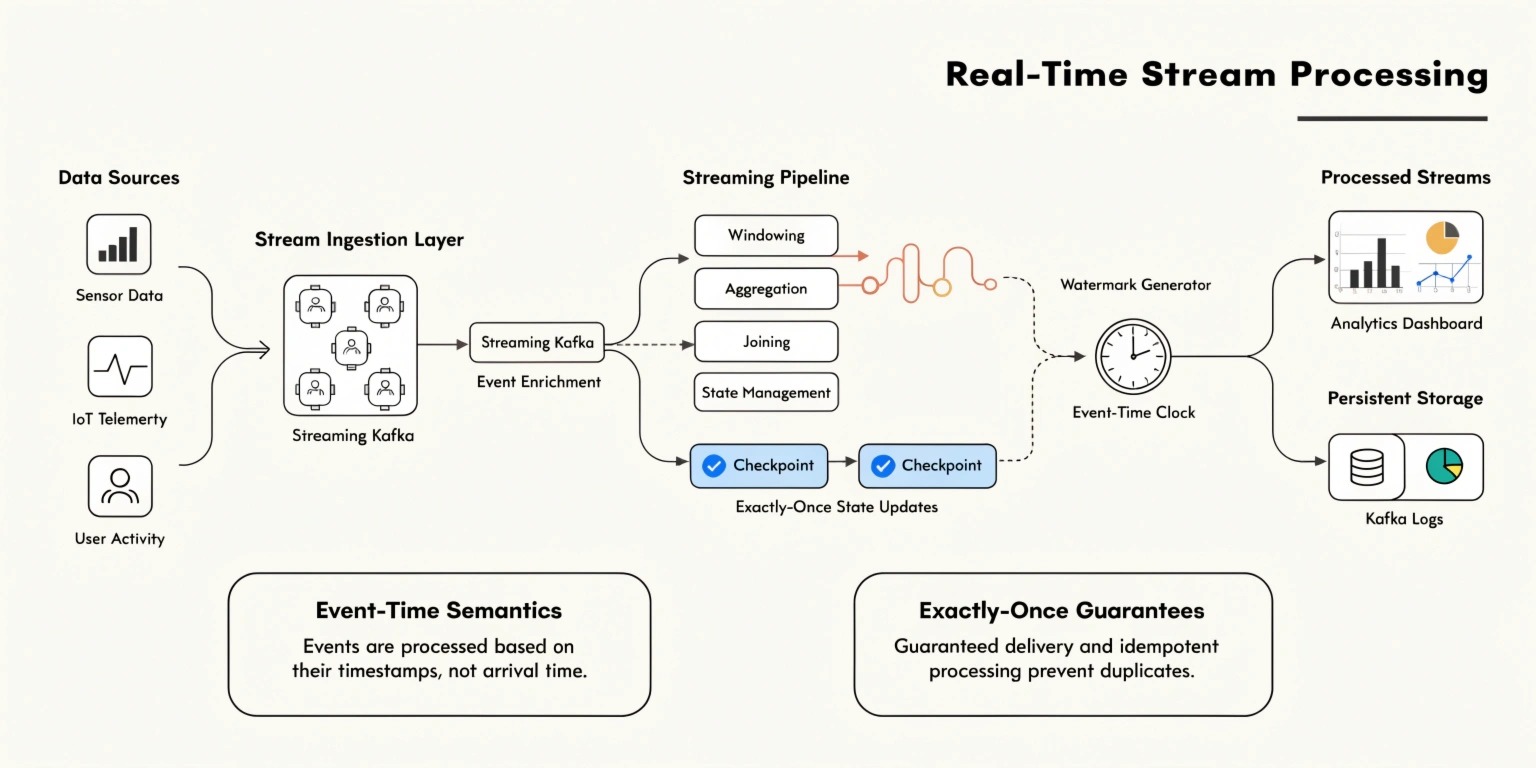
Modern applications generate continuous streams of data from user interactions, financial transactions, IoT devices, online services, and business systems. Processing this information in real time enables organizations to detect fraud, personalize customer experiences, monitor infrastructure, and make faster decisions. However, building reliable streaming applications involves more than processing events as they arrive. Systems must account for delayed messages, out-of-order events, failures, and duplicate processing.
Two important concepts address these challenges: event-time semantics and exactly-once processing guarantees. Together, they help developers build streaming pipelines that produce accurate, consistent results even when data arrives late or infrastructure experiences failures.
Understanding Real-Time Stream Processing
Real-time stream processing continuously consumes, transforms, and analyzes events as they enter a system. Unlike traditional batch processing, which operates on accumulated datasets, streaming applications process data incrementally and deliver results with minimal delay.
For example, an e-commerce platform might process order events to track sales, update inventory, identify suspicious purchases, and generate live dashboards. A streaming architecture commonly includes event producers, a message broker, processing engines, state storage, and downstream systems.
Technologies such as Apache Kafka, Apache Flink, and Kafka Streams support different parts of this architecture. Kafka provides durable event transport, while processing frameworks transform events, maintain state, and calculate results.
The challenge is ensuring that these calculations remain correct when events do not arrive in chronological order or when a processing task fails.
What Is Event-Time Semantics?
Event-time semantics means processing events according to when they actually occurred, rather than when the processing system received them.
Consider a mobile application that records a user action at 10:05 AM. Due to network delays, the event may reach the server at 10:05:30 AM. If the application groups events using processing time, the action may be assigned to the wrong time window. Event-time processing instead uses the timestamp associated with the original action.
This distinction is essential for applications where timing affects accuracy, including financial analytics, clickstream analysis, industrial monitoring, and fraud detection.
Streaming systems commonly distinguish three timestamps:
- Event time: When the event occurred in the source system.
- Ingestion time: When the event entered the streaming infrastructure.
- Processing time: When a processing operator handled the event.
Choosing the appropriate timestamp model helps ensure that time-based calculations reflect real-world activity rather than unpredictable network conditions.
Managing Late and Out-of-Order Events with Watermarks
Distributed systems cannot guarantee that every event arrives immediately or in chronological order. Network interruptions, offline devices, retries, and uneven data sources can introduce delays.
A watermark helps a streaming engine estimate how far event-time processing has progressed. It indicates that events with timestamps earlier than a particular point are unlikely to arrive, although some systems may still accept such events afterward.
For example, a sales analytics application might calculate revenue in five-minute windows. A watermark can indicate that the system has progressed beyond a window's expected completion time, allowing the engine to emit results.
Developers must select an appropriate late-event strategy. Possible approaches include:
- Accepting late events and updating previously emitted results.
- Sending excessively late events to a separate processing path.
- Discarding late events when business requirements permit.
- Using allowed-lateness settings to keep windows open for additional updates.
Short delays improve responsiveness but can increase the number of incomplete results. Longer delays improve completeness while increasing processing latency and state retention. The right balance depends on the application's accuracy and responsiveness requirements.
Understanding Exactly-Once Processing Guarantees
Exactly-once processing aims to ensure that each logical input event contributes to the final result only once, even when failures and retries occur.
In distributed streaming systems, this is challenging because a processing task may complete an operation but fail before confirming that completion. After recovery, the task might process the same event again.
A system without suitable safeguards could count an order twice, duplicate an aggregate, or repeat a downstream operation.
Exactly-once processing commonly relies on coordinated mechanisms such as:
- Checkpointing: Periodically saves operator state and processing progress.
- Transactional writes: Commits related output operations atomically.
- Offset management: Tracks which input records have been processed.
- Deterministic recovery: Restores a consistent state after failure.
- Idempotent operations: Ensures repeated execution does not create additional effects.
Frameworks such as Apache Flink support checkpoint-based recovery and coordinated state consistency. Kafka-based pipelines can use transactions and appropriate consumer and producer configurations to achieve exactly-once processing within supported boundaries.
However, exactly-once semantics do not automatically guarantee that every external side effect occurs only once. Database writes, payment APIs, email notifications, and other integrations require compatible transactional mechanisms, idempotency keys, deduplication, or an outbox-based design.
Combining Event Time and Exactly-Once Processing
Event-time semantics and exactly-once guarantees solve different problems, but they work together in reliable streaming architectures.
Event time determines which time window should contain an event. Exactly-once processing helps ensure that failures and retries do not incorrectly multiply that event's contribution to the result.
Consider a payment analytics platform that calculates transaction totals every minute. Events may arrive late, and a processing node may restart during aggregation. Event-time windows help place transactions in the correct minute, while checkpointing and transactional output mechanisms help recover processing without introducing duplicate committed results.
The system must still define how late transactions affect previously published totals and how downstream consumers handle updates. Correctness depends on the complete processing design, not on one configuration setting.
Best Practices for Production Streaming Systems
To build reliable stream-processing applications, development teams should follow several practices.
First, define timestamp ownership and clock synchronization requirements at the event source. Inconsistent timestamps can undermine accurate event-time calculations.
Second, choose window sizes, watermark strategies, and late-event policies according to business needs. Financial reconciliation may prioritize completeness, while live monitoring may prioritize low latency.
Third, test recovery behavior by simulating worker failures, broker interruptions, duplicate messages, and delayed events. Verify both internal state and downstream results.
Fourth, monitor processing lag, watermark progress, checkpoint duration, state size, retry rates, and late-event volume. These metrics reveal bottlenecks and correctness risks.
Finally, document delivery guarantees at every system boundary. A pipeline may provide exactly-once processing internally while an external integration still requires deduplication or idempotency controls.
Conclusion
Real-time stream processing is a foundation for responsive, data-driven applications. Event-time semantics help systems interpret delayed and out-of-order events accurately, while exactly-once processing mechanisms improve consistency during retries and failures.
When combined with carefully designed windows, watermarks, checkpointing, transactional output, and robust monitoring, these techniques enable businesses to build dependable streaming pipelines. The key is to define what correctness means for each application and implement guarantees across the entire data flow, including external systems and business operations.
For organizations investing in real-time analytics and distributed applications, a well-designed streaming architecture can improve decision-making, operational visibility, and trust in data-driven outcomes.