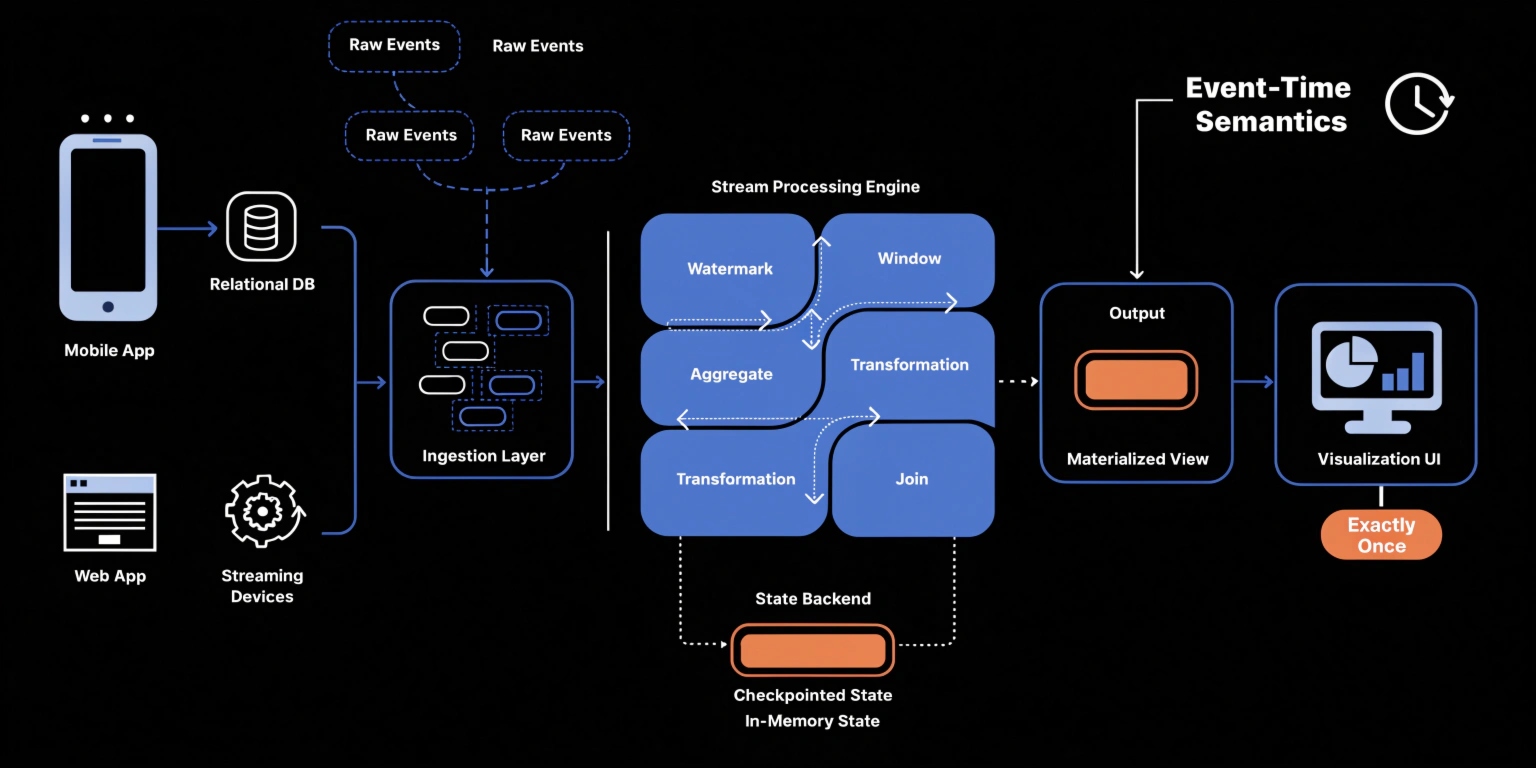
Event-time semantics and exactly-once guarantees help real-time streaming systems process delayed events accurately while maintaining consistent results during failures. With watermarks, checkpointing, state management, and transactional sinks, enterprises can build reliable, scalable, and low-latency data pipelines.
Modern applications generate enormous volumes of continuous data through financial transactions, IoT sensors, mobile applications, online purchases, and user interactions. Businesses need to process these events in real time to detect fraud, monitor operations, personalize experiences, and make faster decisions.
However, streaming data introduces two important challenges: events may arrive later than expected, and system failures may cause data to be processed repeatedly. Event-time semantics and exactly-once processing guarantees help address these problems when implemented with appropriate system architecture.
1. Understanding Real-Time Stream Processing
Real-time stream processing analyzes continuously arriving events instead of waiting for an entire dataset to become available.
For example, an e-commerce platform can process purchase events as they occur, update sales dashboards, detect suspicious transactions, and calculate product demand.
Unlike traditional batch processing, streaming systems operate on unbounded data. They must manage incoming events continuously while controlling latency, memory usage, and processing consistency.
Popular technologies include Apache Flink, Kafka Streams, and Apache Spark Structured Streaming. Each provides different processing models and operational capabilities, so the right choice depends on latency requirements, deployment architecture, state management needs, and integration with existing infrastructure.
2. Event Time vs. Processing Time
A central challenge in streaming applications is deciding when an event should be considered to have occurred.
Event time is the timestamp associated with when the event happened at its source. Processing time is when the streaming application processes the event.
Consider a delivery application where a vehicle records its location at 10:00 AM, but network connectivity delays the message until 10:04 AM.
An event-time system uses the original timestamp of 10:00 AM, while a processing-time system may treat the event as occurring at 10:04 AM.
This distinction matters when calculating time-based metrics. A dashboard measuring vehicle activity by processing time could place the event in the wrong interval, while event-time processing can assign it to the interval in which the activity actually occurred.
Event time is particularly valuable for financial analytics, sensor monitoring, user behavior analysis, and systems that receive data from geographically distributed sources.
3. Managing Delayed Events with Watermarks
Real-world events do not always arrive in chronological order. Network delays, offline devices, retries, and distributed communication can cause older events to appear after newer ones.
Streaming engines use watermarks to estimate how far event-time processing has progressed.
A watermark indicates that the system considers events earlier than a particular timestamp sufficiently complete for certain computations, subject to the engine's semantics and configuration.
For example, a five-minute event-time window may aggregate website activity from 10:00 AM to 10:05 AM. A watermark helps the system determine when it can produce or finalize results for that interval.
Watermarks do not automatically guarantee that no older events will ever arrive. Systems must define what happens to events that arrive after a window has been finalized.
Depending on the application, late events can be dropped, routed to a side output, used to update previously emitted results, or processed through a correction workflow.
Choosing a watermark strategy requires balancing result accuracy against latency. Waiting longer may capture more delayed events, but it also postpones final results.
4. Understanding Exactly-Once Processing Guarantees
Distributed systems can fail because of network interruptions, application crashes, broker failures, or infrastructure problems. When a component restarts, messages may be replayed.
This creates the risk of duplicate processing. For example, a payment analytics pipeline might count the same transaction twice if a retry is handled incorrectly.
Exactly-once processing aims to ensure that each relevant input event contributes to the managed computation's results only once, even when failures occur.
However, exactly-once semantics must be understood across the entire pipeline. A processing engine may recover its internal state consistently while an external database or API still receives duplicate writes.
Therefore, developers should distinguish exactly-once state processing from end-to-end exactly-once effects.
5. Using Checkpointing and State Recovery
Many stream-processing applications maintain state, including running totals, session information, window aggregates, and fraud-detection indicators.
Checkpointing periodically captures consistent snapshots of processing state and relevant source positions.
If a failure occurs, a compatible streaming engine can restore a checkpoint and resume processing from the corresponding position rather than rebuilding everything from the beginning.
Apache Flink supports stateful stream processing and checkpoint-based recovery. With correctly configured sources and compatible transactional or idempotent sinks, applications can maintain consistent results across failures.
Checkpoint intervals, storage reliability, state size, and recovery time all affect performance. Frequent checkpoints can improve recovery points but introduce overhead, while infrequent checkpoints may increase recovery time and replay work.
6. Coordinating Sources, Processing, and Sinks
Reliable streaming requires coordination between input sources, processing logic, and output destinations.
Apache Kafka can provide durable event storage and replayable input streams. Processing engines can track source positions and maintain application state. Output systems must then handle retries and recovery without creating unintended duplicate effects.
Common approaches include:
- Transactional writes: Commit output changes atomically where supported.
- Idempotent operations: Ensure repeated operations with the same identifier do not create duplicate effects.
- Deduplication: Track event identifiers to recognize previously processed records.
- Consistent recovery: Coordinate state restoration with source offsets and output commits.
For example, a sales analytics pipeline can use stable transaction IDs and idempotent database updates to reduce duplicate counting during retries.
The exact implementation depends on the streaming framework, source connector, destination, and their transaction capabilities.
7. Balancing Reliability, Latency, and Scalability
Strong consistency does not eliminate the need for performance engineering.
Large state stores, frequent checkpoints, network communication, and transactional commits can increase latency. High event volumes may also create backpressure when downstream components cannot process data quickly enough.
To improve scalability, developers should monitor event throughput, processing latency, watermark lag, checkpoint duration, recovery time, and backpressure.
Partitioning workloads across parallel operators can improve throughput, but state partitioning and event ordering must be designed carefully. Hot keys can create uneven workloads, while insufficient capacity can cause growing event backlogs.
Load testing should simulate delayed events, traffic spikes, and component failures rather than testing only normal operating conditions.
8. Practical Applications and Best Practices
Event-time semantics and exactly-once guarantees are useful in payment analytics, inventory tracking, fraud detection, real-time reporting, and IoT monitoring.
For successful implementation, teams should define timestamp rules, select an appropriate watermark strategy, configure checkpointing, test failure recovery, and verify the behavior of output destinations.
They should also document assumptions about late events, duplicate identifiers, retention periods, and correction policies.
Most importantly, test the full pipeline under realistic failure conditions. A guarantee that works inside the processing engine may not extend automatically to every external service.
Conclusion
Real-time stream processing with event-time semantics and exactly-once guarantees enables organizations to build reliable data pipelines that handle out-of-order events, recover from failures, and produce consistent results.
Event timestamps and watermarks help manage delayed data, while checkpointing, coordinated recovery, transactional writes, and idempotent operations help prevent inconsistent or duplicated outcomes.
By selecting suitable streaming technologies and testing the complete processing pipeline, businesses can deliver accurate real-time analytics while balancing reliability, scalability, and latency.
We build scalable web, mobile, and game products for clients worldwide — combining modern frameworks, cloud infrastructure, and best engineering practices.
.jpg)
.jpg)
.jpg)