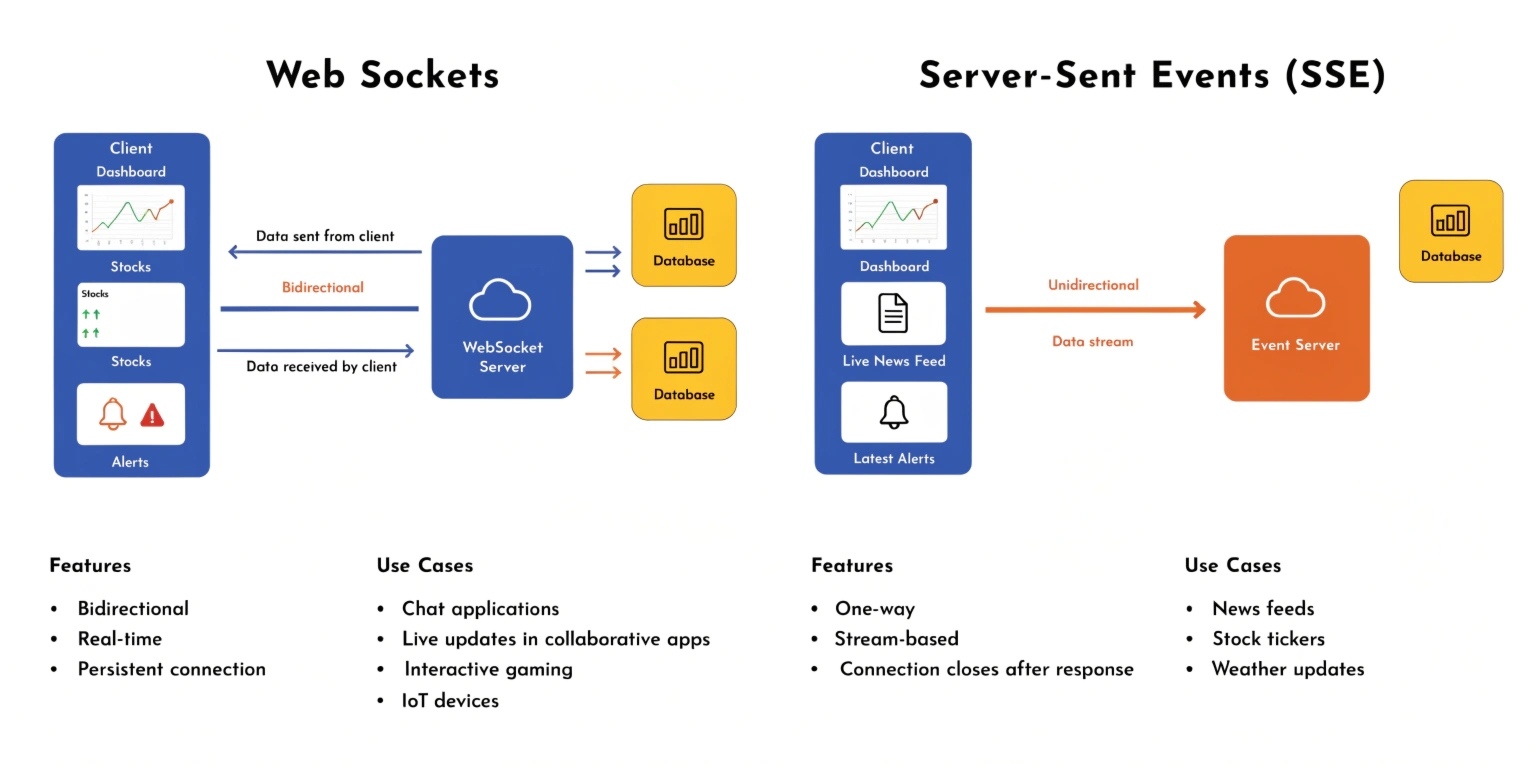
Web Sockets and SSE power real-time applications, but choosing the wrong one can impact performance and scalability. Learn their differences, use cases, and how to select the right approach for modern real-time systems.
Main Content :
Modern applications are no longer static. Users expect live updates—chat messages, stock prices, notifications, dashboards, and collaborative editing—all happening in real time.
To enable this, developers rely on technologies like WebSocket and Server-Sent Events (SSE).
While both provide real-time communication, they differ significantly in architecture, performance, and use cases.
Choosing the wrong approach can lead to scalability issues, unnecessary complexity, or poor user experience.
Understanding Real-Time Communication
Traditional web communication follows a request-response model over HTTP:
- Client sends a request
- Server responds
- Connection closes
This model is inefficient for real-time updates because the client must repeatedly poll the server.
WebSockets and SSE solve this by enabling persistent connections and server-driven updates.
What is WebSocket?
WebSocket is a full-duplex communication protocol that establishes a persistent connection between client and server.
Once connected:
- Both client and server can send messages anytime
- Communication is bidirectional
- Low latency is maintained
This makes WebSockets ideal for interactive applications.
Key Features:
- Full-duplex (two-way communication)
- Low overhead after connection setup
- Supports binary and text data
- Works over a single TCP connection
Common Use Cases:
- Chat applications
- Multiplayer games
- Real-time collaboration tools
- Financial trading platforms
What is Server-Sent Events (SSE)?
SSE is a simpler technology that allows servers to push updates to clients over standard HTTP connections.
However, unlike WebSockets:
- Communication is one-way (server → client only)
- Built on top of HTTP
- Uses text-based event streams
Key Features:
- Unidirectional communication
- Automatic reconnection
- Simpler implementation
- Native browser support via EventSource API
Common Use Cases:
- Live notifications
- News feeds
- Stock tickers
- Monitoring dashboards
WebSockets vs SSE: Core Differences
1. Communication Model
- WebSocket → Bidirectional
- SSE → Unidirectional
If your app requires user input to be sent frequently (e.g., chat), WebSockets are necessary.
2. Complexity
- WebSocket → More complex (custom protocol handling)
- SSE → Simpler (built on HTTP)
SSE is easier to implement and debug, especially for lightweight applications.
3. Performance
WebSockets:
- Lower latency after handshake
- Efficient for high-frequency data exchange
SSE:
- Slightly higher overhead
- Efficient for low-to-medium frequency updates
4. Scalability
SSE works well with HTTP infrastructure:
- Compatible with proxies and load balancers
- Easier horizontal scaling
WebSockets require:
- Stateful connections
- Special handling in load balancers
At scale, managing millions of WebSocket connections can become complex.
5. Data Format
- WebSocket → Binary + text
- SSE → Text only
If your application requires binary data (e.g., audio/video streaming), WebSockets are the better choice.
When to Use WebSockets
Choose WebSockets when:
- You need real-time bidirectional communication
- Latency must be extremely low
- The application is highly interactive
- Data exchange is frequent and continuous
Examples:
- Chat systems
- Gaming platforms
- Collaborative editing tools
When to Use SSE
Choose SSE when:
- You only need server-to-client updates
- Simplicity is a priority
- Real-time updates are moderate
- You want easier scaling with HTTP infrastructure
Examples:
- Notification systems
- Live dashboards
- Social media feeds
Architectural Considerations
Load Balancing
WebSockets require sticky sessions or specialized routing, while SSE works more naturally with traditional HTTP load balancing.
Fault Tolerance
SSE includes built-in reconnection logic, making it more resilient in unstable networks.
WebSockets require custom reconnection strategies.
Hybrid Approach: Best of Both Worlds
Many modern applications combine both technologies:
- Use SSE for passive updates (notifications, feeds)
- Use WebSockets for interactive features (chat, editing)
This hybrid approach optimizes both performance and complexity.
Performance Optimization Tips
Regardless of the technology:
- Compress payloads
- Minimize message size
- Use efficient serialization formats
- Implement backpressure handling
- Monitor connection health
Real-time systems must balance speed with scalability.
The Future of Real-Time Communication
With advancements like HTTP/2, HTTP/3, and edge computing, real-time data delivery continues to evolve.
However, WebSockets and SSE remain foundational technologies for building responsive, real-time user experiences.
Final Thoughts
There is no universal winner between WebSockets and SSE.
The right choice depends on:
- Communication needs
- System complexity
- Scalability requirements
- Developer expertise
If your application demands interactivity and speed, WebSockets are the way to go.
If your goal is simplicity and efficient server push, SSE is often the better choice.
In modern system design, the best architects don’t just pick technologies—they align them with real-world use cases.
We build scalable web, mobile, and game products for clients worldwide — combining modern frameworks, cloud infrastructure, and best engineering practices.
.jpg)
.jpg)
.jpg)