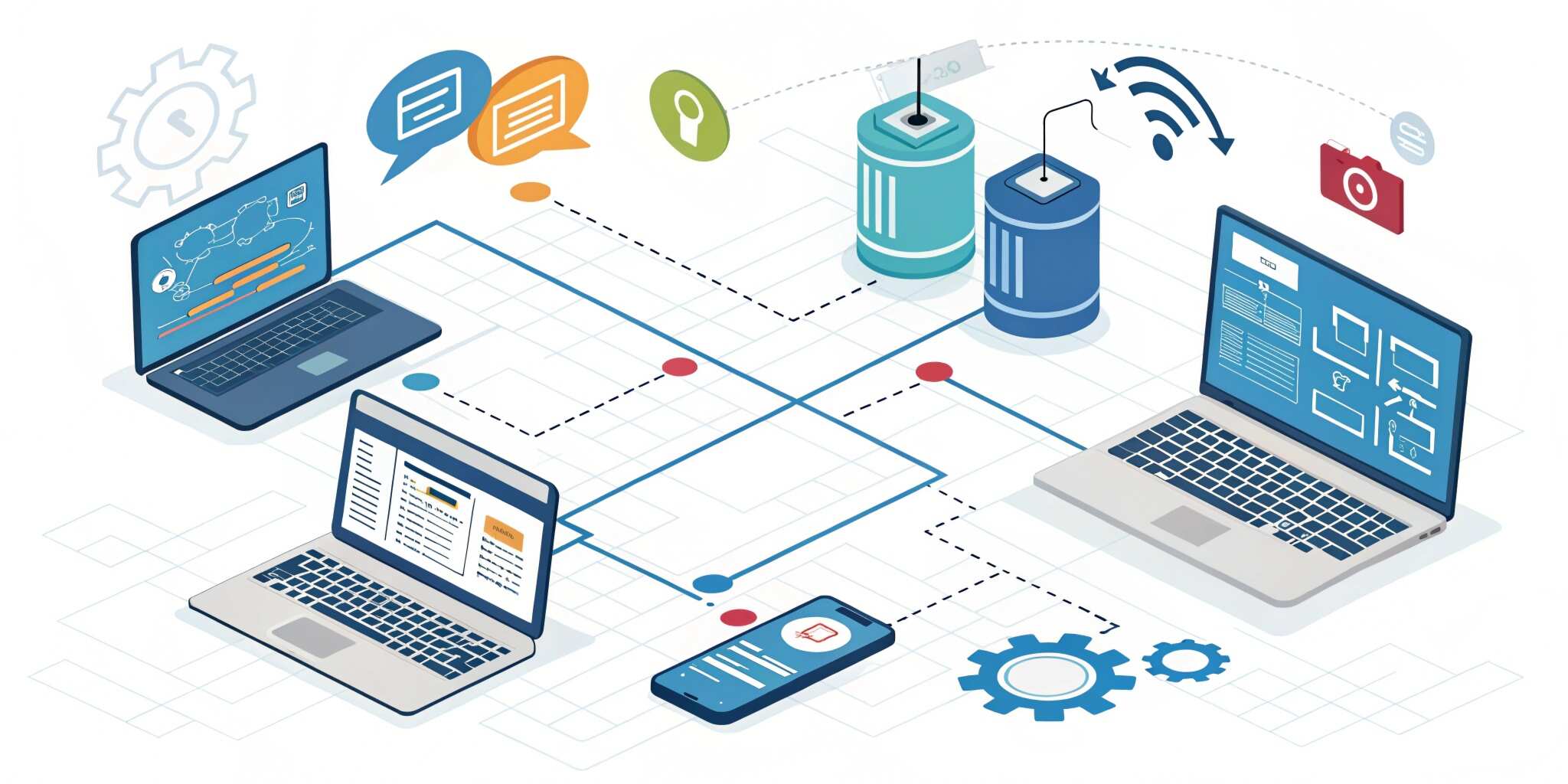
Real-time collaboration has become a defining feature of modern digital products, allowing multiple users to edit shared content simultaneously without overwriting each other's work. Applications such as Google Docs, Notion, Figma, Miro, Slack, and GitHub Codespaces have set new expectations for interactive teamwork experiences. To enable seamless shared editing and conflict-free synchronization, developers rely on advanced distributed system techniques like Operational Transform (OT) and Conflict-Free Replicated Data Types (CRDTs). These technologies allow web applications to handle concurrent changes from multiple users, maintain consistent state, and support offline-first behavior without sacrificing performance.
Operational Transform is one of the earliest and most successful approaches to collaborative editing, famously powering Google Docs. OT works by transforming operations so they remain valid even when other operations are applied concurrently. For example, if one user deletes a character while another inserts text near the same location, OT repositions the operations to avoid conflicts and maintain the correct resulting document. By maintaining a linear history of edits and transforming changes based on position indexes, OT ensures that all users end up with identical document states while still seeing real-time updates. This makes OT ideal for centralized systems where a server acts as a control authority to manage updates.
CRDTs, on the other hand, follow a distributed architecture and allow each client to maintain its own local state, later merging changes in a mathematically deterministic way. Unlike OT, CRDTs do not require a central server for conflict resolution because they use algebraic rules to ensure that merging operations always results in consistent state across devices, even if edits occur offline. This makes CRDTs ideal for collaborative whiteboard tools, offline-first note apps, peer-to-peer networks, and edge computing environments. Libraries such as Y.js, Automerge, and Fluid Framework are becoming increasingly popular among developers building collaborative features.
One of the biggest advantages of CRDTs and OT in real-time collaboration is the ability to support low-latency interactions and immediate feedback. Instead of waiting for server confirmation, users see updates instantly, leading to smooth UI experiences similar to native desktop applications. Combined with WebSockets, WebRTC, or HTTP/3, these systems enable bidirectional messaging, ensuring that all clients remain synchronized in real time.
Another benefit is improved fault tolerance. With CRDTs especially, if the server fails or the network disconnects, users can continue working offline without losing progress. Once the connection is restored, states automatically merge without manual conflict resolution. This is essential for enterprise and creative applications where workflow interruptions cannot be tolerated.
However, building real-time collaborative systems also comes with challenges. Implementing OT requires complex transformation logic and heavy coordination overhead, which grows with the number of operations. CRDTs, while decentralized and more scalable, can increase memory usage and payload sizes as data structures grow. Developers must also solve issues related to cursor presence, undo/redo history, identity tracking, user permissions, and security against malicious edits.
Designing the user interface for collaborative software requires thoughtful visual feedback features such as live cursors, avatar presence indicators, color-highlighting, change history timelines, and commenting systems. These elements transform real-time collaboration from a technical capability into a meaningful user experience.
Looking ahead, real-time collaboration is becoming essential across industries—not only in document editing and design tools but also in e-learning platforms, healthcare systems, multiplayer coding environments, and 3D metaverse experiences. Combining CRDTs with WebGPU, edge computing, and AI-driven generative models will enable next-generation digital teamwork tools where teams collaborate in realistic real-time virtual environments.
In a world where remote and hybrid work continues to grow, real-time collaborative applications will remain a core requirement for productivity and creativity. By embracing CRDTs and Operational Transform, developers can build powerful, resilient, and highly interactive systems that provide seamless user experiences across connected and offline environments.