Main Content
Modern web applications need more than attractive interfaces. They must deliver excellent performance, strong SEO, scalable architecture, fast navigation, and reliable user experiences. Two technologies frequently considered for modern frontend development are React.js and Next.js. Although they are closely related, they solve different problems.
React.js is a JavaScript library primarily focused on building user interfaces, while Next.js is a React-based framework that provides additional features such as routing, server-side rendering, static generation, data fetching, caching, and multiple rendering strategies.
One of the most important differences between them is how applications can render content. Understanding CSR, SSR, SSG, ISR, and hybrid rendering makes it easier to select the right technology for a project.
React.js and Client-Side Rendering (CSR)
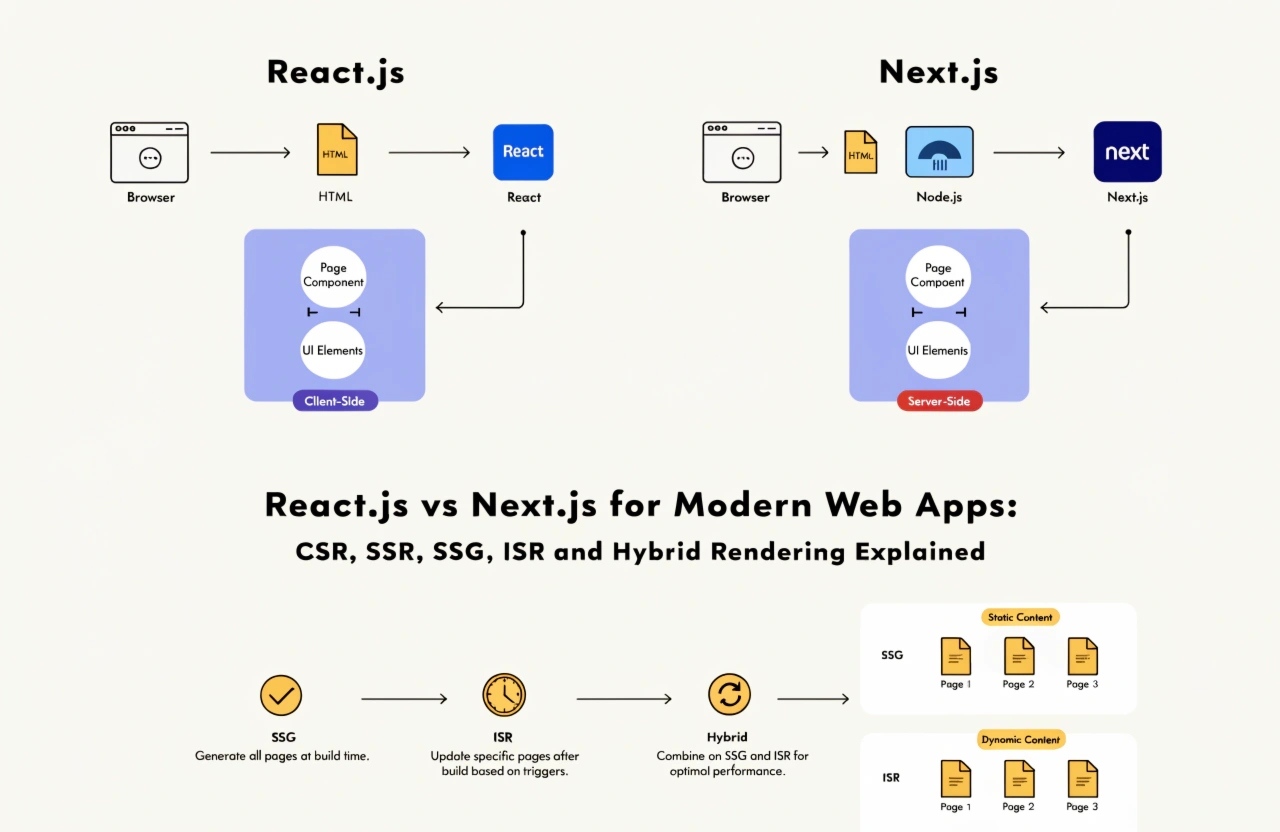
React.js is commonly associated with Client-Side Rendering (CSR). In a traditional CSR application, the browser initially receives a basic HTML document and JavaScript files. React then executes in the browser and generates the user interface.
This approach works particularly well for highly interactive applications such as admin dashboards, internal business tools, project management systems, and applications where SEO is not the primary requirement.
CSR can provide smooth interactions after the application has loaded. However, the initial JavaScript download and execution can affect the first load experience, especially on slower devices or networks. SEO can also require additional consideration because important content may depend on JavaScript execution.
Server-Side Rendering (SSR) with Next.js
Next.js introduces Server-Side Rendering (SSR) capabilities. With SSR, the server generates the HTML for a request before sending it to the browser.
This can improve the initial content experience because users can receive meaningful HTML earlier. It can also be valuable for pages where content changes frequently and needs to be generated based on current data.
For example, an e-commerce product page, news page, or personalized application page may benefit from server rendering when the content needs to be current.
SSR can improve SEO and initial rendering, but it also introduces server-side processing and architectural considerations that developers need to manage.
Static Site Generation (SSG)
Static Site Generation (SSG) creates HTML pages ahead of time rather than generating them for every request.
SSG is especially useful when content does not change frequently. Examples include documentation websites, marketing pages, blogs, landing pages, portfolios, and company websites.
Because pages are generated before users request them, static pages can be delivered efficiently through hosting infrastructure and content delivery networks.
The main limitation is that frequently changing content may require rebuilding pages or using another rendering approach.
Incremental Static Regeneration (ISR)
Incremental Static Regeneration (ISR) provides an approach between completely static pages and fully dynamic server-rendered pages.
With ISR, pages can be generated statically and updated when necessary without requiring the entire website to be rebuilt. This is useful for applications where content changes periodically rather than with every request.
For example, an e-commerce website with thousands of products could use static generation while allowing product information to be refreshed periodically.
ISR can therefore provide a useful balance between performance and content freshness.
Hybrid Rendering
One of Next.js's major advantages is the ability to use different rendering strategies within the same application.
A website does not necessarily need to choose CSR, SSR, or SSG for every page. Developers can select an appropriate strategy based on the requirements of each route.
For example:
- A homepage can use static generation.
- Product pages can use static or incremental generation.
- A personalized dashboard can rely heavily on client-side rendering.
- Frequently changing content can use server-side rendering.
- Marketing pages can prioritize static generation and SEO.
This flexibility is particularly useful for large applications with multiple types of content.
React.js vs Next.js: Which Should You Choose?
React.js can be an excellent choice when developers want maximum flexibility and primarily need a UI library for building client-side applications. It allows teams to select their own routing, data-fetching, state-management, and build-tooling solutions.
Next.js is often more suitable when a project requires an integrated application framework with routing, rendering options, optimization capabilities, and production-oriented architecture.
For SEO-focused websites, content platforms, e-commerce applications, SaaS products, and applications requiring different rendering strategies, Next.js can provide significant architectural advantages.
However, the right choice depends on the project rather than simply choosing the newer or more feature-rich technology.
Final Thoughts
React.js and Next.js are not necessarily competitors. Next.js builds on React and expands its capabilities for full-scale web application development.
The key difference is flexibility versus an integrated framework experience. React.js gives developers a flexible foundation for building interfaces, while Next.js provides a broader framework with multiple rendering strategies.
Understanding CSR, SSR, SSG, ISR, and hybrid rendering allows development teams to make better architectural decisions. By selecting the appropriate rendering model for each page, businesses can create web applications that are fast, scalable, SEO-friendly, and optimized for modern user expectations.