Main Content
Quantum Computing vs Traditional Encryption: What Businesses Need to Know
Cybersecurity has become one of the most critical concerns for businesses of every size. From customer databases to financial transactions, organizations rely heavily on encryption to protect confidential information. However, the rapid development of quantum computing has introduced a new challenge that could redefine digital security.
While quantum computers are still evolving, experts believe they will eventually possess the computational power to break many of today's widely used encryption algorithms. Understanding this technological shift is essential for businesses that want to remain secure in the coming decades.
Understanding Traditional Encryption
Traditional encryption converts readable information into encrypted data using mathematical algorithms and cryptographic keys. Only authorized users possessing the correct key can decrypt the information.
The most common encryption methods include:
- RSA Encryption
- AES (Advanced Encryption Standard)
- Elliptic Curve Cryptography (ECC)
These algorithms secure:
- Online banking
- E-commerce websites
- Corporate email
- Cloud storage
- VPN connections
- Digital signatures
- Government communications
Current encryption methods rely on mathematical problems that classical computers find extremely difficult to solve.
What Makes Quantum Computing Different?
Unlike traditional computers that process information using binary bits (0 or 1), quantum computers use quantum bits, known as qubits.
Qubits can exist in multiple states simultaneously through quantum phenomena such as superposition and entanglement. This allows quantum computers to perform certain calculations exponentially faster than classical computers.
Rather than replacing traditional computers, quantum computers are designed to solve highly specialized computational problems.
Potential applications include:
- Drug discovery
- Climate modeling
- Financial optimization
- Artificial Intelligence
- Logistics optimization
- Scientific simulations
- Advanced cryptography
However, their greatest impact on cybersecurity comes from their ability to solve complex mathematical problems that underpin current encryption.
Why Is Traditional Encryption at Risk?
Today's public-key encryption methods depend on the difficulty of factoring extremely large prime numbers.
For conventional computers, this task would require thousands or even millions of years.
Quantum computers, however, could use algorithms such as Shor's Algorithm to solve these mathematical problems dramatically faster.
If sufficiently powerful quantum computers become commercially available, they could potentially compromise:
- Banking systems
- Government databases
- Healthcare records
- Cryptocurrency wallets
- Corporate intellectual property
- Secure communications
- Cloud services
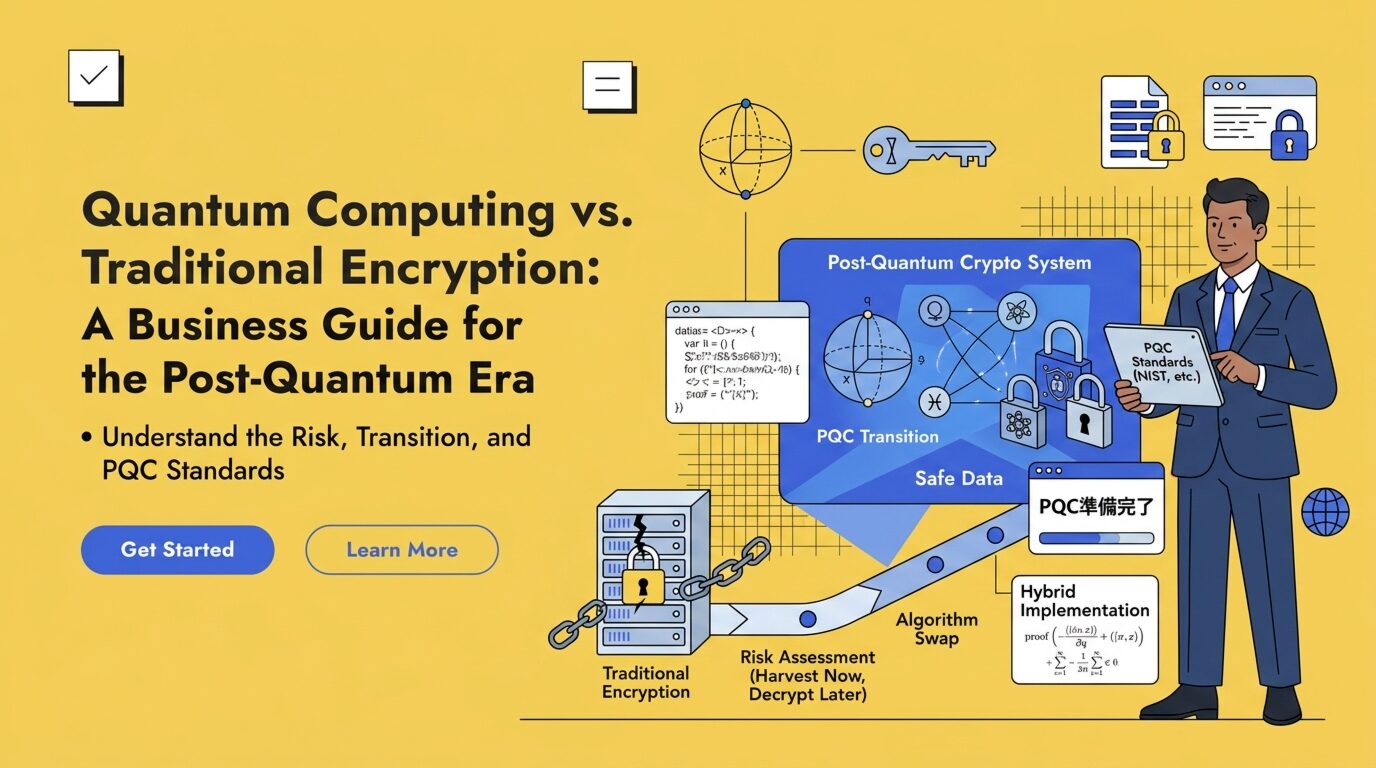
Although this capability is not yet fully realized, organizations must begin preparing now because encrypted data stolen today could be decrypted in the future—a concept known as "Harvest Now, Decrypt Later."
Quantum Computing vs Traditional Encryption
FeatureTraditional EncryptionQuantum EraSecurity BasisMathematical complexityQuantum-resistant mathematicsComputing PowerClassical processorsQuantum processorsVulnerabilitySecure todaySome algorithms vulnerableSpeedFast for current systemsPotentially faster problem-solvingFuture ReadinessLimitedDesigned for long-term protectionKey AlgorithmsRSA, ECCPost-Quantum Cryptography (PQC)
What Is Post-Quantum Cryptography?
Post-Quantum Cryptography (PQC) refers to encryption algorithms specifically designed to resist attacks from both classical and quantum computers.
Researchers worldwide are developing new cryptographic standards that remain secure even against future quantum machines.
These algorithms focus on mathematical problems that quantum computers cannot efficiently solve.
Examples include:
- Lattice-based cryptography
- Hash-based cryptography
- Code-based cryptography
- Multivariate cryptography
Many technology companies have already begun testing these next-generation security methods.
Business Risks of Ignoring Quantum Security
Organizations that delay preparation may face serious risks, including:
Data Breaches
Sensitive customer information may become vulnerable once quantum attacks become practical.
Regulatory Challenges
Governments are expected to introduce new cybersecurity standards requiring quantum-resistant encryption.
Financial Loss
Security incidents can result in lawsuits, regulatory fines, and operational disruptions.
Reputation Damage
Customers expect businesses to protect personal and financial information using modern security practices.
Competitive Disadvantage
Organizations adopting quantum-safe security early may earn greater customer trust.
How Businesses Can Prepare Today
Although large-scale quantum attacks are not yet common, preparation should begin immediately.
Conduct a Cryptographic Inventory
Identify where encryption is currently used across applications, databases, APIs, cloud services, and internal systems.
Adopt Crypto Agility
Design systems that allow encryption algorithms to be upgraded without rebuilding the entire infrastructure.
Stay Updated with Industry Standards
Monitor developments from international cybersecurity organizations regarding post-quantum cryptographic standards.
Work with Security Vendors
Choose technology providers actively implementing quantum-resistant security features.
Train IT Teams
Educate cybersecurity professionals about emerging quantum risks and future migration strategies.
Secure Long-Term Sensitive Data
Protect information that must remain confidential for many years, such as healthcare records, legal documents, and government contracts.
Industries Most Affected
Several sectors should prioritize quantum readiness:
- Banking and Financial Services
- Healthcare
- Government
- Defense
- Telecommunications
- Cloud Computing
- E-commerce
- Insurance
- Manufacturing
- Technology Companies
These industries handle highly valuable data that could become future targets.
The Road Ahead
Quantum computing represents both an extraordinary opportunity and a cybersecurity challenge. While fully capable quantum computers are still under development, organizations should not wait until the technology becomes mainstream.
Preparing today by adopting flexible security architectures, monitoring emerging standards, and planning migration toward post-quantum cryptography will reduce future risks significantly.
Businesses that embrace proactive cybersecurity strategies will be better positioned to protect customer trust, maintain compliance, and remain resilient in the next generation of computing.
The transition to quantum-safe encryption may take years, but early planning is the key to ensuring long-term digital security.