One of the most enduring debates in game development is the choice between procedural design and handcrafted content. Procedural systems promise infinite variation and scalability, while handcrafted design delivers precision, emotional impact, and authorial intent. In practice, the most successful games rarely rely exclusively on one approach. Instead, they find a careful balance that leverages the strengths of both to serve gameplay, narrative, and long-term engagement.
Procedural design focuses on generating content through systems and rules rather than manual creation. Levels, items, encounters, and even narratives can be assembled dynamically based on algorithms and random seeds. This approach excels at creating replayability, ensuring that each playthrough feels different. Games built around procedural design encourage exploration and adaptability, as players cannot rely on memorized patterns or fixed solutions.
Handcrafted content, by contrast, is intentionally authored by designers, artists, and writers. Every level layout, story beat, and encounter is carefully curated to evoke specific emotions and pacing. This approach is particularly effective for narrative-driven experiences, tutorials, and moments that require tight control over difficulty and presentation. Handcrafted content ensures clarity, polish, and thematic cohesion, which are often difficult to guarantee with fully procedural systems.
The primary strength of procedural design lies in scalability. A small set of systems can generate vast amounts of content, reducing production costs and enabling long-term engagement. This is especially valuable for roguelikes, sandbox games, and live-service titles where content exhaustion is a constant risk. Procedural generation also supports emergent gameplay, where unexpected interactions between systems create memorable player stories without explicit scripting.
However, procedural design has limitations. Without careful constraints, generated content can feel repetitive, incoherent, or lacking in emotional impact. Players may recognize patterns behind the randomness, reducing the sense of discovery over time. Purely procedural narratives often struggle to deliver strong character arcs or meaningful thematic progression, which can weaken emotional investment.
Handcrafted content excels where procedural systems struggle. Narrative pacing, cinematic moments, and carefully tuned difficulty curves benefit from direct human control. Designers can guide players through learning experiences, introduce mechanics deliberately, and build emotional resonance through intentional storytelling. These strengths make handcrafted content essential for onboarding, climactic moments, and story-driven games.
The downside of handcrafted content is its cost and finite nature. Creating high-quality manual content requires significant time, resources, and iteration. Once players consume that content, replay value often diminishes unless alternative paths or endings are provided. This makes purely handcrafted approaches less sustainable for games designed to last hundreds of hours.
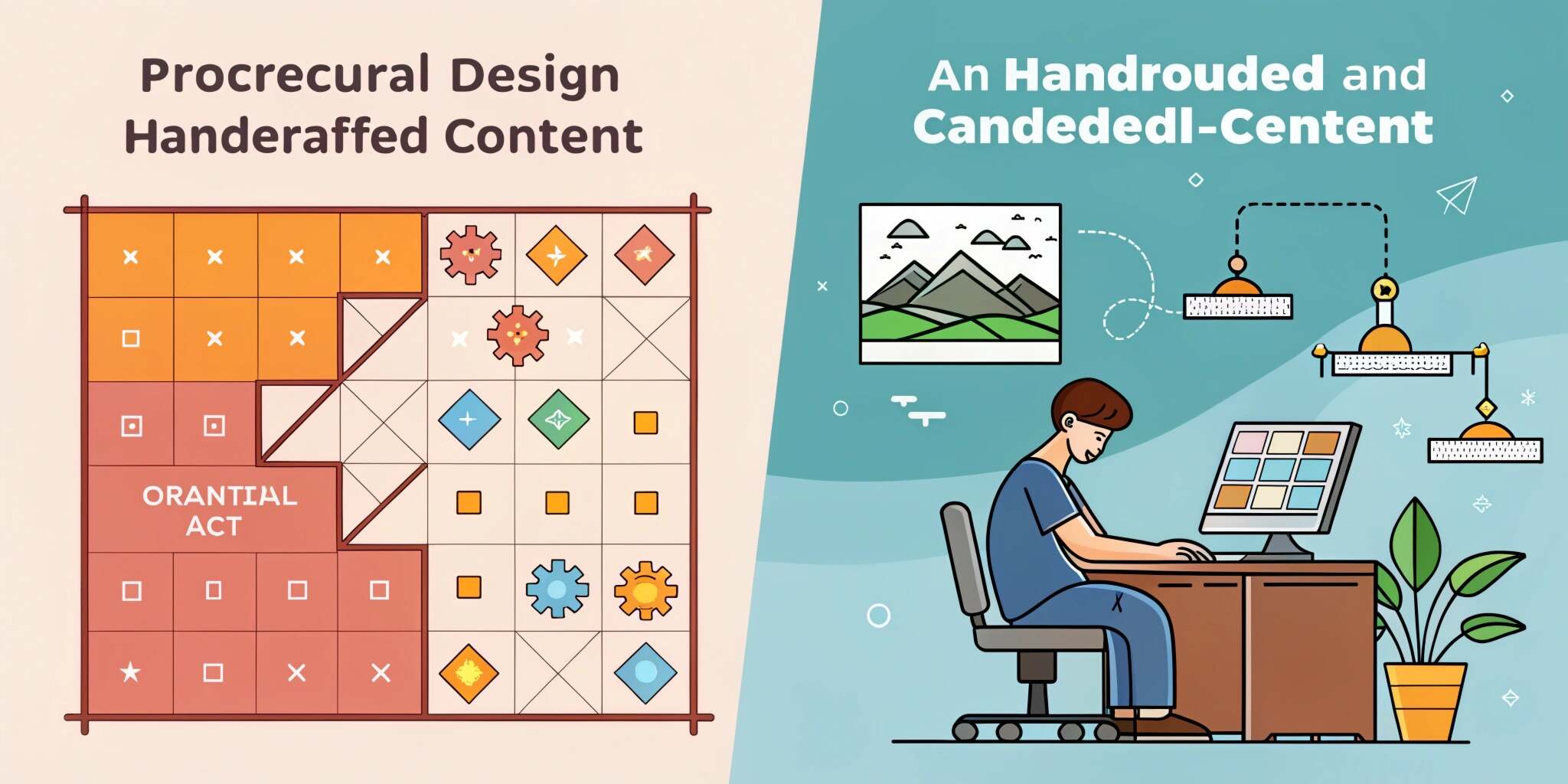
The most effective solution is a hybrid design approach. In hybrid systems, handcrafted content provides structure and intent, while procedural systems introduce variation and replayability. For example, a game might use handcrafted levels as templates while procedurally altering enemy placement, loot distribution, or environmental conditions. This preserves design quality while preventing repetition.
Narrative systems can also benefit from hybrid design. Core story arcs and characters may be handcrafted, while side quests, dialogue variations, or world events are procedurally generated. This allows players to experience a coherent narrative framework while still feeling that the world reacts dynamically to their choices and playstyle.
From a player experience perspective, balance is key. Too much procedural content can feel impersonal, while too much handcrafted content can feel static. Players tend to value meaningful variation within a well-defined structure. When systems support player agency and discovery without sacrificing clarity or emotional engagement, replay value and satisfaction increase significantly.
In conclusion, procedural design and handcrafted content are not opposing philosophies but complementary tools. Procedural systems provide scale, adaptability, and longevity, while handcrafted design ensures quality, intention, and emotional depth. By thoughtfully combining both approaches, developers can create games that feel expansive yet personal, unpredictable yet purposeful. Finding this balance is not just a technical decision but a creative one that defines the identity and success of modern games.