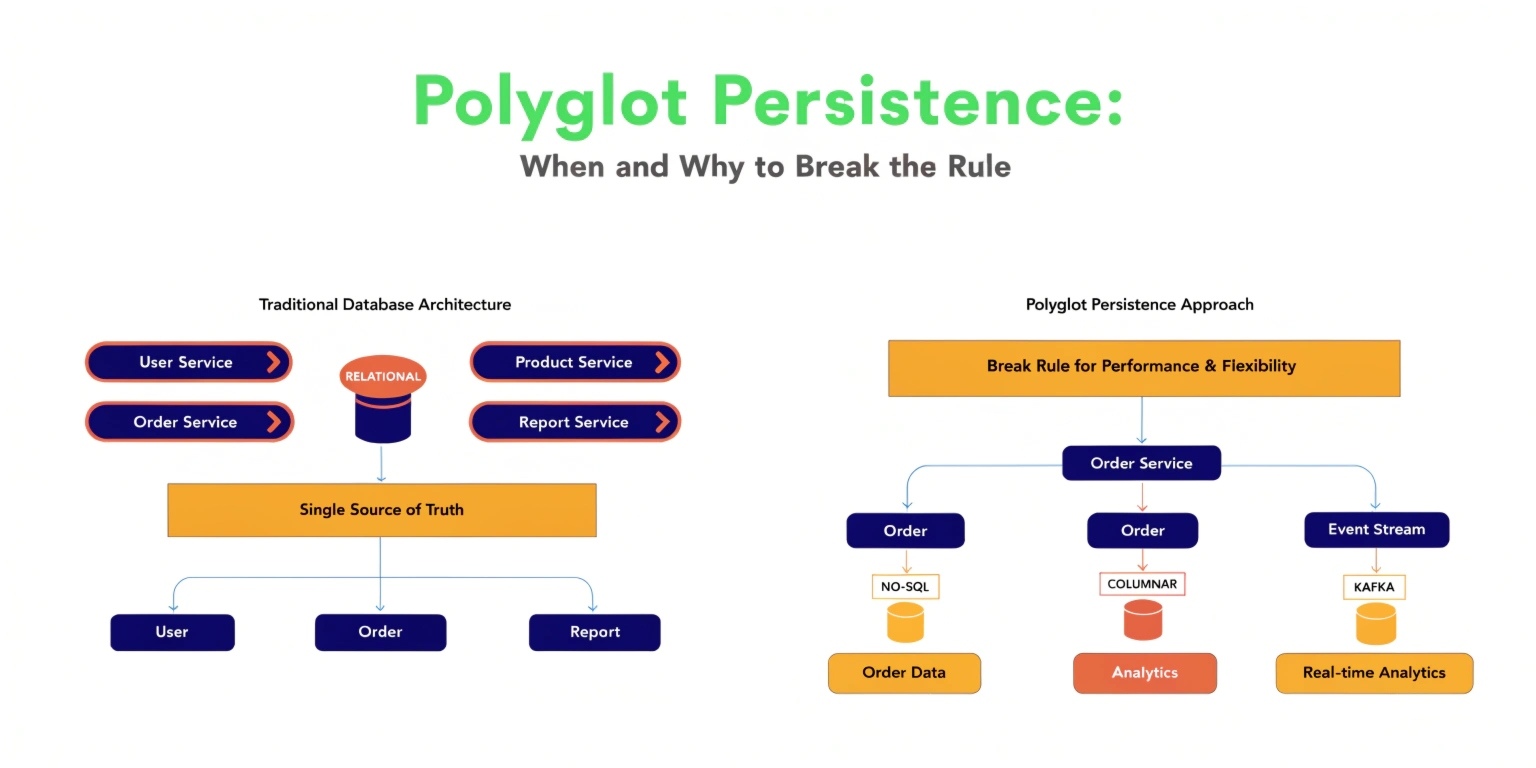
For decades, software architecture followed a simple rule: choose one database and use it everywhere. Whether it was MySQL, PostgreSQL, or Oracle, the idea was consistency, simplicity, and maintainability.
But modern distributed systems have challenged this assumption.
Enter polyglot persistence—an architectural approach where multiple database technologies coexist within a single application ecosystem. Instead of forcing every workload into a relational model, architects select the best storage solution for each specific use case.
The question is not whether polyglot persistence is powerful. It is.
The real question is: When should you break the single-database rule?
Why the Single-Database Approach Fails at Scale
Traditional relational databases are excellent at:
- ACID transactions
- Strong consistency
- Complex joins
- Structured data
However, modern applications require:
- Real-time analytics
- Massive horizontal scalability
- Flexible schemas
- Event streaming
- Graph relationships
- High-speed caching
Trying to solve all these requirements with one database often leads to:
- Performance bottlenecks
- Over-indexing and query complexity
- Vertical scaling limitations
- Operational strain
For example:
- A payment system requires strong transactional guarantees.
- A recommendation engine needs graph traversal.
- A real-time feed requires low-latency key-value access.
- An analytics pipeline benefits from columnar storage.
Forcing all of this into a single relational database creates architectural friction.
What is Polyglot Persistence?
Polyglot persistence means using multiple data storage technologies, each chosen based on workload characteristics.
Common combinations include:
- Relational database for transactional data
- Document database for flexible user profiles
- Graph database for recommendation systems
- Key-value store for caching
- Time-series database for metrics
- Search engine for full-text queries
In microservices architectures, this becomes even more natural. Each service owns its data and can select its storage engine independently.
This aligns well with patterns like:
- CQRS (Command Query Responsibility Segregation)
- Event-driven architecture
- Domain-driven design
When Should You Break the Rule?
Polyglot persistence makes sense when:
1. Workloads Have Fundamentally Different Access Patterns
If one domain requires complex joins and another requires ultra-fast lookups, separating storage engines improves performance dramatically.
2. Scalability Requirements Differ
Some services may need horizontal scalability across regions, while others need strong consistency and transactional safety.
For example:
- Product catalog → Document store
- Orders → Relational database
- Caching → In-memory store
3. Performance Is Business-Critical
At scale, optimizing for milliseconds matters. Using a search engine for search instead of implementing LIKE queries in SQL can reduce response times from seconds to milliseconds.
4. You Are Building a Microservices Architecture
In monoliths, polyglot persistence increases coupling and operational overhead. In microservices, data isolation is already part of the design, making database diversity easier to manage.
When NOT to Use Polyglot Persistence
Breaking the single-database rule introduces complexity. Avoid it when:
- Your application is small or early-stage
- Your team lacks operational maturity
- You do not have clear performance bottlenecks
- Data consistency requirements are extremely strict across domains
More databases mean:
- More backups
- More monitoring
- More failure points
- More DevOps complexity
- Cross-database data consistency challenges
Premature polyglot persistence is architectural overengineering.
Architectural Trade-Offs
Adopting multiple databases introduces important trade-offs:
1. Data Consistency
Maintaining consistency across different databases requires patterns like:
- Event sourcing
- Saga pattern
- Asynchronous messaging
You sacrifice simplicity for flexibility.
2. Operational Overhead
Each database has:
- Different scaling strategies
- Different security configurations
- Different failure modes
Operational excellence becomes mandatory.
3. Increased Learning Curve
Developers must understand multiple query languages, performance tuning methods, and data modeling strategies.
Real-World Pattern: A Scalable E-Commerce System
Consider a large e-commerce platform:
- Orders → Relational DB (ACID compliance)
- Product catalog → Document store (flexible schema)
- Recommendations → Graph database
- Search → Search engine
- Session management → Key-value store
Each system solves a specific problem efficiently. Together, they create a scalable architecture that no single database could handle optimally.
Best Practices for Implementation
If you decide to adopt polyglot persistence:
- Start with a single database. Add others only when justified.
- Ensure clear data ownership per service.
- Avoid cross-database joins.
- Use event-driven communication between services.
- Invest heavily in monitoring and observability.
- Automate backup and disaster recovery strategies.
Polyglot persistence should be driven by measurable requirements, not architectural trends.
Final Thoughts
Polyglot persistence is not about using multiple databases because it sounds modern. It is about selecting the right tool for the right job.
The single-database rule works well—until it doesn’t.
When scale, performance, and domain complexity demand specialization, breaking the rule can unlock massive architectural advantages.
But remember:
Every database you add is a strategic decision, not a technical experiment.
Architect for necessity, not novelty.