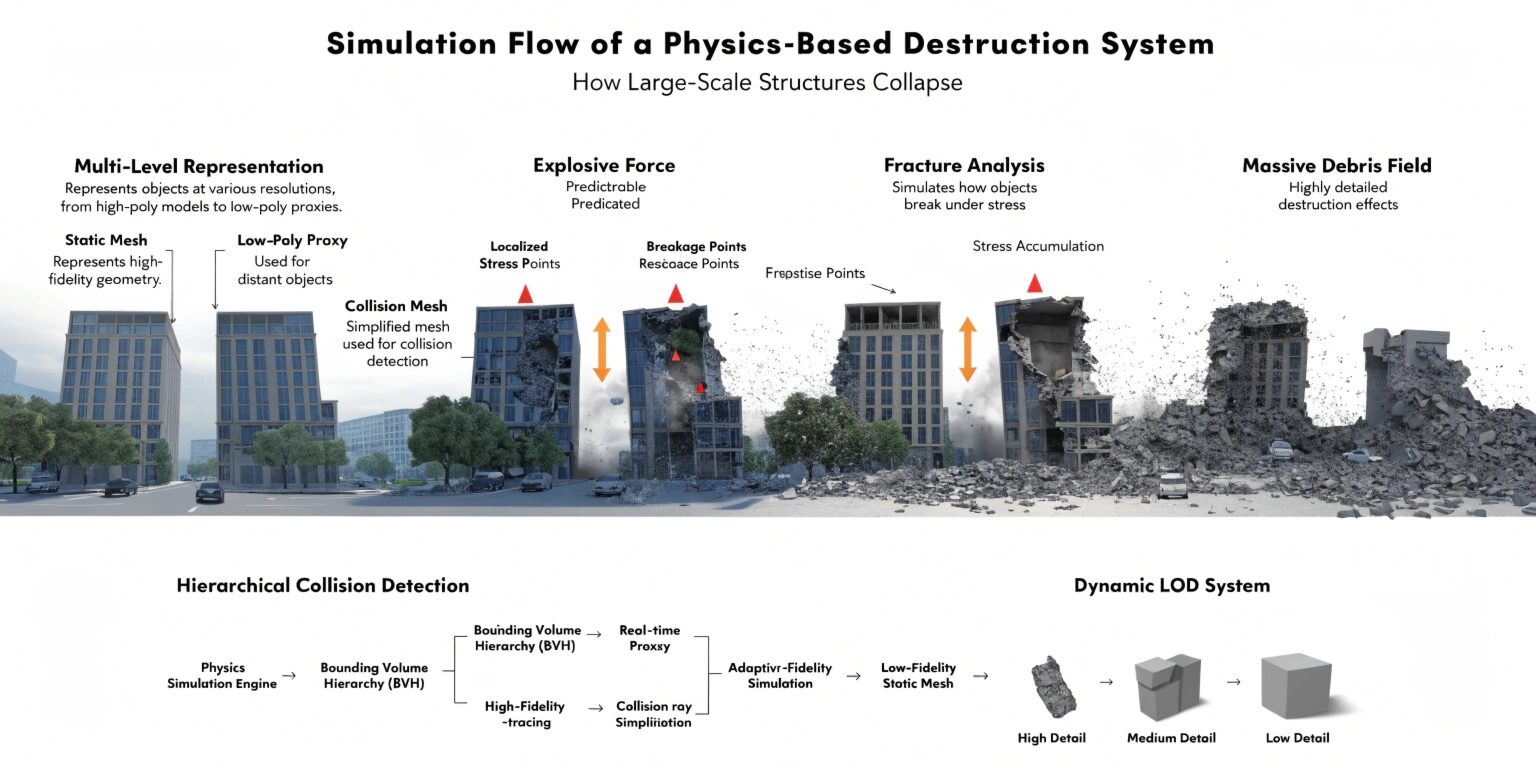
Destruction systems have evolved from simple scripted animations to fully dynamic, physics-driven simulations. Modern players expect buildings to crumble realistically, debris to react naturally, and environments to change dynamically. However, achieving physics-based destruction at scale is one of the most complex challenges in game development.
From indie projects to AAA titles, developers must balance realism with performance, especially when simulating thousands of interacting objects in real time.
What is Physics-Based Destruction?
Physics-based destruction refers to systems where objects break, fracture, and interact based on real-world physics principles rather than pre-defined animations.
These systems rely on:
- Rigid body dynamics
- Collision detection
- Fracture mechanics
- Constraints and forces
Game engines like Unreal Engine (with Chaos Physics) and Unity provide built-in tools for implementing such systems.
Core Components of Destruction Systems
1. Fracture Algorithms
Before destruction occurs, objects are pre-fractured into smaller pieces using algorithms such as:
- Voronoi fracture
- Boolean fragmentation
- Procedural slicing
These techniques determine how objects break under stress.
2. Rigid Body Simulation
Each fragment becomes a rigid body affected by gravity, forces, and collisions. Managing hundreds or thousands of rigid bodies simultaneously is computationally expensive.
3. Collision Detection
Efficient collision systems are critical. Broad-phase and narrow-phase collision detection help reduce unnecessary calculations.
4. Constraints and Joints
Structures like buildings rely on constraints to hold pieces together until a certain force threshold is exceeded.
Challenges of Scaling Destruction Systems
1. Performance Bottlenecks
Simulating thousands of fragments can overwhelm CPU and GPU resources, leading to frame drops.
2. Memory Usage
Each fragment requires memory for physics data, collision meshes, and rendering.
3. Network Synchronization
In multiplayer games, destruction must be synchronized across clients, increasing complexity.
4. Real-Time Constraints
Games must maintain stable frame rates (e.g., 60 FPS), leaving limited time for physics calculations.
Optimization Techniques for Large-Scale Destruction
1. Level of Detail (LOD) for Physics
Just like graphics, physics simulations can use LOD:
- High detail near the player
- Simplified or disabled physics for distant objects
2. Sleeping and Deactivation
Inactive fragments can be put to “sleep” to save computation. Only active objects are simulated.
3. GPU Acceleration
Offloading physics calculations to the GPU significantly improves performance, especially for large-scale simulations.
4. Instancing and Batching
Rendering multiple fragments efficiently reduces draw calls and improves performance.
5. Precomputed vs Real-Time Destruction
Hybrid approaches combine:
- Precomputed fracture patterns
- Real-time physics simulation
This balances realism and performance.
Real-World Game Examples
- Battlefield Series – Large-scale destructible environments
- Rainbow Six Siege – Tactical destruction mechanics
- Control – Real-time physics-heavy environments
These games demonstrate how destruction systems enhance immersion and gameplay.
Design Considerations
1. Gameplay vs Realism
Too much realism can negatively impact gameplay. Designers must balance:
- Visual impact
- Player control
- Performance
2. Predictability
Players should understand how destruction behaves to use it strategically.
3. Artistic Direction
Destruction should align with the game’s visual style and tone.
Future Trends in Destruction Systems
The future of destruction systems lies in:
- Procedural generation for dynamic environments
- Machine learning for realistic fracture prediction
- Cloud-based physics simulation for large-scale multiplayer worlds
- Advanced GPU physics engines
As hardware improves, fully destructible worlds are becoming more feasible.
Best Practices for Developers
- Start with simple prototypes
- Use engine-provided tools before building custom systems
- Profile performance continuously
- Limit the number of active physics objects
- Combine multiple optimization techniques
Conclusion
Physics-based destruction systems bring unparalleled realism and immersion to modern games. However, scaling them efficiently requires a deep understanding of physics simulation, optimization strategies, and system design.
By leveraging techniques like LOD, GPU acceleration, and hybrid simulation models, developers can create stunning destructible environments without compromising performance.
As technology continues to evolve, large-scale, fully dynamic destruction will become a standard feature in next-generation game engines—unlocking new possibilities for gameplay and storytelling.