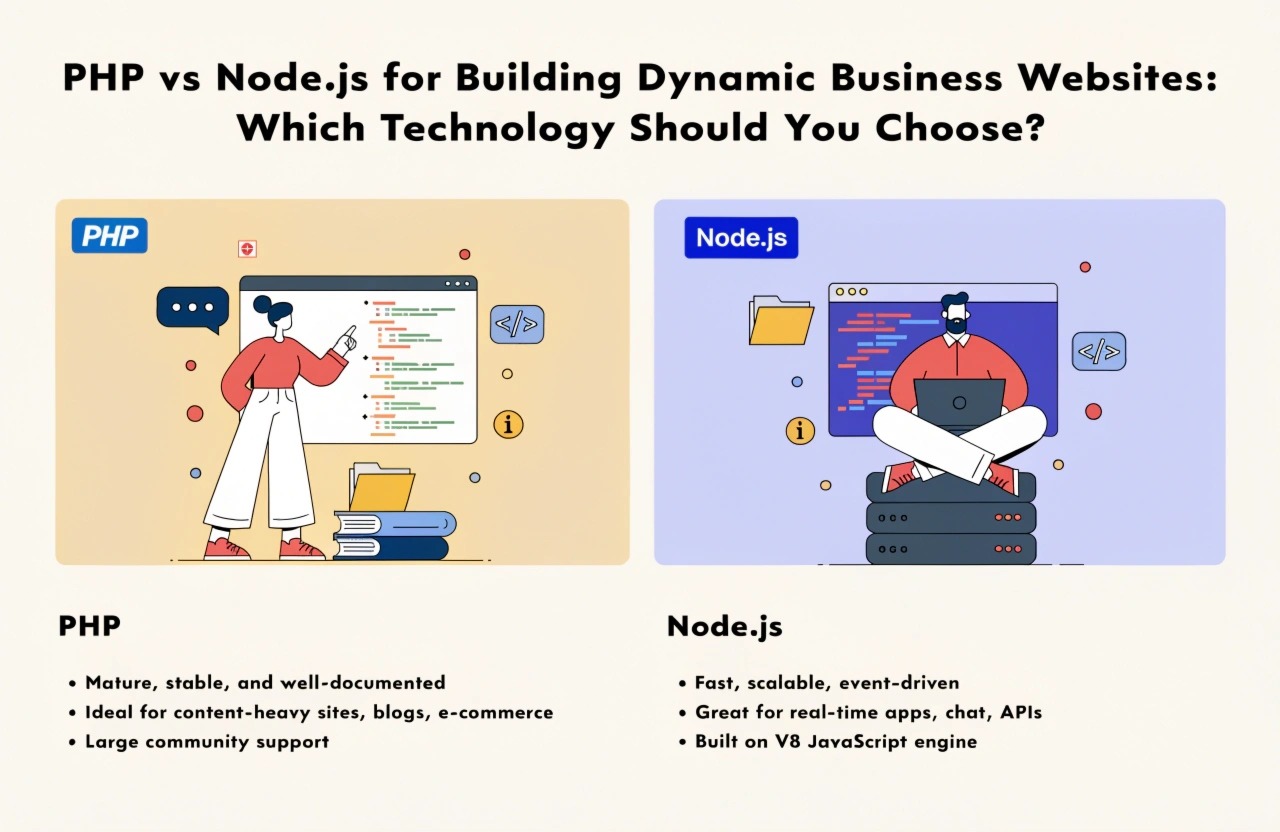
Compare PHP and Node.js for dynamic business websites, including performance, scalability, security, development costs, and SEO. Discover which backend technology best fits your project requirements, budget, and long-term business goals.
PHP vs Node.js for Building Dynamic Business Websites
Building a dynamic business website requires more than an attractive design. Businesses need reliable performance, secure data management, smooth user experiences, and the flexibility to introduce new features as they grow. Choosing the right backend technology is an important decision that affects development time, maintenance costs, and future scalability.
PHP and Node.js are two popular technologies used to build dynamic websites and web applications. Both support database integration, user authentication, content management, and custom business functionality. However, their architectures, development approaches, and ideal use cases differ.
Understanding these differences helps businesses select a technology that aligns with their requirements and long-term objectives.
1. Understanding PHP and Node.js
What Is PHP?
PHP is a server-side scripting language widely used for web development. It processes requests on the server, communicates with databases, and generates dynamic content for website visitors.
PHP powers numerous content-driven websites and platforms. It is commonly used with MySQL and MariaDB databases and supports frameworks such as Laravel and Symfony.
Businesses can use PHP to develop corporate websites, eCommerce platforms, customer portals, booking systems, blogs, and content management solutions. Its mature ecosystem and broad hosting support make it a practical option for many traditional web projects.
What Is Node.js?
Node.js is a JavaScript runtime that allows developers to execute JavaScript outside a web browser. It uses an event-driven, non-blocking I/O model that is particularly useful for handling many concurrent operations involving network requests and databases.
Node.js is commonly used with frameworks and libraries such as Express.js and NestJS. It can work with databases including PostgreSQL, MySQL, and MongoDB.
Businesses often choose Node.js for APIs, interactive dashboards, real-time applications, and systems that need to process frequent client-server communication.
2. Performance and Website Speed
Website performance influences user experience, engagement, and conversion rates. Both PHP and Node.js can deliver fast websites when developers use suitable architecture, caching, efficient database queries, and optimized code.
PHP performs well for many request-response applications, including corporate websites, product catalogs, and content management systems. Modern PHP versions, supported by appropriate server configurations and tools such as OPcache, can provide strong performance.
Node.js handles I/O-heavy operations efficiently through its non-blocking architecture. This can be advantageous for websites involving live notifications, frequent API requests, chat features, or continuously updated dashboards.
However, Node.js does not automatically make every website faster. CPU-intensive tasks can block its event loop unless they are appropriately offloaded or distributed.
Which is better? PHP is an excellent choice for many content-focused business websites, while Node.js can be particularly suitable for applications with extensive concurrent I/O and real-time interactions.
3. Scalability and Future Growth
Scalability determines how easily a website can accommodate more users, data, and functionality as a business expands.
PHP applications can scale through load balancing, caching, database optimization, and additional application servers. Frameworks such as Laravel provide structured development practices that help teams maintain larger projects.
Node.js applications can also scale horizontally by running multiple application instances behind a load balancer. Its asynchronous architecture can be useful for applications that handle numerous simultaneous connections.
The best approach depends on application design, infrastructure, database performance, and workload patterns.
For example, a company website that primarily publishes services and receives enquiries may work efficiently with PHP. A customer support platform featuring live chat, instant updates, and real-time notifications may benefit from Node.js.
4. Development Cost and Time
Development costs depend on project complexity, required integrations, developer availability, infrastructure, and ongoing maintenance—not just the programming language.
PHP can be cost-effective for business websites because of its established hosting ecosystem, extensive documentation, and mature content management options. Laravel can accelerate the development of custom features through reusable components and built-in tools.
Node.js may reduce development complexity when a team already uses JavaScript across its frontend and backend. Sharing language knowledge and some validation logic can simplify collaboration, although frontend and backend code still require appropriate separation and testing.
Businesses should compare the total cost of ownership, including development, hosting, security updates, testing, and future enhancements.
5. Security and Database Integration
Security is essential for websites handling customer information, enquiries, transactions, or employee records.
PHP frameworks such as Laravel provide features that help developers implement authentication, validation, CSRF protection, and secure password handling. Node.js applications can achieve comparable security using appropriate frameworks, maintained dependencies, authentication libraries, and secure configuration.
Neither technology is automatically secure. Developers must prevent SQL injection, cross-site scripting, unauthorized access, and exposure of sensitive information. Regular updates, access controls, HTTPS, and security testing are equally important.
Both technologies support relational databases and other storage systems. PHP frequently appears in MySQL-based projects, while Node.js supports relational and NoSQL databases. The final choice should reflect the application's data structure and consistency requirements.
6. SEO and Business Website Requirements
Search engine optimization is important for businesses that depend on organic traffic and online visibility.
PHP can generate HTML on the server, making it straightforward to deliver crawlable content, page titles, metadata, and structured data. Node.js can also support server-side rendering and pre-rendering through suitable application frameworks and architectures.
Neither PHP nor Node.js guarantees better search rankings. Search visibility depends on content quality, technical SEO, page performance, mobile usability, internal linking, and other ranking factors.
For service websites, company profiles, landing pages, and blogs, businesses should prioritize accessible content, clear navigation, fast loading, and a well-structured website regardless of the backend technology.
7. Which Technology Should Your Business Choose?
Choose PHP when you need a content-focused business website, an established CMS, a Laravel-based application, or a practical solution with broad hosting compatibility.
Choose Node.js when you need real-time communication, API-heavy applications, frequent asynchronous operations, or a JavaScript-centered development environment.
For example, a corporate website with service pages, a blog, and a contact form could be built effectively with PHP. An online collaboration platform with live updates and messaging may be better suited to Node.js.
Before deciding, define your functional requirements, expected traffic, integrations, security needs, budget, and maintenance plan. Evaluate the experience of your development team and consider how the application may evolve over the next several years.
Conclusion
PHP and Node.js are both capable technologies for building modern, dynamic business websites. PHP offers a mature ecosystem and practical advantages for content-driven projects, while Node.js provides an event-driven architecture that can suit real-time and I/O-intensive applications.
There is no universal winner. The right technology is the one that meets your business requirements, fits your budget, and supports reliable long-term maintenance.
Working with an experienced web development team can help you evaluate the available options and build a secure, scalable, and user-friendly website that supports your business growth.
We build scalable web, mobile, and game products for clients worldwide — combining modern frameworks, cloud infrastructure, and best engineering practices.
.jpg)
.jpg)
.jpg)