Website performance is more important than ever in 2027, and PHP continues to power millions of modern web applications. This guide explores essential PHP performance optimization techniques, including OPcache, Redis caching, database optimization, asynchronous processing, PHP 8+ improvements, and cloud-native practices. Learn practical strategies that help developers build faster, scalable, and high-performing PHP applications while improving user experience and search engine rankings.
PHP Performance Optimization Techniques Every Developer Should Know in 2027
PHP has evolved significantly over the years and remains one of the most widely used programming languages for web development. Thanks to PHP 8.x enhancements, JIT compilation, asynchronous processing, and better cloud integration, developers in 2027 have access to powerful tools for building high-performance applications.
However, simply using the latest PHP version isn't enough. Performance optimization requires a combination of coding best practices, server configuration, database tuning, and caching strategies. Here are the most important techniques every PHP developer should implement.
1. Always Use the Latest Stable PHP Version
Every major PHP release introduces performance improvements, memory optimizations, and security enhancements.
Modern PHP versions offer:
- Faster execution
- Better memory management
- Improved Just-In-Time (JIT) compilation
- Enhanced error handling
- Optimized object-oriented performance
Running outdated PHP versions can reduce application performance by a significant margin while increasing security risks.
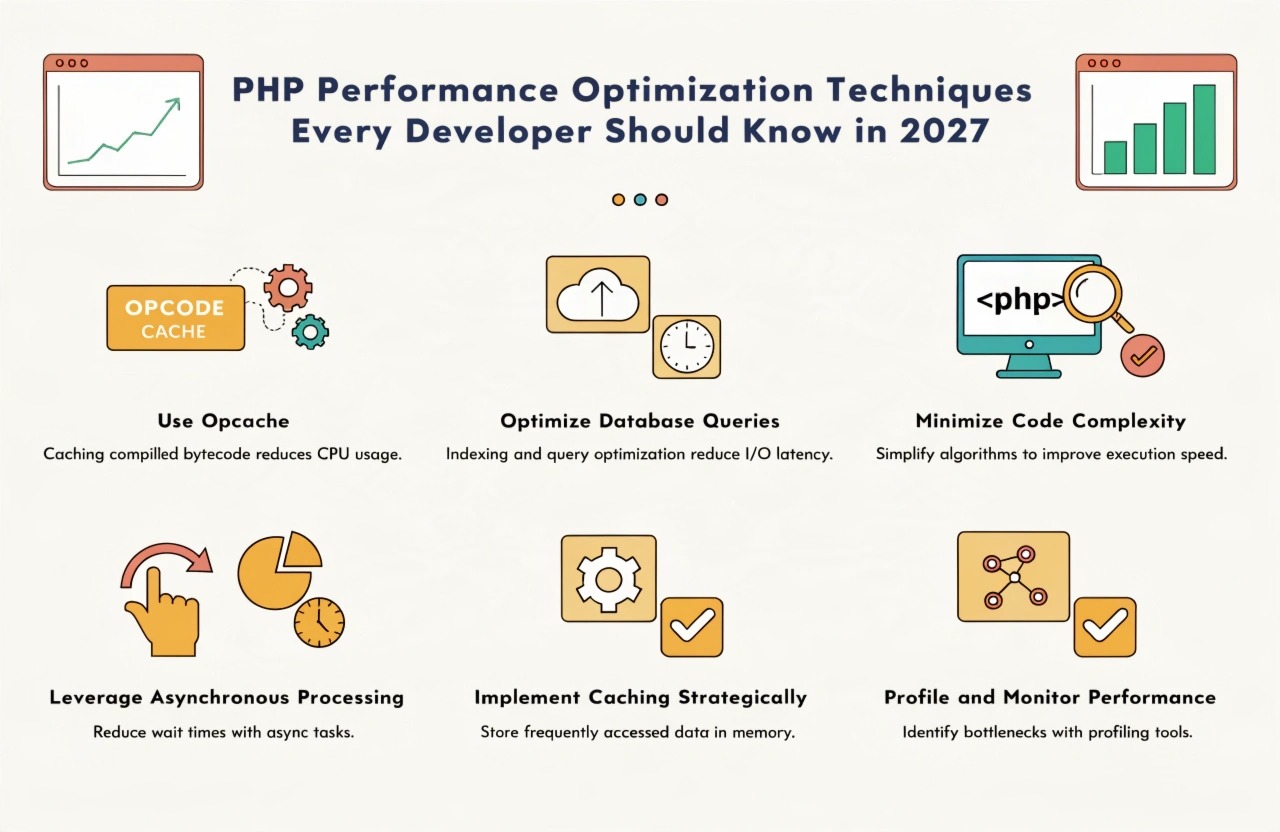
2. Enable OPcache
One of the simplest ways to improve PHP performance is enabling OPcache.
Instead of compiling PHP scripts during every request, OPcache stores compiled bytecode in memory.
Benefits include:
- Faster execution
- Lower CPU usage
- Reduced response time
- Better scalability
Every production PHP server should have OPcache enabled and properly configured.
3. Implement Smart Caching
Caching eliminates unnecessary processing and database queries.
Popular caching solutions include:
- Redis
- Memcached
- APCu
- Browser caching
- Full-page caching
- Object caching
Applications using Redis often experience dramatic improvements in response times because frequently requested data is served directly from memory instead of being regenerated.
4. Optimize Database Queries
Database bottlenecks remain one of the biggest causes of slow PHP applications.
Best practices include:
- Create proper indexes
- Avoid SELECT *
- Use prepared statements
- Optimize JOIN operations
- Limit unnecessary queries
- Implement pagination
- Cache expensive queries
Monitoring slow query logs helps identify performance issues before users notice them.
5. Minimize HTTP Requests
Even a fast backend suffers if pages load dozens of unnecessary resources.
Reduce requests by:
- Combining CSS files
- Combining JavaScript files
- Compressing images
- Using SVG icons
- Lazy loading images
- Removing unused assets
Smaller pages improve Core Web Vitals and overall user experience.
6. Use Asynchronous Processing
Modern PHP applications increasingly rely on asynchronous processing for long-running tasks.
Examples include:
- Email sending
- Image processing
- PDF generation
- Video conversion
- Notification systems
- Background jobs
Queue systems like Laravel Queue, RabbitMQ, or Redis Queue keep web requests fast by moving heavy tasks into background workers.
7. Profile Your Application
Optimization should always be data-driven.
Use profiling tools such as:
- Xdebug
- Blackfire
- Tideways
- Laravel Telescope
Profiling helps identify:
- Slow functions
- Memory leaks
- Database bottlenecks
- Expensive loops
- API latency
Rather than guessing where the issue lies, developers can focus on measurable improvements.
8. Optimize Composer Dependencies
Large projects often include unnecessary packages that increase loading time.
Developers should:
- Remove unused libraries
- Update dependencies regularly
- Optimize Composer autoloading
- Use authoritative class maps in production
Keeping dependencies lean reduces memory usage and improves startup performance.
9. Optimize Memory Usage
Efficient memory management is increasingly important for scalable cloud applications.
Tips include:
- Unset unused variables
- Stream large files instead of loading them into memory
- Use generators for large datasets
- Avoid unnecessary object creation
- Reuse resources whenever possible
Lower memory consumption allows servers to handle more concurrent users.
10. Leverage Content Delivery Networks (CDNs)
Static assets should never overload your application server.
Using a CDN helps deliver:
- Images
- CSS
- JavaScript
- Fonts
- Videos
Benefits include:
- Reduced latency
- Faster global access
- Lower bandwidth costs
- Improved reliability
CDNs have become standard for enterprise PHP applications.
11. Optimize API Performance
Modern PHP applications are increasingly API-driven.
Improve API performance by:
- Compressing JSON responses
- Using pagination
- Implementing response caching
- Limiting unnecessary fields
- Applying rate limiting
- Using HTTP/2 or HTTP/3
Fast APIs enhance both frontend performance and third-party integrations.
12. Monitor Application Performance Continuously
Performance optimization is an ongoing process.
Developers should monitor:
- Server response time
- CPU utilization
- Memory consumption
- Database performance
- Cache hit rates
- Error logs
- API response times
Continuous monitoring enables proactive issue resolution before users experience slowdowns.
The Future of PHP Performance
In 2027, PHP is more powerful than ever. AI-assisted code optimization, edge computing, serverless deployments, containerized environments, and cloud-native architectures are transforming how PHP applications are built and optimized.
Frameworks like Laravel and Symfony continue to embrace these advancements, making high-performance development more accessible than ever. Developers who combine modern PHP features with effective caching, database optimization, and infrastructure best practices can deliver applications that are fast, scalable, and ready for future demands.
Conclusion
Performance is no longer optional—it's a critical factor in user satisfaction, SEO, and business success. By upgrading to the latest PHP version, enabling OPcache, implementing intelligent caching, optimizing database queries, leveraging asynchronous processing, and continuously monitoring performance, developers can build applications that meet the expectations of modern users.
Mastering these optimization techniques in 2027 will help developers create responsive, efficient, and scalable PHP applications that stand out in an increasingly competitive digital landscape.
We build scalable web, mobile, and game products for clients worldwide — combining modern frameworks, cloud infrastructure, and best engineering practices.
.jpg)
.jpg)
.jpg)