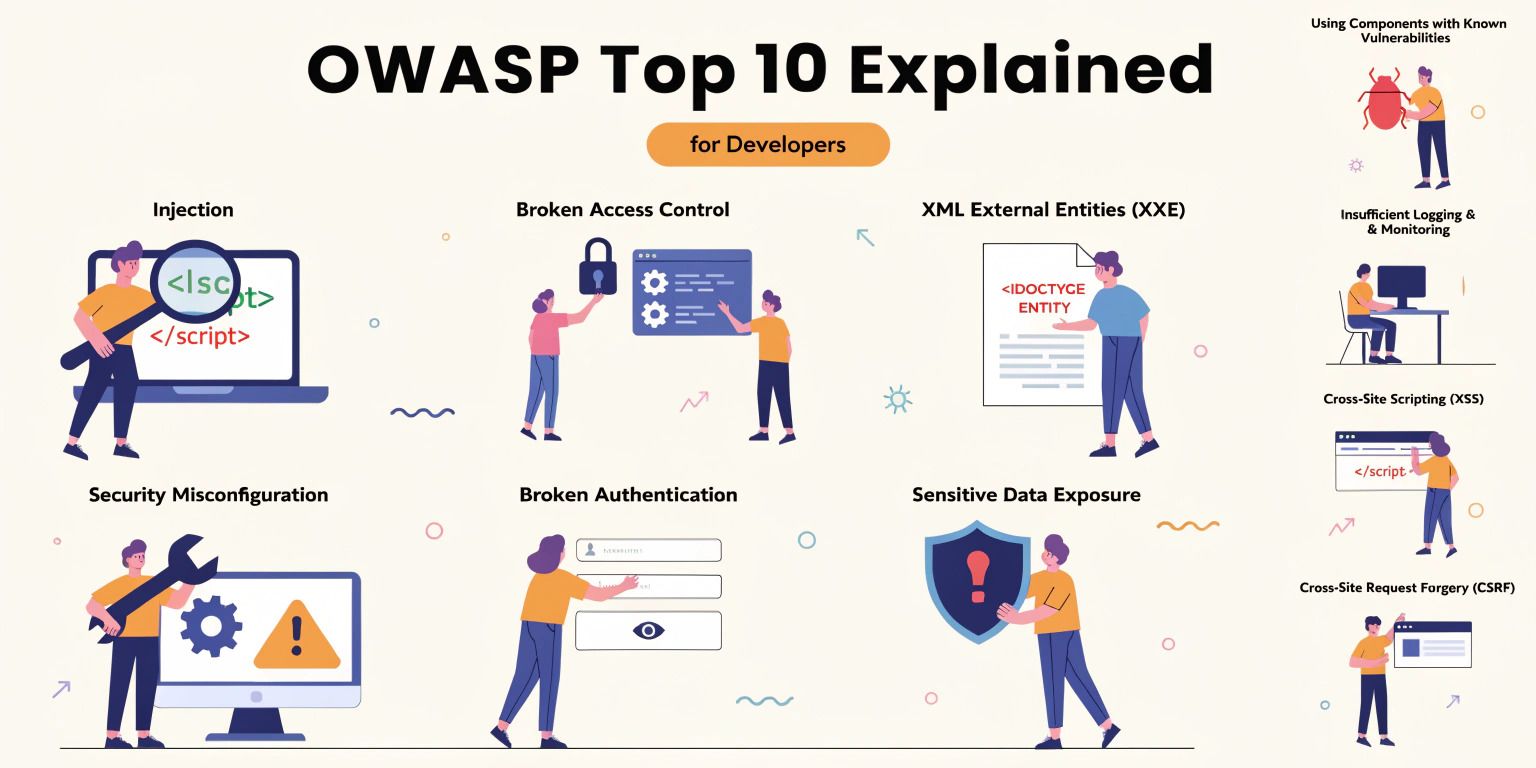
The OWASP Top 10 highlights major web application security risks developers should understand. From broken access control and injection to insecure design and vulnerable dependencies, learning these risks helps development teams build, test, and maintain more secure applications.
Web applications process sensitive information such as customer accounts, payment details, personal data, business information, and authentication credentials. A single security weakness can expose this information or allow attackers to manipulate application functionality.
The OWASP Top 10 is one of the most widely recognized resources for understanding critical web application security risks. Published by the Open Worldwide Application Security Project, it provides developers and security teams with a practical framework for identifying common application security problems.
Understanding the OWASP Top 10 is not only useful for security professionals. Developers can use it throughout the software development lifecycle to build more secure applications.
1. Broken Access Control
Broken access control occurs when users can perform actions or access resources they should not be authorized to access.
For example, a normal user might change an account ID in a URL and access another customer's information.
Developers should enforce authorization on the server side for every sensitive operation.
Access control should follow the principle of least privilege, ensuring users and services receive only the permissions they actually need.
2. Cryptographic Failures
Cryptographic failures occur when sensitive information is not adequately protected.
Examples include storing passwords in plain text, transmitting sensitive data without appropriate encryption, or using weak cryptographic algorithms.
Developers should use established cryptographic libraries and appropriate encryption protocols rather than creating custom encryption systems.
Passwords should be securely hashed using modern password-hashing algorithms, and sensitive data should be protected both in transit and where appropriate at rest.
3. Injection
Injection vulnerabilities occur when untrusted input is interpreted as commands or queries.
SQL injection is one of the best-known examples.
Instead of directly inserting user input into database queries, developers should use parameterized queries or prepared statements.
Input validation and safe APIs can provide additional protection.
Injection can also affect other technologies, including operating system commands, NoSQL databases, LDAP queries, and template engines.
4. Insecure Design
Security problems can originate during the design stage rather than only through coding mistakes.
An application may technically work as intended while having an insecure business workflow.
Developers and architects should perform threat modeling and identify abuse cases before implementation.
Security requirements should be considered alongside functional requirements during system design.
5. Security Misconfiguration
Security misconfiguration happens when applications, servers, cloud services, frameworks, or databases are configured insecurely.
Examples include unnecessary services, default credentials, verbose error messages, exposed administrative interfaces, and improperly configured cloud storage.
Teams should use secure defaults, remove unnecessary components, regularly review configurations, and avoid exposing sensitive information through error responses.
6. Vulnerable and Outdated Components
Modern applications rely heavily on third-party libraries, frameworks, packages, containers, and external services.
A vulnerability in one dependency can potentially affect the entire application.
Developers should maintain an inventory of dependencies, monitor security advisories, apply security updates, and remove unnecessary packages.
Software composition analysis can help organizations identify known vulnerabilities in third-party components.
7. Identification and Authentication Failures
Authentication weaknesses can allow attackers to compromise user accounts.
Examples include weak passwords, poor session management, missing multi-factor authentication, predictable credentials, and insecure password recovery mechanisms.
Applications should implement secure authentication frameworks, protect sessions, apply appropriate rate limiting, and provide strong account recovery processes.
Multi-factor authentication can provide an additional layer of protection for sensitive applications.
8. Software and Data Integrity Failures
Software and data integrity failures involve trusting code, packages, updates, or data without properly verifying their integrity.
Modern applications often depend on automated build pipelines, package repositories, CI/CD systems, and external components.
Developers should use trusted sources, verify package integrity where appropriate, protect build pipelines, and restrict who can modify production artifacts.
9. Security Logging and Monitoring Failures
Security controls are less effective when organizations cannot detect suspicious activity.
Applications should generate useful security logs for events such as authentication failures, privilege changes, suspicious requests, and important administrative operations.
Logs should be protected from unauthorized modification and monitored for unusual patterns.
Effective monitoring can help security teams detect attacks and investigate incidents more quickly.
10. Server-Side Request Forgery
Server-Side Request Forgery, commonly known as SSRF, occurs when an attacker can manipulate a server into making requests to unintended destinations.
This can potentially expose internal services or sensitive resources.
Developers should validate and restrict user-controlled URLs, use allowlists where practical, restrict network access from application servers, and carefully handle redirects.
Cloud environments require additional attention because internal metadata services can sometimes contain sensitive information.
Integrating OWASP Into Development
Security should not be treated as a final testing phase.
Development teams can integrate OWASP principles throughout the software lifecycle:
Planning → Threat Modeling → Secure Coding → Code Review → Security Testing → Deployment → Monitoring
Security testing can include static analysis, dependency scanning, dynamic application testing, penetration testing, and manual security reviews.
Why Developers Should Learn OWASP Top 10
The OWASP Top 10 gives developers a common security vocabulary and highlights areas that deserve attention during application development.
Understanding these risks can help developers recognize vulnerabilities earlier and avoid introducing common security weaknesses into production systems.
However, the OWASP Top 10 should be treated as an awareness and risk-prioritization resource rather than a complete security checklist.
Conclusion
The OWASP Top 10 provides developers with a practical foundation for understanding common web application security risks.
Broken access control, cryptographic failures, injection, insecure design, misconfiguration, vulnerable components, authentication weaknesses, integrity failures, logging gaps, and SSRF can all create significant security risks when they are not properly addressed.
The best security strategy is proactive. By integrating secure design, secure coding, dependency management, automated testing, threat modeling, and continuous monitoring into the development lifecycle, teams can reduce vulnerabilities and build applications that are more resilient against modern attacks.
We build scalable web, mobile, and game products for clients worldwide — combining modern frameworks, cloud infrastructure, and best engineering practices.
.jpg)
.jpg)
.jpg)