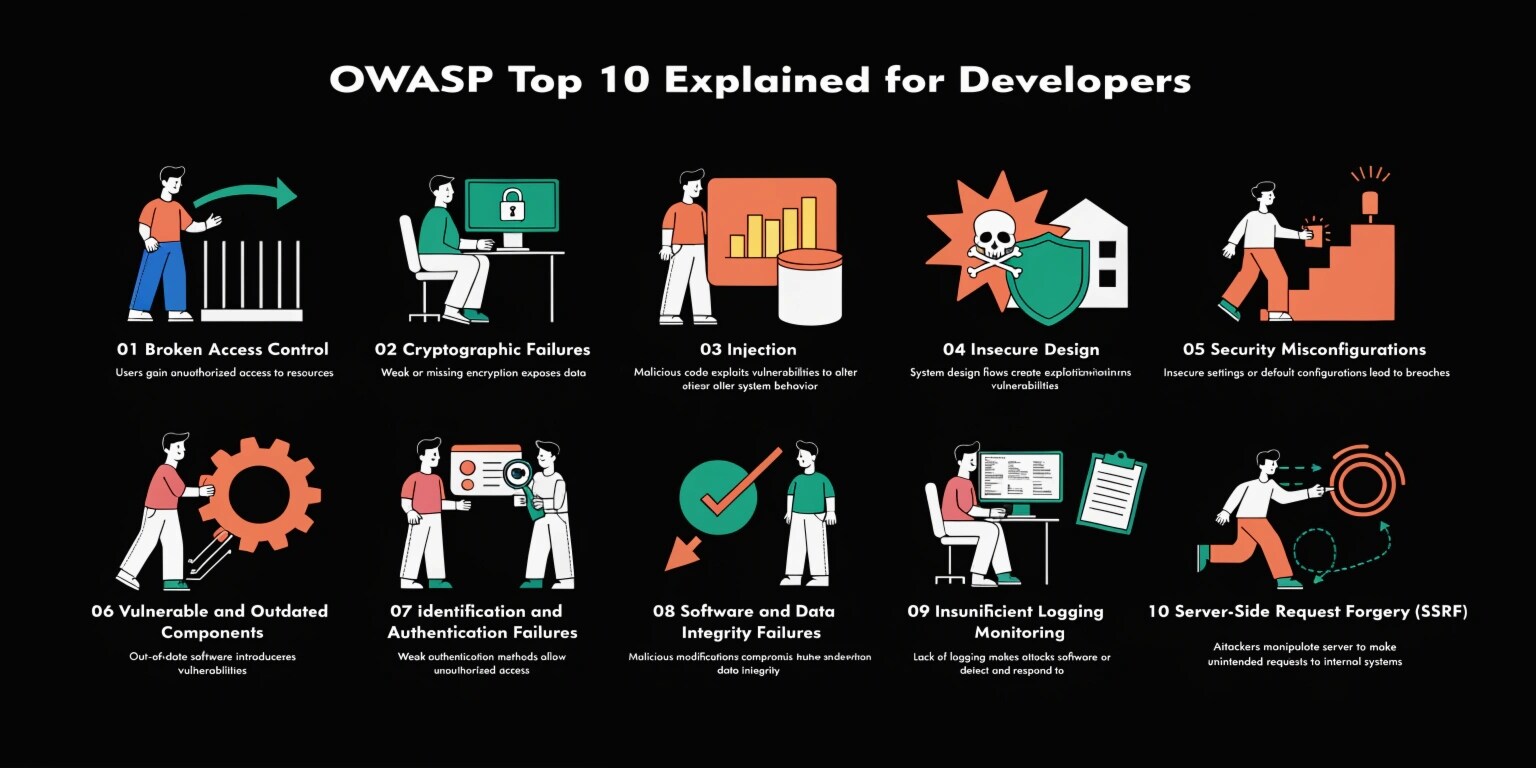
This blog explains the OWASP Top 10 security risks for developers, covering common vulnerabilities and best practices to build secure web applications and protect user data.
In today’s digital world, security is no longer optional—it’s essential. As applications become more complex and interconnected, they also become more vulnerable to cyber threats. To help developers build secure systems, the OWASP publishes a list of the most critical web application security risks known as the OWASP Top 10.
Understanding these vulnerabilities is crucial for developers aiming to create secure, reliable applications.
What is OWASP Top 10?
The OWASP Top 10 is a regularly updated list of the most critical security risks to web applications. It serves as a standard awareness document for developers, security professionals, and organizations.
The list highlights common vulnerabilities and provides guidance on how to mitigate them.
Overview of OWASP Top 10 Risks
Let’s break down the key risks developers should understand:
1. Broken Access Control
This occurs when users can access data or perform actions beyond their permissions.
Example:
A user accessing another user’s account data by modifying a URL.
Prevention:
- Implement role-based access control
- Validate permissions on the server side
2. Cryptographic Failures
Previously known as “Sensitive Data Exposure,” this risk involves improper protection of sensitive data.
Example:
Storing passwords in plain text.
Prevention:
- Use strong encryption algorithms
- Enforce HTTPS
- Secure data at rest and in transit
3. Injection Attacks
Injection flaws occur when untrusted data is sent to an interpreter.
Example:
SQL Injection allowing attackers to manipulate database queries.
Prevention:
- Use parameterized queries
- Validate and sanitize inputs
4. Insecure Design
This refers to flaws in application architecture rather than implementation.
Example:
Lack of security controls in system design.
Prevention:
- Adopt secure design principles
- Perform threat modeling
5. Security Misconfiguration
Improper configuration of servers, frameworks, or applications can expose vulnerabilities.
Example:
Leaving default credentials unchanged.
Prevention:
- Disable unnecessary features
- Regularly update and patch systems
6. Vulnerable and Outdated Components
Using outdated libraries or frameworks can introduce known vulnerabilities.
Example:
Running an old version of a library with known exploits.
Prevention:
- Regularly update dependencies
- Use vulnerability scanning tools
7. Identification and Authentication Failures
Weak authentication mechanisms can allow attackers to compromise accounts.
Example:
Poor password policies or lack of multi-factor authentication.
Prevention:
- Implement strong authentication
- Use MFA (Multi-Factor Authentication)
8. Software and Data Integrity Failures
This involves failures in ensuring the integrity of software and data.
Example:
Using unverified updates or plugins.
Prevention:
- Use trusted sources
- Implement integrity checks
9. Security Logging and Monitoring Failures
Without proper logging, detecting and responding to attacks becomes difficult.
Example:
No logs for suspicious login attempts.
Prevention:
- Enable detailed logging
- Monitor and analyze logs regularly
10. Server-Side Request Forgery (SSRF)
SSRF allows attackers to make requests from the server to internal resources.
Example:
Accessing internal APIs through manipulated URLs.
Prevention:
- Validate and sanitize URLs
- Restrict outbound requests
Why Developers Should Care
Ignoring security risks can lead to:
- Data breaches
- Financial losses
- Reputation damage
- Legal consequences
By understanding the OWASP Top 10, developers can proactively secure applications and reduce vulnerabilities.
Best Practices for Secure Development
To build secure applications:
- Follow secure coding standards
- Perform regular security testing
- Use automated security tools
- Implement DevSecOps practices
- Educate teams on security awareness
Security should be integrated into every stage of development, not treated as an afterthought.
Conclusion
The OWASP Top 10 provides a valuable roadmap for developers to understand and mitigate the most critical security risks. By addressing these vulnerabilities, developers can build safer, more reliable applications.
In an era where cyber threats are constantly evolving, staying informed and proactive is the key to protecting both users and businesses. Security is not just a feature—it’s a responsibility.
We build scalable web, mobile, and game products for clients worldwide — combining modern frameworks, cloud infrastructure, and best engineering practices.
.jpg)
.jpg)
.jpg)