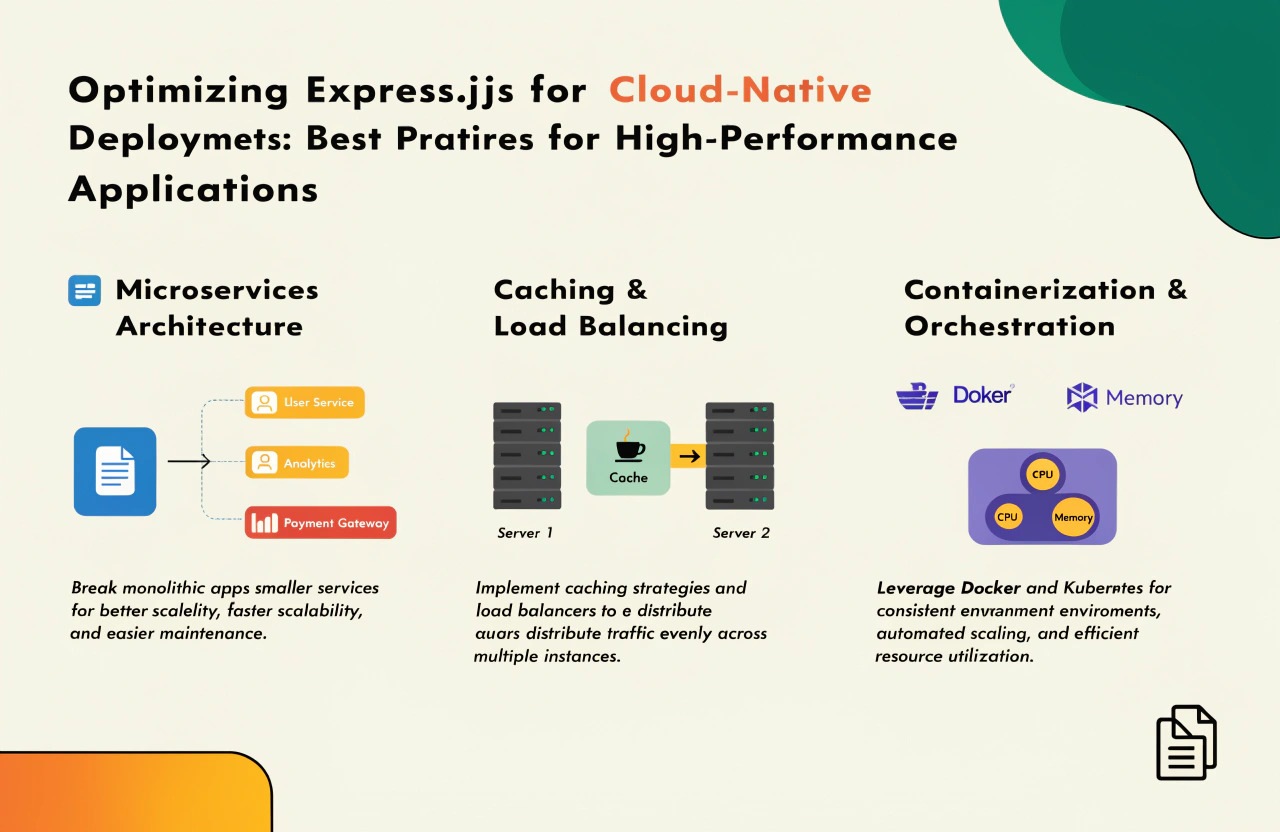
Optimizing Express.js for Cloud-Native Deployments
Modern businesses expect applications to be scalable, highly available, and capable of handling unpredictable traffic. Cloud-native architecture enables developers to build applications that automatically scale, recover from failures, and integrate seamlessly with modern infrastructure.
Express.js remains one of the most popular Node.js frameworks because of its simplicity, flexibility, and extensive ecosystem. However, simply deploying an Express.js application to the cloud is not enough. Without proper optimization, applications may suffer from poor performance, increased costs, and limited scalability.
Let's explore the best practices for optimizing Express.js applications for cloud-native deployments.
1. Containerize Your Application with Docker
Docker is the foundation of cloud-native development.
Packaging an Express.js application into a container ensures consistency across development, testing, and production environments.
Benefits include:
- Consistent deployments
- Easy scaling
- Faster releases
- Simplified dependency management
- Platform independence
A lightweight Docker image using Node.js Alpine significantly reduces deployment size and startup time.
2. Design Stateless Applications
Cloud-native applications should never depend on local server storage.
Instead of storing:
- User sessions
- Uploaded files
- Cache
- Authentication tokens
Use cloud services such as:
- Redis
- Object Storage
- Cloud Databases
Stateless applications make horizontal scaling effortless because any instance can serve any incoming request.
3. Enable Horizontal Scaling
Express.js applications work exceptionally well behind load balancers.
Instead of increasing server resources vertically, create multiple instances.
Advantages include:
- High availability
- Better fault tolerance
- Increased request capacity
- Reduced downtime
Platforms like Kubernetes automatically add or remove containers based on traffic.
4. Use Reverse Proxies
Running Express.js directly on the internet is not recommended.
A reverse proxy such as Nginx provides:
- SSL termination
- Static file serving
- Request buffering
- Compression
- Load balancing
- Security filtering
This reduces workload on the Express server while improving performance.
5. Implement Efficient Caching
Database queries often become the biggest bottleneck.
Use Redis to cache:
- Frequently requested APIs
- User profiles
- Product information
- Dashboard statistics
- Authentication data
Benefits include:
- Faster responses
- Lower database load
- Better scalability
- Improved user experience
Even a few milliseconds saved per request significantly improves overall performance.
6. Optimize Database Queries
Cloud-native performance depends heavily on efficient database communication.
Best practices include:
- Database indexing
- Query optimization
- Connection pooling
- Pagination
- Lazy loading
- Avoiding unnecessary joins
Using an ORM wisely while writing optimized queries ensures lower response times.
7. Compress API Responses
Enable Gzip or Brotli compression.
Smaller payloads mean:
- Faster downloads
- Reduced bandwidth
- Improved mobile performance
- Lower cloud networking costs
Express middleware makes enabling compression straightforward.
8. Secure APIs
Security should be integrated into every deployment.
Recommended middleware includes:
- Helmet
- Rate limiting
- CORS configuration
- Input validation
- JWT authentication
- HTTPS enforcement
Protecting APIs against common vulnerabilities improves reliability and customer trust.
9. Monitor Application Performance
Cloud-native applications require continuous monitoring.
Track metrics such as:
- CPU usage
- Memory consumption
- Response times
- API latency
- Error rates
- Database performance
Monitoring tools provide alerts before small issues become production outages.
10. Use Kubernetes for Orchestration
Kubernetes automates application deployment and scaling.
Key advantages include:
- Auto-scaling
- Rolling updates
- Self-healing containers
- Service discovery
- Load balancing
- Resource optimization
Express.js applications running inside Kubernetes clusters can handle millions of requests efficiently.
11. Configure Health Checks
Cloud platforms constantly verify application health.
Implement:
- Liveness probes
- Readiness probes
- Startup probes
Health endpoints allow orchestration platforms to restart unhealthy containers automatically.
12. Automate CI/CD Pipelines
Modern deployments rely on continuous integration and continuous delivery.
A CI/CD pipeline should:
- Run automated tests
- Perform code quality checks
- Build Docker images
- Deploy automatically
- Roll back failed releases
Automation minimizes human errors while accelerating software delivery.
13. Manage Environment Variables Securely
Avoid hardcoding:
- API keys
- Database credentials
- Secret tokens
- Third-party configurations
Use secure secret management systems offered by cloud providers to protect sensitive information.
14. Optimize Logging
Effective logging helps identify production issues quickly.
Store logs centrally instead of locally.
Important logs include:
- API requests
- Authentication events
- Exceptions
- Database errors
- System performance
Structured logging simplifies troubleshooting across distributed systems.
15. Adopt Microservices When Appropriate
Large applications often benefit from splitting functionality into independent services.
Examples:
- Authentication Service
- Payment Service
- Notification Service
- Inventory Service
- User Service
Each service can scale independently, reducing infrastructure costs while improving maintainability.
Performance Optimization Tips
For maximum Express.js performance:
- Use asynchronous programming wherever possible.
- Avoid blocking operations in request handlers.
- Optimize middleware execution order.
- Minimize unnecessary dependencies.
- Enable HTTP Keep-Alive.
- Use clustering for multi-core CPUs.
- Optimize JSON serialization.
- Remove unused routes and middleware.
- Implement graceful shutdown handling.
- Benchmark APIs regularly.
These small improvements collectively create significant performance gains under heavy workloads.
Conclusion
Cloud-native deployment transforms how Express.js applications are built, deployed, and maintained. By combining Docker, Kubernetes, caching, load balancing, monitoring, security, and automated CI/CD pipelines, developers can build backend services that are fast, resilient, and highly scalable.
As organizations increasingly adopt cloud-first strategies, optimizing Express.js for cloud-native environments is no longer optional—it is essential. Following these best practices helps reduce operational costs, improve user experience, and ensure applications remain reliable even during periods of high demand.