Optical Character Recognition (OCR) has become a cornerstone of modern automation, enabling machines to extract text from images, scanned documents, and handwritten notes. From digitizing paper records to automating invoice processing, OCR pipelines play a vital role in data-driven systems.
Two dominant approaches define the OCR landscape today: traditional engines like Tesseract and modern deep learning-based OCR systems. Understanding their differences is crucial for building efficient and scalable solutions.
What Is an OCR Pipeline?
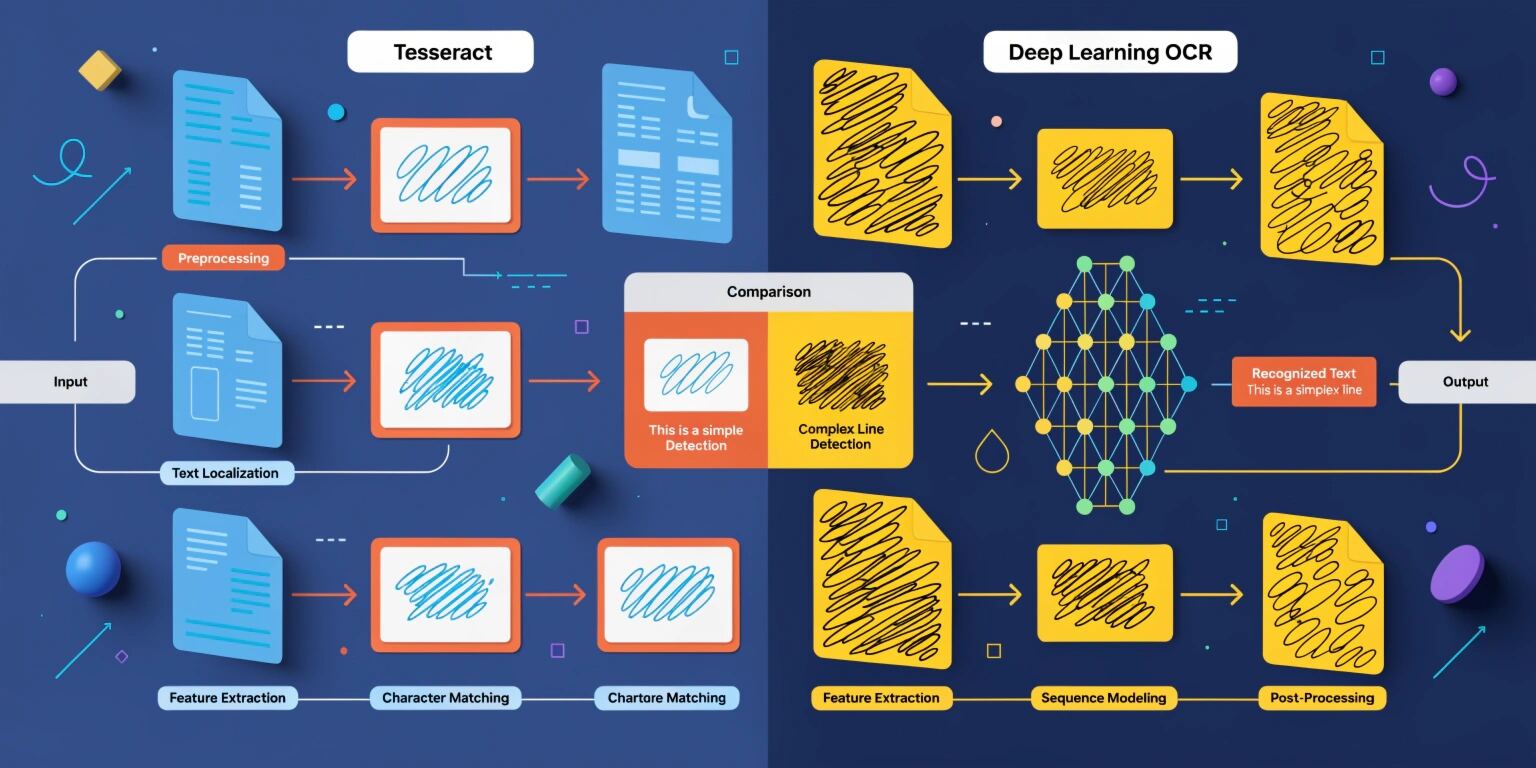
An OCR pipeline refers to the complete workflow involved in converting images into machine-readable text. A typical pipeline includes:
- Image Preprocessing (noise removal, binarization, resizing)
- Text Detection (identifying regions containing text)
- Text Recognition (converting images into characters)
- Post-processing (error correction, formatting, NLP integration)
The effectiveness of each stage determines the overall accuracy and performance of the system.
Overview of Tesseract OCR
Tesseract is an open-source OCR engine originally developed by HP and later maintained by Google. It uses traditional image processing techniques combined with LSTM-based recognition in newer versions.
Strengths of Tesseract
- Free and open-source
- Easy to integrate with multiple programming languages
- Works well with clean, high-quality scanned documents
- Lightweight and fast for simple use cases
Limitations
- Struggles with noisy or low-resolution images
- Limited support for complex layouts
- Lower accuracy with handwritten or stylized text
Tesseract is ideal for projects where cost efficiency and simplicity are priorities.
Overview of Deep Learning OCR
Deep learning OCR systems leverage neural networks, particularly Convolutional Neural Networks (CNNs) and Recurrent Neural Networks (RNNs), to achieve high accuracy in text recognition.
Popular frameworks include:
- CRNN (Convolutional Recurrent Neural Network)
- Transformer-based OCR models
- Cloud-based APIs (Google Vision, AWS Textract, Azure OCR)
Strengths of Deep Learning OCR
- High accuracy, even with noisy or complex images
- Handles multiple fonts, languages, and handwriting
- Better layout detection and context understanding
- Scalable for enterprise-level applications
Limitations
- Requires more computational resources
- Higher implementation and infrastructure costs
- Needs training data for custom use cases
Tesseract vs Deep Learning OCR: Key Comparison
1. Accuracy
- Tesseract: Good for structured, clean documents
- Deep Learning OCR: Superior accuracy in real-world conditions
2. Performance
- Tesseract: Faster for lightweight tasks
- Deep Learning OCR: Slower but more robust
3. Scalability
- Tesseract: Limited scalability for complex workflows
- Deep Learning OCR: Highly scalable with cloud integration
4. Flexibility
- Tesseract: Limited customization
- Deep Learning OCR: Highly adaptable with training
5. Cost
- Tesseract: Free
- Deep Learning OCR: Paid tools or infrastructure costs
When to Choose Tesseract
Use Tesseract if:
- You are working with clean, printed documents
- Budget constraints are a concern
- You need a quick and simple OCR solution
- The application does not require high accuracy
When to Choose Deep Learning OCR
Choose deep learning OCR if:
- You deal with real-world images (receipts, forms, handwritten notes)
- Accuracy is critical
- You need multi-language or complex layout support
- You are building enterprise-grade automation systems
Hybrid OCR Pipelines
In many real-world applications, a hybrid approach works best:
- Use Tesseract for simple documents
- Use deep learning OCR for complex cases
- Combine results using confidence scoring
This approach balances cost, performance, and accuracy.
Best Practices for OCR Pipelines
- Invest in strong image preprocessing techniques
- Use data augmentation to improve model performance
- Implement error correction using NLP models
- Continuously evaluate accuracy with real-world data
- Optimize pipelines for speed and scalability
Real-World Applications
- Invoice Processing: Extract structured data from bills
- Document Digitization: Convert physical records into digital formats
- License Plate Recognition: Identify text in images
- Healthcare Records: Automate patient data extraction
Conclusion
Choosing between Tesseract and deep learning OCR depends on your project requirements, budget, and accuracy needs. While Tesseract remains a reliable choice for simple tasks, deep learning OCR is the future for complex, large-scale applications.
By understanding their strengths and limitations, developers can design OCR pipelines that are both efficient and intelligent—unlocking the full potential of automated text extraction.