Main Content
The Domain Name System (DNS) is one of the fundamental components of the internet. Whenever users visit a website, applications communicate with servers, or devices connect to online services, DNS helps translate human-readable domain names into IP addresses. Because DNS plays such a critical role, protecting DNS infrastructure is essential for modern cybersecurity.
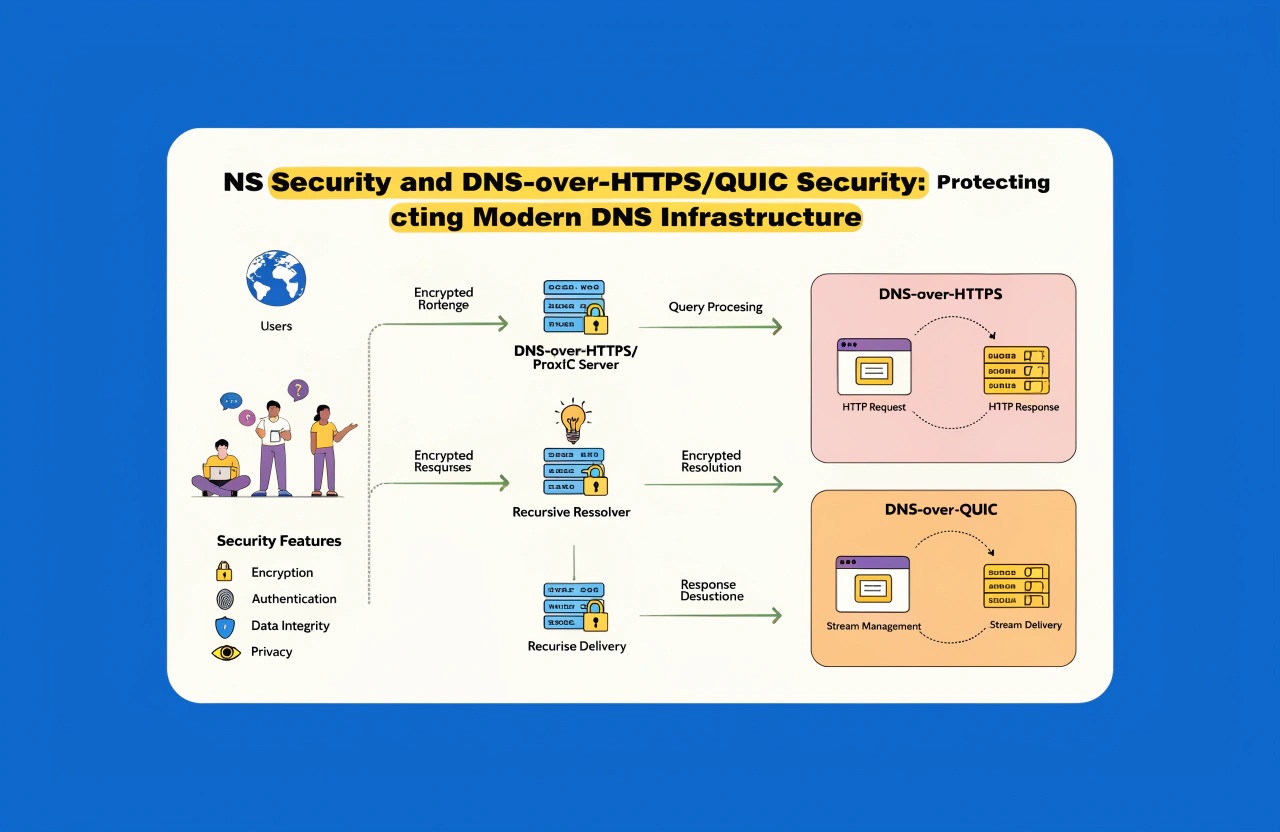
Two important areas of DNS protection are NS security and encrypted DNS technologies such as DNS-over-HTTPS (DoH) and DNS-over-QUIC (DoQ). These technologies address different security challenges but can work together to improve privacy, reliability, and resilience.
Understanding NS Security
NS stands for Name Server. NS records identify the authoritative name servers responsible for managing DNS information for a domain. If attackers compromise name-server infrastructure or manipulate delegation information, they may redirect users toward malicious websites or services.
NS security therefore involves protecting authoritative DNS servers, registrar accounts, DNS management platforms, and delegation records. Organizations should use strong authentication, role-based access control, secure administrative accounts, regular monitoring, and carefully controlled DNS changes.
Another important technology is DNS Security Extensions (DNSSEC). DNSSEC adds cryptographic signatures to DNS data, allowing resolvers to verify that DNS responses have not been modified or forged. This helps protect against attacks such as DNS cache poisoning and certain forms of DNS spoofing.
What Is DNS-over-HTTPS?
Traditional DNS queries can be transmitted without encryption, allowing network operators, attackers, or intermediaries to potentially observe or manipulate DNS traffic.
DNS-over-HTTPS (DoH) addresses this issue by sending DNS queries through HTTPS connections. Since HTTPS provides encryption, DNS requests can be protected against straightforward network interception.
DoH can improve user privacy by making DNS traffic more difficult to inspect in transit. It is particularly useful on public networks, where unencrypted DNS traffic may be exposed to monitoring or manipulation.
However, encryption alone does not make DNS completely secure. Organizations still need secure resolvers, authentication controls, threat detection, DNSSEC validation, and appropriate policies.
Understanding DNS-over-QUIC
DNS-over-QUIC (DoQ) is another modern approach to encrypted DNS communication. Instead of using traditional TCP-based HTTPS transport, DoQ uses the QUIC protocol.
QUIC provides encrypted communication and can offer advantages such as reduced connection establishment overhead, improved handling of network changes, and efficient multiplexed communication. These characteristics make QUIC increasingly relevant to modern internet applications.
DoQ can therefore provide encrypted DNS communication while taking advantage of QUIC's transport capabilities.
Security Benefits of DoH and DoQ
The major benefit of DoH and DoQ is confidentiality. Encrypting DNS traffic makes it more difficult for unauthorized parties to read DNS queries while they are being transmitted.
They can also help reduce certain forms of DNS manipulation and improve privacy on networks where traditional DNS traffic is exposed.
However, organizations should recognize that encrypted DNS creates operational considerations. Security teams may have less visibility into DNS queries if users bypass corporate resolvers. For enterprise environments, DNS policies should therefore clearly define which resolvers are permitted and how encrypted DNS traffic is monitored.
Common DNS Security Threats
DNS infrastructure can face several threats, including:
- DNS spoofing
- DNS cache poisoning
- DNS hijacking
- Domain takeover
- Unauthorized NS record modification
- DNS tunneling
- DDoS attacks against DNS infrastructure
- Malicious domain redirection
- Compromised DNS administrator accounts
A strong DNS security strategy should address both infrastructure security and DNS traffic protection.
Best Practices for Modern DNS Security
Organizations can strengthen DNS security by implementing several layers of protection. These include enabling DNSSEC where appropriate, securing registrar and DNS-provider accounts with multi-factor authentication, restricting administrative access, monitoring DNS changes, maintaining redundant authoritative servers, and regularly reviewing NS records.
Organizations should also evaluate DoH and DoQ policies based on their security requirements. Encrypted DNS should not simply be blocked without considering legitimate privacy and security benefits. Instead, enterprises can use managed resolvers and endpoint policies to maintain appropriate visibility and control.
The Future of DNS Security
As internet traffic becomes increasingly encrypted, DNS security will continue to evolve. DoH and DoQ provide stronger privacy for DNS communication, while DNSSEC helps authenticate DNS information. These technologies solve different problems and should be viewed as complementary rather than interchangeable.
For developers, network administrators, and cybersecurity teams, understanding how NS security, DNSSEC, DoH, and DoQ work together is becoming increasingly important. A layered approach that combines encryption, authentication, access control, monitoring, redundancy, and threat intelligence can help organizations build more secure DNS infrastructure.