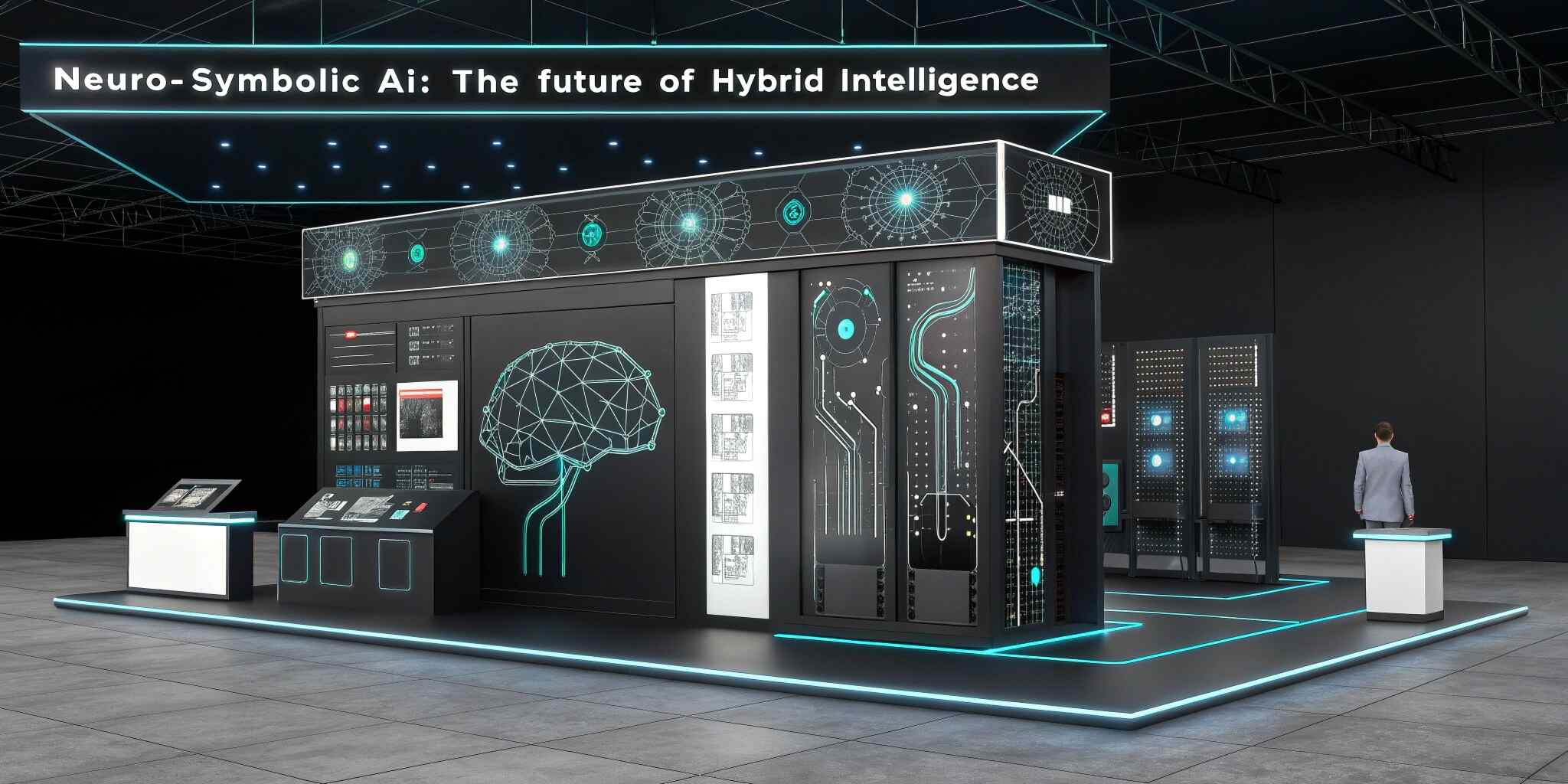
Artificial Intelligence continues to evolve rapidly, but many existing AI models face limitations that prevent them from achieving human-like understanding. Deep learning excels at pattern recognition, yet it struggles with reasoning, transparency, and logical problem-solving. On the other hand, symbolic AI is strong in rule-based logic but weak in adaptability and learning from data. To overcome these challenges, researchers and enterprises are adopting Neuro-Symbolic AI, a hybrid approach that combines the strengths of both methodologies to create more powerful, interpretable, and context-aware AI systems.
Neuro-Symbolic AI integrates the probabilistic learning capabilities of neural networks with the structured reasoning power of symbolic logic systems, enabling machines not only to recognize patterns but also to understand relationships, infer rules, draw conclusions, and explain decisions. This represents a major shift from traditional AI architectures that rely heavily on black-box deep learning models where reasoning is hidden and difficult to validate. With growing industry demands for transparency, accountability, and reliability, neuro-symbolic intelligence is emerging as a practical pathway toward more responsible AI adoption.
One of the key advantages of Neuro-Symbolic AI is explainability. Neural networks can produce highly accurate predictions, but their decision-making process is often opaque. By integrating symbolic reasoning components and knowledge graphs, AI systems can provide clear explanations for their outputs. This is essential in fields such as finance, healthcare, autonomous vehicles, and law enforcement, where decisions must be auditable and ethically justified. Hybrid intelligence helps eliminate concerns surrounding regulatory compliance and algorithmic bias.
Another significant benefit is generalization and adaptability. Deep learning models typically require enormous training datasets, yet they still struggle with uncommon scenarios or edge cases. Symbolic reasoning enables systems to apply logic and pre-defined rules to unfamiliar data, reducing failure rates in real-world conditions. This capability is particularly critical in autonomous robotics, where machines must analyze dynamic environments and make decisions safely.
The applications of Neuro-Symbolic AI are expanding across industries. In enterprise knowledge management, hybrid AI systems connect unstructured and structured data using reasoning engines to improve search accuracy, fraud analytics, and predictive forecasting. In healthcare, the combination of neural learning and symbolic inference supports medical diagnosis by correlating symptoms, patient history, and clinical guidelines. Autonomous vehicles utilize neuro-symbolic reasoning to interpret road rules and unexpected driving scenarios more safely. Smart manufacturing benefits from predictive maintenance and automated decision-making with contextual awareness. In conversational AI, models that combine knowledge graphs with neural language understanding produce more accurate and meaningful responses.
Despite its immense potential, Neuro-Symbolic AI also faces challenges. Integrating symbolic reasoning frameworks with neural models requires complex architectures and computational resources. Developing high-quality knowledge graphs and logic-based systems demands extensive domain expertise. Another challenge is the lack of standardized scaling frameworks for hybrid architectures, although ongoing research is making progress. Enterprises adopting neuro-symbolic intelligence must balance performance efficiency with interpretability requirements.
Looking ahead, Neuro-Symbolic AI is gaining traction as a foundational technology for Artificial General Intelligence (AGI) — a goal where machines exhibit human-like reasoning, adaptability, and decision-making.
By bridging perception and cognition, hybrid AI approaches could enable systems capable of autonomous scientific discovery, ethical decision-making, and real-world understanding. As industries seek more trustworthy and intelligent AI automation, the adoption of neuro-symbolic systems is expected to accelerate significantly.
In conclusion, Neuro-Symbolic AI represents a transformative step in the evolution of artificial intelligence, delivering the strengths of deep learning and symbolic reasoning in a unified model. It improves explainability, reliability, and contextual intelligence, helping enterprises build smarter and more ethically aligned systems. With growing demand for responsible and scalable AI, hybrid intelligence is set to shape the future of automation, research, and intelligent computing.