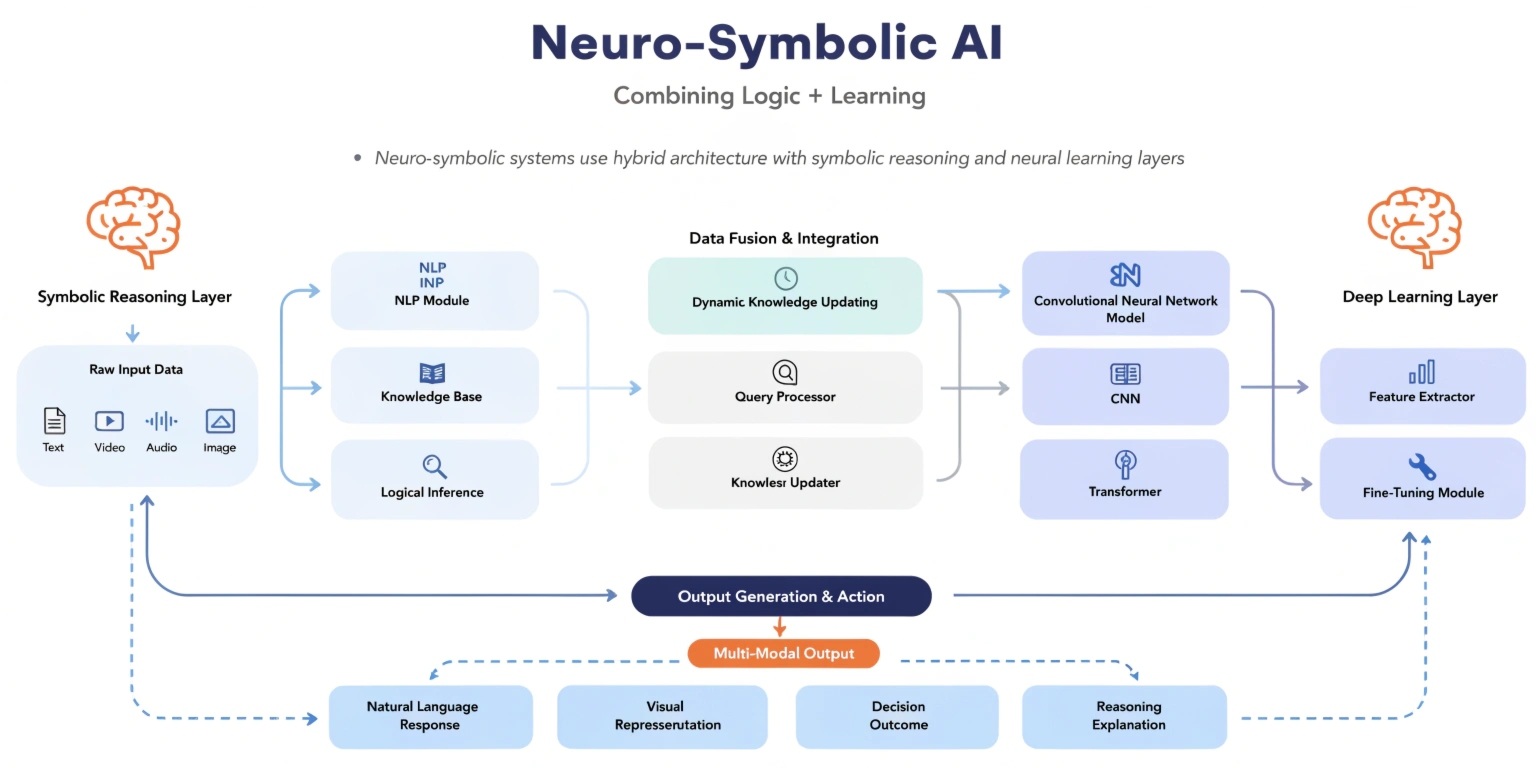
Artificial intelligence has made remarkable progress with deep learning models, yet it still struggles with reasoning, interpretability, and generalization. This gap has led to the rise of Neuro-Symbolic AI, an approach that combines the strengths of neural networks and symbolic logic to create smarter and more reliable systems.
What is Neuro-Symbolic AI?
Neuro-symbolic AI is a hybrid paradigm that integrates two major AI approaches:
- Neural networks (data-driven learning)
- Symbolic AI (rule-based reasoning and logic)
Traditional neural networks excel at pattern recognition but lack reasoning capabilities. On the other hand, symbolic systems can reason logically but struggle with unstructured data like images or speech.
By combining both, neuro-symbolic AI enables systems to learn from data while also applying logical rules, making them more powerful and interpretable.
Why Traditional AI Falls Short
Modern AI, especially deep learning, has achieved breakthroughs in areas like image recognition and natural language processing. However, it faces key limitations:
- Lack of explainability (“black-box” problem)
- Poor reasoning and logical inference
- High data dependency
- Difficulty handling abstract concepts
These challenges highlight the need for systems that can both learn and reason—something neuro-symbolic AI aims to solve.
How Neuro-Symbolic AI Works
At its core, neuro-symbolic AI integrates learning and reasoning in a unified framework. This can be achieved through:
1. Neural Perception + Symbolic Reasoning
Neural networks process raw data (images, text), while symbolic systems interpret results using logic rules.
2. Knowledge Graph Integration
Structured knowledge bases help AI systems understand relationships and context.
3. Differentiable Reasoning
Logic operations are embedded into neural architectures, allowing end-to-end training.
Organizations like IBM have been pioneers in advancing neuro-symbolic systems, particularly in explainable AI research.
Key Benefits
1. Explainability
Unlike black-box models, neuro-symbolic systems provide logical explanations for their decisions, making them more transparent.
2. Better Generalization
By incorporating rules and knowledge, these systems can perform well even with limited data.
3. Improved Reasoning
They can handle complex tasks requiring logical inference, such as planning and decision-making.
4. Data Efficiency
Less reliance on massive datasets compared to pure deep learning models.
Real-World Applications
Healthcare
Neuro-symbolic AI can combine patient data with medical knowledge to improve diagnosis and treatment recommendations.
Finance
Used for fraud detection and risk analysis, where both pattern recognition and rule-based logic are essential.
Autonomous Systems
Self-driving systems benefit from combining perception (neural) with decision-making logic (symbolic).
Natural Language Understanding
Helps in understanding context, semantics, and reasoning beyond simple text prediction.
Challenges and Limitations
Despite its promise, neuro-symbolic AI faces several challenges:
- Integration Complexity: Combining two paradigms is technically challenging
- Scalability Issues: Symbolic reasoning can become computationally expensive
- Standardization: Lack of unified frameworks and tools
- Skill Gap: Requires expertise in both machine learning and logic systems
Overcoming these challenges will be key to widespread adoption.
Neuro-Symbolic AI vs Traditional AI
AspectNeural NetworksSymbolic AINeuro-Symbolic AILearningData-drivenRule-basedHybridExplainabilityLowHighHighReasoningLimitedStrongStrongFlexibilityHighLowHigh
This hybrid approach bridges the gap between perception and reasoning, making AI systems more robust and intelligent.
Future of Neuro-Symbolic AI
As AI systems become more integrated into critical domains, the demand for explainability and reliability will grow. Neuro-symbolic AI is expected to play a crucial role in:
- Explainable AI (XAI)
- Human-AI collaboration
- Advanced decision-making systems
- Ethical AI development
It represents a shift from purely data-driven models to knowledge-driven intelligence.
Conclusion
Neuro-symbolic AI is redefining the future of artificial intelligence by combining the best of both worlds—learning and logic. It addresses the limitations of traditional AI and opens new possibilities for building intelligent, transparent, and efficient systems.
As industries demand smarter and more accountable AI solutions, neuro-symbolic approaches will become increasingly important. The future of AI is not just about learning—it’s about understanding, reasoning, and explaining.