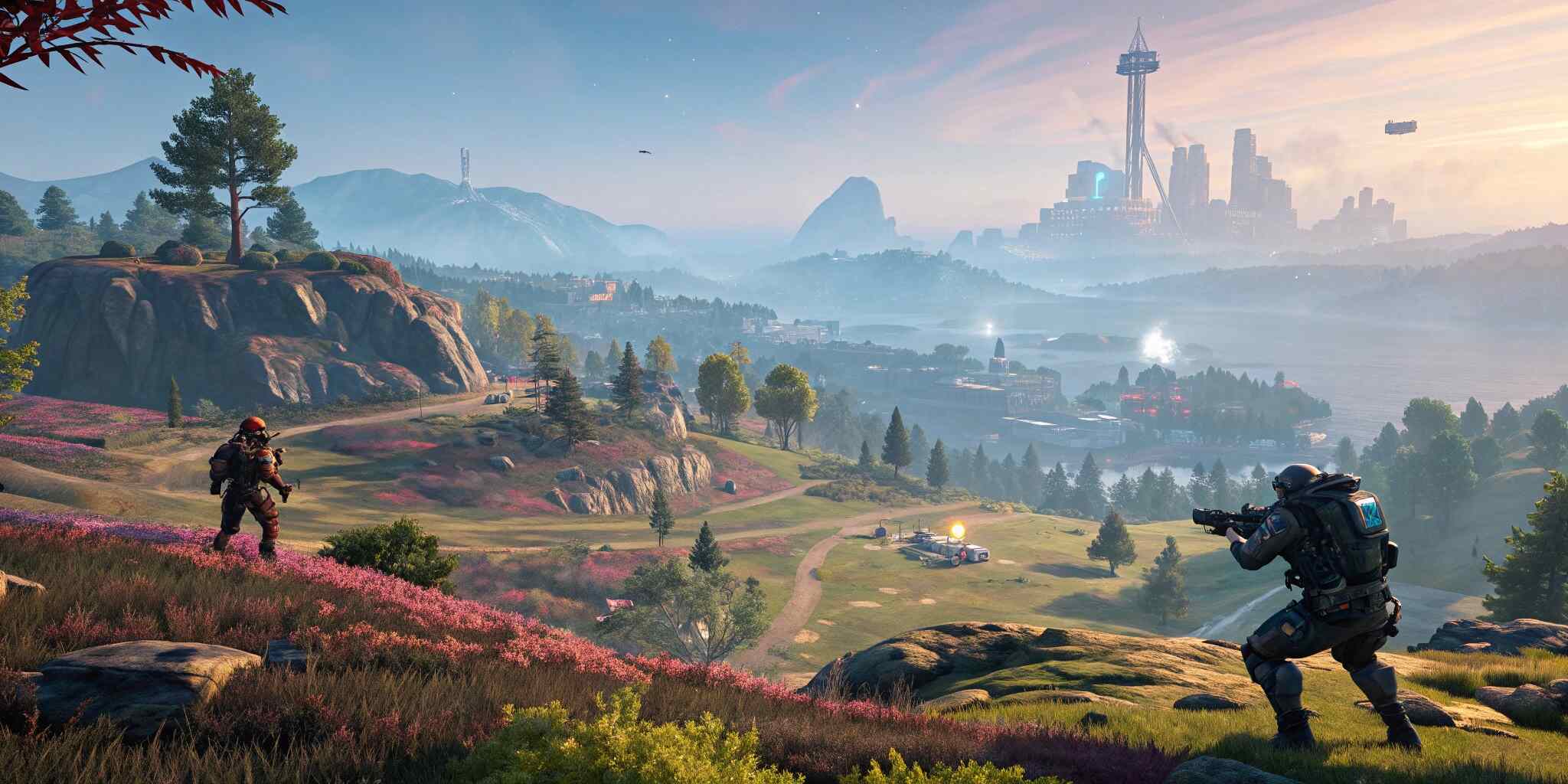
Procedural world generation has long been a cornerstone of sandbox, open-world, and survival games. From the endless landscapes of Minecraft to the universe-spanning terrain of No Man’s Sky, procedural algorithms allow developers to build massive environments from limited manual input. Today, a new technology is pushing these capabilities even further—Neural Radiance Fields (NeRFs). By combining the power of AI-driven scene reconstruction with procedural systems, NeRFs are poised to redefine how infinite game worlds are created, rendered, and experienced.
NeRFs, unlike traditional mesh-based assets, represent scenes as continuous functions learned by neural networks. Instead of relying on polygonal geometry, NeRFs encode color and density at any point in 3D space, enabling them to generate highly detailed, photorealistic visuals with accurate lighting, shadows, and global illumination. When combined with procedural generation, NeRFs can bring unprecedented realism to environments that evolve dynamically or infinitely.
One of the most significant advantages of integrating NeRFs with procedural worlds is the drastic reduction in content creation time. Procedural terrain systems typically produce raw geometry that requires additional work—texture painting, foliage placement, lighting passes, and optimization. NeRFs bypass many of these steps. Developers can capture small real-world patches—rocks, forests, cliffs—or generate synthetic NeRFs and feed them into procedural assembly systems. The result is a world built from modular, neural assets that maintain consistent lighting and seamless blending.
Another advantage lies in how NeRFs handle lighting. Traditional procedural environments rely heavily on baked light maps or runtime lighting, which can become performance-heavy in large worlds. NeRFs naturally encode light transport, meaning every procedurally generated section automatically inherits realistic illumination and shading. This is especially powerful for open-world games where time-of-day cycles or weather effects require dynamic environmental lighting.
NeRF-based procedural ecosystems also enable infinite variation without repetitive patterns. One of the main criticisms of procedural worlds is their tendency to feel algorithmic or predictable. However, neural models can be trained to generate subtle variations in terrain, foliage, materials, and lighting patterns that mimic nature’s randomness. By sampling from different latent representations, procedural systems can continuously generate terrain that feels handcrafted yet infinitely diverse.
Another emerging approach is hybrid rendering, where NeRFs are used for background or mid-distance elements while traditional meshes handle gameplay-critical areas. Procedural systems can generate the structure of the world—heightmaps, biome zones, cave systems—while NeRFs act as detailed "skins" applied to the environment. This hybrid method allows developers to maintain interactivity and physics accuracy while leveraging neural rendering’s strengths in visual fidelity.
However, applying NeRFs to full-scale procedural worlds is not without challenges. Real-time performance remains a major concern. While technologies like NVIDIA's Instant-NGP and hardware-accelerated neural rendering have made massive progress, generating vast worlds entirely as NeRF volumes can be computationally demanding. Streaming NeRFs in and out of memory, similar to how open-world games stream textures and meshes, is an area of active research. Several developers are exploring solutions involving level-of-detail (LOD) NeRFs, multi-resolution grids, and dynamic neural caching.
Another challenge is editability. NeRFs encode scenes holistically, making it difficult to modify individual objects or environmental elements after training. For procedural systems that rely on frequent regeneration, this poses issues. Advances in editable NeRFs, object-centric NeRFs, and hybrid latent-space editing are beginning to address this challenge, but widespread implementation is still evolving.
Despite these hurdles, the future of NeRF-driven procedural worlds is incredibly promising. As GPU performance increases and neural rendering becomes more integrated into mainstream engines like Unreal and Unity, developers will gain the ability to build worlds that not only stretch infinitely but also deliver photorealistic fidelity without traditional asset pipelines. Future games may feature landscapes that blend real-world scanned regions with AI-generated environments, creating worlds that feel both familiar and fantastical.
In the coming years, NeRFs will likely become a foundational tool in procedural world-building. They offer a revolutionary blend of automation, realism, and infinite creativity—pushing open-world games into a new era where developers can generate, refine, and explore vast environments with unprecedented ease.