Introduction
Technology has become a critical part of modern business operations. Companies rely on software development companies, cloud providers, technology vendors, consultants, and IT service providers to support everything from daily operations to large-scale digital transformation projects.
However, choosing the right technology partner is only one part of the process. Businesses also need strong IT contract negotiation and contract management practices to ensure that expectations, responsibilities, costs, timelines, and risks are clearly defined.
A well-negotiated IT contract can prevent misunderstandings, control expenses, protect business interests, and create a strong foundation for a long-term partnership. On the other hand, unclear contracts can result in project delays, unexpected costs, disputes, security concerns, and poor service quality.
What Is IT Contract Management?
IT contract management is the process of creating, negotiating, executing, monitoring, and renewing agreements between a business and an IT service provider or technology vendor.
It covers the entire contract lifecycle, including:
- Requirement identification
- Vendor selection
- Contract negotiation
- Pricing and payment terms
- Service-level agreements
- Data security requirements
- Intellectual property ownership
- Project deliverables
- Change management
- Compliance
- Performance monitoring
- Contract renewal or termination
Effective contract management ensures that both parties understand what they are expected to deliver and how success will be measured.
Why Negotiation Matters in IT Contracts
Negotiation is not simply about getting the lowest possible price. A successful IT negotiation should create value for both parties while protecting the interests of the business.
Businesses should consider factors such as:
Cost: Pricing should be transparent and aligned with the expected scope of work.
Quality: Lower pricing should not compromise software quality, security, performance, or support.
Timeline: Development milestones and delivery dates should be realistic and clearly documented.
Resources: The contract should define the expected team structure, expertise, and availability where relevant.
Support: Maintenance, technical support, bug fixes, and response times should be clearly established.
The goal is to create an agreement that is commercially practical and operationally achievable.
Key Elements of an IT Contract
A strong IT contract should clearly define important areas of the relationship.
1. Scope of Work
The scope should explain exactly what the vendor is responsible for delivering. Ambiguous requirements can lead to disagreements and additional costs.
2. Deliverables and Milestones
Projects should be divided into measurable milestones. Each milestone can include specific deliverables, deadlines, and acceptance criteria.
3. Payment Terms
Payment schedules should be clearly documented. Contracts may include monthly payments, milestone-based payments, fixed pricing, or time-and-material models.
4. Service-Level Agreements
SLAs define expected service standards. They may cover uptime, response times, issue resolution, support availability, and system performance.
5. Intellectual Property
The contract should clearly explain who owns source code, designs, documentation, databases, and other project-related intellectual property.
6. Data Security and Confidentiality
IT contracts often involve sensitive business information. Confidentiality, data protection, access controls, and security responsibilities should be explicitly addressed.
7. Change Management
Technology projects frequently change during development. A proper change-management process should explain how new requirements will be evaluated, approved, priced, and delivered.
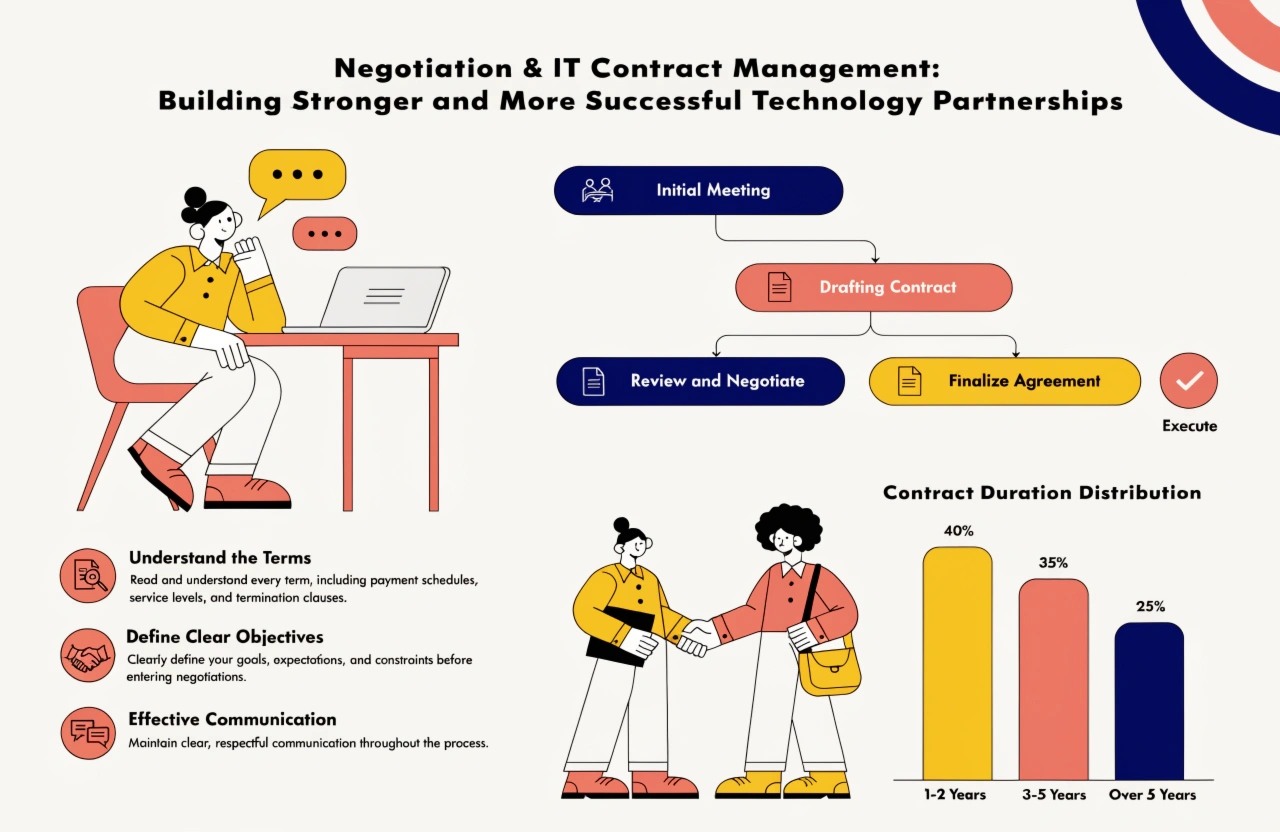
Effective IT Contract Negotiation Strategies
Businesses can improve negotiation outcomes by preparing before discussions begin.
First, clearly identify business requirements and priorities. Separate essential requirements from negotiable preferences.
Second, research the market and understand typical pricing, service models, timelines, and contractual terms.
Third, avoid focusing only on price. Consider the total value offered by the vendor, including expertise, quality, support, scalability, and reliability.
Fourth, define measurable performance expectations. Instead of using vague statements such as "high-quality support," specify response and resolution targets.
Finally, document every important agreement. Verbal commitments should be incorporated into the final contract whenever they affect project scope, pricing, responsibilities, or delivery.
Managing IT Contracts After Signing
Contract management does not end when both parties sign the agreement.
Businesses should regularly review vendor performance against agreed requirements. Project managers and business stakeholders should monitor milestones, invoices, service levels, deliverables, and unresolved issues.
A centralized contract management process can also make it easier to track important dates such as renewal deadlines, payment schedules, warranty periods, and termination notice requirements.
Regular reviews help organizations identify problems early instead of waiting until the contract reaches its renewal stage.
Managing Risks in IT Contracts
Technology projects can involve financial, operational, security, and legal risks.
Contracts should address potential risks through clearly defined responsibilities and procedures.
Important areas include:
- Data breaches and security incidents
- Project delays
- Failure to meet SLAs
- Third-party dependencies
- Unexpected costs
- Intellectual property disputes
- Service interruptions
- Regulatory requirements
- Vendor lock-in
- Contract termination
Organizations should also establish escalation procedures for serious issues.
The Role of Technology in Contract Management
Modern businesses increasingly use contract lifecycle management platforms to automate contract workflows.
Digital contract management tools can help organizations store agreements, track obligations, monitor renewal dates, manage approvals, and maintain audit records.
Automation can reduce administrative work and minimize the risk of missing important contractual deadlines.
Building Long-Term IT Partnerships
The strongest IT contracts are not designed only to protect one party. They establish a framework for cooperation.
Successful technology partnerships depend on transparency, communication, accountability, and continuous improvement.
Businesses should regularly communicate with technology providers, review performance, discuss upcoming requirements, and address issues before they become major problems.
A flexible but well-defined contract can also make it easier to scale services as business requirements change.
Conclusion
Negotiation and IT contract management play an important role in successful technology projects. A well-structured agreement provides clarity around scope, pricing, timelines, responsibilities, security, intellectual property, support, and performance expectations.
Businesses should approach IT contracts strategically rather than treating them as administrative paperwork. Effective negotiation can create better commercial outcomes, while continuous contract management helps ensure that those agreements deliver value throughout their lifecycle.
As organizations continue investing in software, cloud services, cybersecurity, AI, and digital transformation, strong IT contract management will become increasingly important for controlling risk and building reliable technology partnerships.