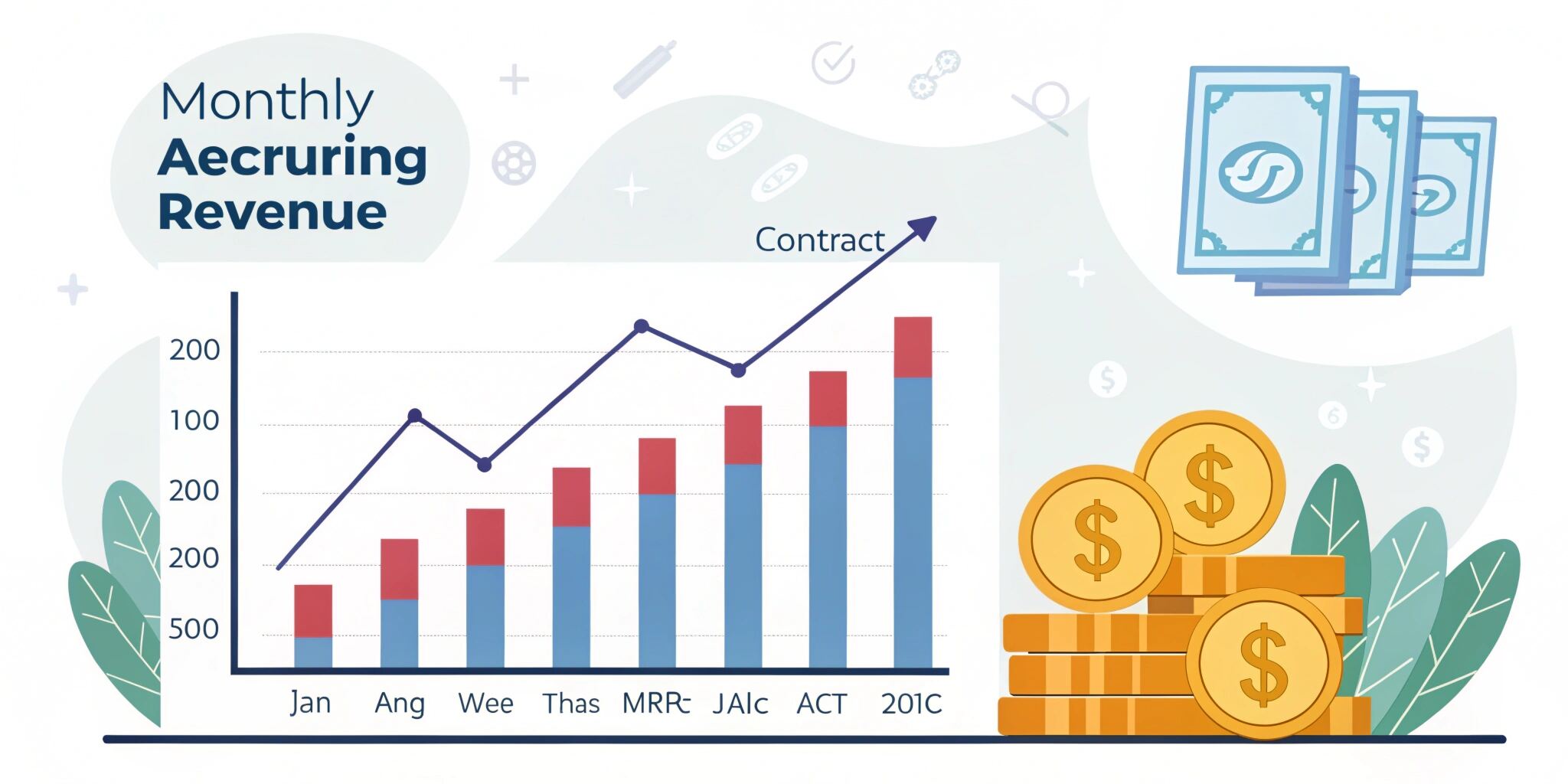
In IT service companies and SaaS businesses, revenue stability is more important than revenue size. A company earning ₹5 lakh every month consistently is often healthier than one earning ₹20 lakh randomly. This stability comes from recurring revenue, and two major metrics that measure it are Monthly Recurring Revenue (MRR) and Annual Contract Value (ACV).
Every Business Development Executive (BDE), Account Manager, and Founder should understand these metrics because they directly affect pricing, forecasting, and long-term company growth.
What is Monthly Recurring Revenue (MRR)?
Monthly Recurring Revenue (MRR) is the predictable amount of income a company receives every month from active subscriptions, retainers, or maintenance contracts.
It only includes repeating income, not one-time projects.
Example
If an IT company provides:
- Website maintenance – ₹15,000/month
- SEO services – ₹25,000/month
- Hosting & support – ₹10,000/month
Total MRR = ₹50,000/month
This means even if the company closes no new deals this month, it will still earn ₹50,000.
This is why investors and founders value recurring revenue more than project-based income.
Types of Revenue Included in MRR
- AMC (Annual Maintenance Contract)
- SaaS subscriptions
- Retainer-based development
- Technical support packages
- Hosting services
- Digital marketing monthly plans
Not Included in MRR
- One-time website development
- App development fixed project
- Logo design projects
- One-time consultation fees
MRR Formula
MRR = Sum of all monthly subscription payments from active clients
If a client pays yearly:
Client pays ₹1,20,000 per year
MRR = ₹1,20,000 ÷ 12 = ₹10,000
What is Annual Contract Value (ACV)?
Annual Contract Value (ACV) is the average yearly revenue generated from one customer contract.
While MRR measures monthly income, ACV helps companies understand the value of a client relationship per year.
Example
If a client signs a 12-month contract worth ₹3,60,000:
ACV = ₹3,60,000 per year
ACV Formula
ACV = Total Contract Value ÷ Contract Duration in Years
If a 2-year contract is ₹6,00,000:
ACV = ₹6,00,000 ÷ 2 = ₹3,00,000
Difference Between MRR and ACV
MetricMeasuresTime PeriodMRRMonthly recurring incomeMonthlyACVCustomer contract valueYearly
MRR shows business stability, while ACV shows customer quality.
Why These Metrics Are Important for IT Companies
1. Revenue Forecasting
MRR helps predict next month’s income.
If your MRR is ₹4,00,000 → you already know your minimum revenue.
2. Hiring Decisions
Companies hire developers based on stable MRR, not project income.
3. Company Valuation
Agencies and SaaS companies are valued using recurring revenue.
Higher MRR = Higher company valuation.
4. Sales Performance Measurement
Instead of counting clients, companies measure:
- New MRR generated
- ACV closed by BDE
This is how senior BDE performance is evaluated.
Practical Example (Real Agency Scenario)
An IT agency has:
- 10 maintenance clients (₹10k/month each)
- 5 SEO clients (₹25k/month each)
MRR =
(10 × 10,000) + (5 × 25,000)
= ₹1,00,000 + ₹1,25,000
= ₹2,25,000 monthly recurring revenue
Annual predictable income = ₹27,00,000
Now the company can safely:
- Hire staff
- Invest in marketing
- Plan growth
How BDEs Can Increase MRR
- Convert one-time projects into maintenance contracts
- Offer support packages after project delivery
- Introduce monthly retainers
- Upsell SEO, hosting, or app maintenance
- Renew contracts before expiry
This is why experienced BDEs focus on retainers instead of one-time projects.
Common Mistake Companies Make
Many agencies chase new clients every month instead of building recurring clients. This creates income fluctuation and employee instability.
The real goal of a stable IT company is: Not more clients, but predictable clients.
Conclusion
Monthly Recurring Revenue (MRR) and Annual Contract Value (ACV) are not just financial metrics — they are business health indicators. They show how stable, scalable, and valuable an IT company truly is.
For a Business Development Executive, understanding these metrics changes the mindset from “closing deals” to building long-term revenue. Companies don’t grow by projects; they grow by predictable income.
If an agency wants real scaling, the focus should always shift from one-time development to recurring service relationships.