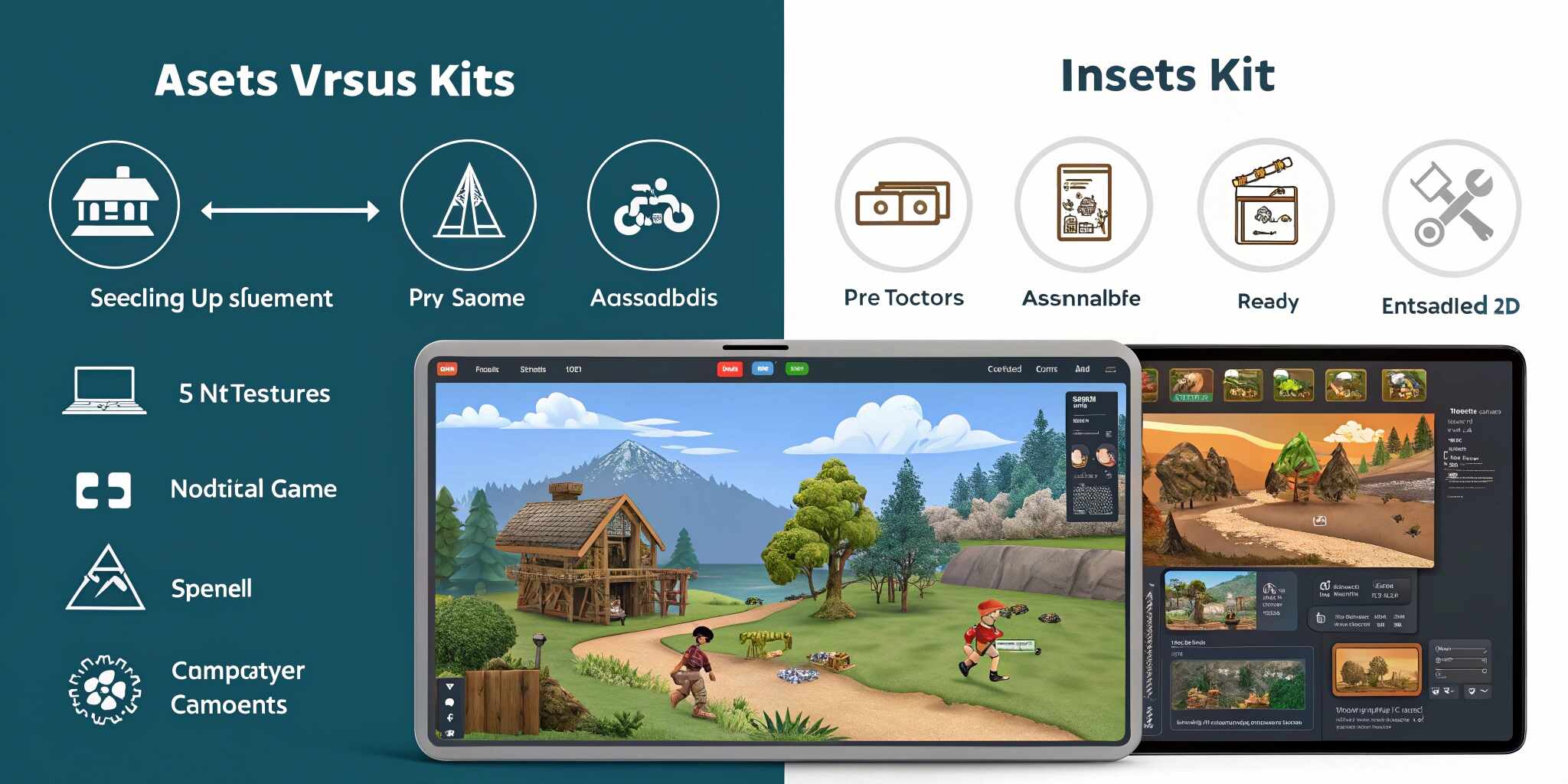
Game development is an art that balances creativity with efficiency. One of the most time-consuming tasks in this process is scene-building, where designers construct immersive worlds that players explore. To speed up this process, developers often rely on modular assets and environment kits. Both approaches encourage asset reuse and consistency, but each comes with its strengths and limitations. Understanding the differences between the two is key to choosing the right strategy for your project.
What Are Modular Assets?
Modular assets are small, reusable building blocks that can be combined in different ways to form larger structures. Examples include walls, floors, doors, windows, and roof tiles. Developers use these pieces like digital Lego bricks to design endless variations of environments.
Key characteristics of modular assets:
- Designed for flexibility and recombination.
- Allow for procedural generation and scalable environments.
- Ideal for projects requiring unique, non-repetitive designs.
For instance, in Unreal Engine or Unity, modular architecture enables developers to build entire cities by reusing a limited number of wall and roof sections.
What Are Environment Kits?
Environment kits are themed collections of assets packaged together for quick world-building. Unlike modular pieces, they usually contain pre-made props, textures, vegetation, and sometimes entire pre-assembled structures.
Key characteristics of environment kits:
- Designed to provide a ready-to-use set of assets.
- Allow for rapid prototyping and scene population.
- Perfect for developers who prioritize speed over granular customization.
An environment kit might include everything needed to build a medieval village: cottages, fences, barrels, grass textures, and trees.
Modular Assets vs Environment Kits
1. Flexibility
- Modular Assets: Extremely flexible, as they can be combined in countless configurations. Great for unique and procedural levels.
- Environment Kits: Limited flexibility. Assets are pre-made to fit a theme, making them harder to adapt outside their intended style.
2. Speed
- Modular Assets: Building takes longer initially because you must design the scene piece by piece.
- Environment Kits: Faster to deploy since assets are pre-packaged and ready to use.
3. Consistency
- Modular Assets: High consistency because the same blocks are reused across different structures.
- Environment Kits: Consistent within a theme but harder to maintain across different kits.
4. Creativity
- Modular Assets: Encourages creativity by allowing developers to experiment with new structures.
- Environment Kits: More restrictive but excellent for beginners or when time is limited.
5. Optimization
- Modular Assets: Often more performance-friendly, as fewer unique meshes and textures are required.
- Environment Kits: Can be heavier due to larger, varied assets.
When to Use Modular Assets
- Large, scalable projects where unique levels are important.
- Open-world or procedural games that rely on repeatable structures.
- Teams with strong 3D modeling capabilities and time to invest in modular design.
Example: A futuristic city game where skyscrapers, roads, and vehicles must be built in countless variations benefits from modular assets.
When to Use Environment Kits
- Small teams or indie developers aiming for quick results.
- Projects where speed and budget are more important than deep customization.
- Prototyping or proof-of-concept stages where visuals matter more than scalability.
Example: A fantasy RPG prototype requiring a medieval village in just a few weeks benefits from an environment kit.
Combining Both Approaches
Many studios don’t choose one over the other—they combine both. A base world might be constructed using modular assets, while environment kits add detail, props, and ambiance. This hybrid method balances flexibility with speed, enabling faster development without sacrificing uniqueness.
Conclusion
Both modular assets and environment kits play a crucial role in modern scene-building. Modular assets shine when flexibility, scalability, and performance are priorities, while environment kits excel in speed and accessibility. By understanding the trade-offs, developers can choose—or blend—the approaches to deliver immersive worlds efficiently.
In today’s competitive game industry, mastering these workflows is essential to building environments that are both visually stunning and production-friendly.