Modern web applications can become extremely complex as organizations add new products, features, teams, and business capabilities. A single frontend codebase may eventually contain thousands of components and require dozens of developers to work within the same deployment pipeline.
This creates challenges around development speed, ownership, testing, releases, and scalability.
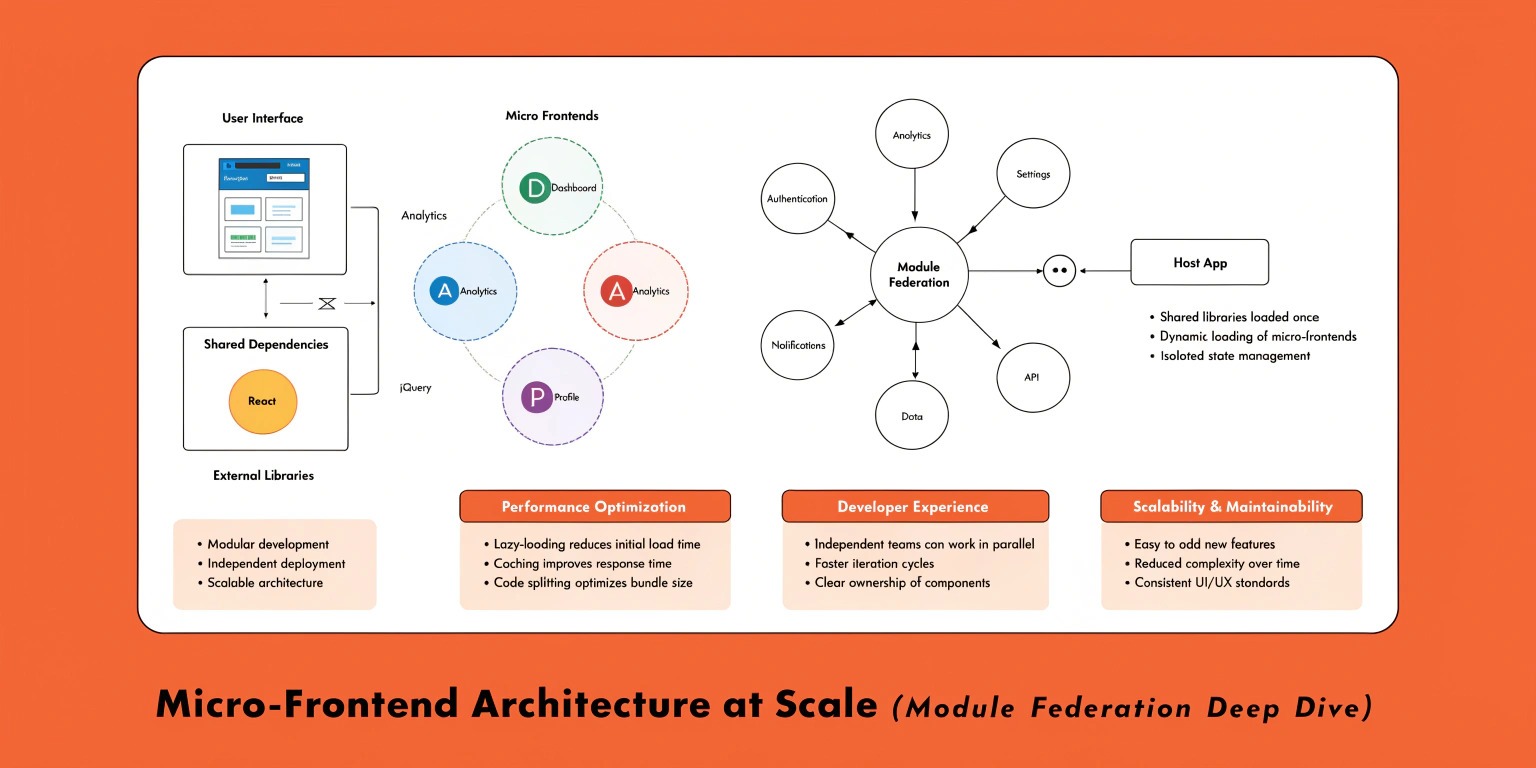
Micro-frontend architecture addresses these challenges by dividing a large frontend application into smaller applications that can be developed and deployed independently. One of the technologies that makes this approach particularly powerful is Module Federation.
Module Federation enables independently built applications to consume JavaScript modules from other applications at runtime, creating a flexible architecture for large-scale frontend systems.
What Is Micro-Frontend Architecture?
Micro-frontends apply the principles of microservices to frontend development.
Instead of building one large application, teams divide functionality into independently owned frontend domains.
For example, an eCommerce platform might contain:
- Product Catalog
- Shopping Cart
- Checkout
- Customer Account
- Order Management
- Recommendations
Each domain can potentially have its own development team and release lifecycle.
The goal is not simply to create smaller frontend files. The real objective is to establish team and business boundaries that allow teams to work independently.
Why Micro-Frontends at Scale?
A traditional monolithic frontend can create several problems as an organization grows.
Common challenges include:
- Large build times
- Difficult deployments
- Team coordination overhead
- Shared-code conflicts
- Risky releases
- Difficult ownership
- Tight coupling
Micro-frontends can address these issues by allowing teams to own specific areas of the application.
However, micro-frontends also introduce distributed-system complexity into frontend development.
Understanding Module Federation
Module Federation is a Webpack capability that allows an application to expose modules that another application can consume.
There are typically two important concepts:
Host: The application consuming remote modules.
Remote: An application exposing modules to other applications.
For example:
The host application might load a checkout interface from a remote application.
Instead of bundling the checkout code into the host during the original build, the module can be resolved at runtime.
This creates independent deployment possibilities.
Runtime Composition
One of Module Federation's biggest advantages is runtime composition.
A host application can load remote functionality dynamically.
Conceptually:
Host Application → Remote Application → Exposed Module
The host does not necessarily need to rebuild whenever the remote application changes.
This enables teams to release specific business capabilities independently.
For large organizations, this can significantly reduce coordination between development teams.
Shared Dependencies
Micro-frontends become complicated when multiple applications depend on the same libraries.
For example, several applications may use:
- React
- React DOM
- UI component libraries
- State management libraries
- Utility packages
Loading multiple versions can increase bundle size and create runtime inconsistencies.
Module Federation allows applications to configure shared dependencies.
Teams can define whether dependencies should be:
- Shared
- Singleton
- Eagerly loaded
- Version constrained
React is often treated carefully as a singleton because multiple React instances can create unexpected behavior.
Version Management
Independent deployment creates a new challenge: compatibility.
Suppose a remote module expects version 18 of a library while the host uses a different version.
Potential problems include:
- Runtime errors
- Duplicate dependencies
- API incompatibilities
- Unexpected UI behavior
Organizations should establish dependency governance and compatibility policies.
Automated testing and semantic versioning can help reduce these risks.
Independent Deployment
One of the strongest reasons to adopt micro-frontends is independent deployment.
A team responsible for the checkout domain could deploy updates without rebuilding the entire platform.
This enables:
- Faster releases
- Smaller deployment risks
- Independent rollback
- Team autonomy
- Continuous delivery
However, deployment independence should be genuine. If every team still needs coordinated releases, much of the architectural benefit disappears.
Performance Considerations
Micro-frontends can improve organizational scalability but potentially hurt application performance.
Loading multiple applications can introduce:
- Additional JavaScript
- Duplicate dependencies
- More network requests
- Larger runtime overhead
Performance strategies include:
- Sharing common dependencies
- Lazy loading remote modules
- Splitting large applications
- Prefetching critical modules
- Caching remote assets
- Monitoring bundle sizes
The architecture should optimize both team productivity and end-user performance.
Routing Strategies
Routing is another important design decision.
There are two common approaches.
Route-Based Micro-Frontends
Different teams own different URL sections.
For example:
/products
/checkout
/account
This is relatively simple and creates clear ownership boundaries.
Component-Level Federation
Individual components or workflows are federated.
For example:
- Search widget
- Payment component
- Recommendation panel
This provides more flexibility but introduces greater runtime complexity.
Organizations should avoid splitting applications too aggressively.
State Management
Shared state can become one of the biggest challenges in micro-frontend architectures.
Teams should avoid creating a massive global state system that tightly couples every micro-frontend.
Prefer:
- Local state where possible
- Domain-specific state
- Explicit communication contracts
- Event-based communication when appropriate
Cross-application state should be limited to genuinely shared business requirements.
Security Considerations
Runtime-loaded code creates additional security responsibilities.
Teams should carefully control:
- Remote module sources
- Deployment permissions
- Content Security Policy
- Dependency integrity
- Authentication
- Authorization
- Secrets management
A compromised remote application could potentially affect the host application.
Remote applications should therefore be treated as trusted production dependencies and governed accordingly.
Observability
Debugging distributed frontend applications requires strong observability.
Teams should monitor:
- Remote loading failures
- JavaScript errors
- Network failures
- Version mismatches
- Performance metrics
- User journeys
Centralized logging and error monitoring can help identify which micro-frontend caused a production issue.
When Should You Use Micro-Frontends?
Micro-frontends are not automatically better than monolithic frontend architecture.
They are most useful when:
- Multiple teams work on one large product
- Business domains are clearly separated
- Independent deployment is valuable
- Teams need technological autonomy
- The application is expected to grow significantly
For a small application with one development team, micro-frontends may introduce unnecessary complexity.
Common Mistakes
Organizations frequently encounter problems by:
- Creating too many micro-frontends
- Sharing too much state
- Duplicating dependencies
- Ignoring performance
- Creating unclear ownership boundaries
- Using micro-frontends without organizational need
- Allowing uncontrolled dependency versions
The architecture should solve a real organizational or technical problem rather than being adopted simply because it is popular.
Future of Micro-Frontend Architecture
The micro-frontend ecosystem continues to evolve alongside modern JavaScript frameworks and deployment platforms.
Emerging approaches include:
- Framework-independent components
- Edge-based composition
- Server-side composition
- Web Components
- Runtime orchestration
- Improved Module Federation tooling
- Distributed frontend observability
- AI-assisted frontend development
These approaches will make it easier for organizations to balance team autonomy with application performance and consistency.
Conclusion
Micro-frontend architecture can provide significant benefits for organizations managing large and complex web applications. Module Federation makes runtime composition and independent deployment practical by allowing applications to expose and consume frontend modules dynamically.
However, successful adoption requires more than configuring a federation plugin. Teams must carefully design ownership boundaries, dependency sharing, deployment workflows, routing, state management, security, performance, and observability.
When applied to the right organizational and technical context, micro-frontends can transform frontend development from a tightly coupled monolith into a scalable ecosystem where teams can build, release, and evolve business capabilities independently.