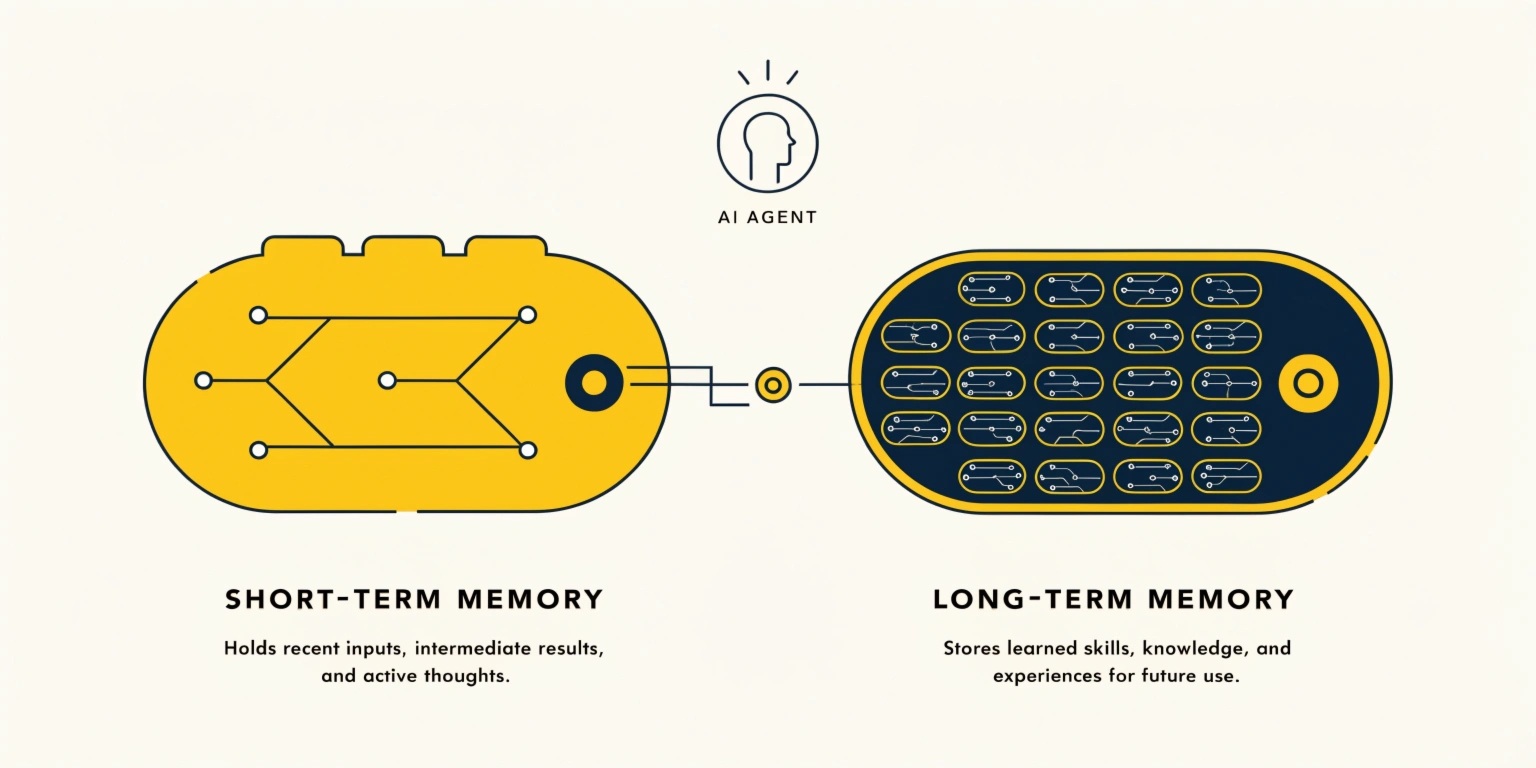
Memory architecture enables AI agents to remember context, personalize interactions, and perform complex tasks efficiently. Learn how short-term and long-term memory work together to build smarter AI-powered web applications.
Artificial Intelligence (AI) agents are transforming modern web applications by enabling intelligent conversations, personalized recommendations, automated workflows, and decision support. Unlike traditional chatbots that respond only to the latest prompt, advanced AI agents can retain context, recall previous interactions, and use stored knowledge to provide more meaningful responses.
The foundation of these capabilities lies in memory architecture. Just as humans rely on short-term and long-term memory to process information and make decisions, AI agents use different memory systems to manage conversation context and persistent knowledge. Designing the right memory architecture is essential for building scalable, intelligent, and user-friendly AI-powered web applications.
This article explores the concepts of short-term and long-term memory in AI agents, their differences, implementation strategies, and best practices for web developers.
What Is Memory Architecture in AI Agents?
Memory architecture refers to the way an AI agent stores, retrieves, updates, and uses information during interactions. It determines how much context the agent remembers, how it recalls historical data, and how effectively it adapts to user needs over time.
Without memory, an AI agent treats every interaction as a new conversation. With a well-designed memory system, it can remember user preferences, previous discussions, project details, and business rules, resulting in more natural and productive interactions.
For web applications, memory architecture improves user engagement, reduces repetitive input, and enables personalized experiences.
Understanding Short-Term Memory
Short-term memory stores temporary information needed during an active conversation or task. It allows the AI agent to maintain context across multiple messages without requiring the user to repeat information.
For example, if a user asks:
"Create a marketing plan for my e-commerce business."
Then follows with:
"Now include social media strategies."
The AI understands that "social media strategies" relate to the previously discussed marketing plan because it retains the conversational context.
Characteristics of Short-Term Memory
- Exists only during the active session
- Maintains conversational flow
- Stores recent prompts and responses
- Limited by the model's context window
- Automatically discarded after the session ends unless saved
Short-term memory is ideal for chatbots, virtual assistants, customer support systems, and collaborative productivity tools.
Understanding Long-Term Memory
Long-term memory stores information that remains available across multiple sessions. Instead of forgetting users after each conversation, the AI retrieves relevant historical information whenever needed.
Examples include:
- User preferences
- Frequently used settings
- Project documentation
- Company knowledge bases
- Customer purchase history
- Frequently asked questions
- Training materials
- Previous conversations
This persistent memory allows AI agents to deliver personalized and context-aware responses even weeks or months after an initial interaction.
Short-Term vs Long-Term Memory
FeatureShort-Term MemoryLong-Term MemoryDurationCurrent sessionMultiple sessionsStorageTemporaryPersistentPurposeConversation contextHistorical knowledgeCapacityLimited by context windowScalable databasesExampleRecent chat messagesUser profile and project history
Both memory types complement each other and are essential for creating intelligent AI systems.
How AI Agents Implement Memory
Modern AI applications combine multiple technologies to manage memory effectively.
Conversation Buffers
Recent messages are temporarily stored and supplied to the language model with each request, enabling the AI to understand ongoing discussions.
Vector Databases
Long-term memory often uses vector databases that store semantic representations of documents and conversations. Instead of relying on exact keyword matching, vector search retrieves information based on meaning and relevance.
Popular vector databases include Pinecone, Weaviate, Milvus, Chroma, and Qdrant.
Retrieval-Augmented Generation (RAG)
RAG combines external knowledge retrieval with language models. Before generating a response, the AI searches relevant documents, retrieves useful information, and incorporates it into the answer.
This approach improves factual accuracy while reducing hallucinations.
Traditional Databases
Relational and NoSQL databases store structured information such as user accounts, order history, preferences, and application settings, complementing semantic memory systems.
Benefits for Web Development
Integrating memory architecture into web applications offers several advantages:
- Personalized user experiences
- Improved customer support
- Reduced repetitive interactions
- Better workflow automation
- Enhanced recommendation systems
- Consistent multi-session conversations
- Faster knowledge retrieval
- Higher user engagement
These capabilities are increasingly important for SaaS platforms, e-commerce websites, healthcare portals, educational platforms, and enterprise applications.
Challenges in Memory Architecture
Although powerful, memory systems introduce several technical challenges.
Context Window Limitations
Large Language Models can process only a limited amount of information at once. Developers must carefully manage which context is included in each request.
Data Privacy
Storing user conversations requires strong encryption, access controls, and compliance with regulations such as GDPR and other applicable privacy laws.
Memory Relevance
Not every conversation should be stored permanently. AI systems must distinguish between temporary context and valuable long-term information.
Performance
As memory grows, efficient indexing and retrieval become essential to maintain fast response times.
Best Practices
To build reliable AI memory systems, follow these recommendations:
- Separate short-term and long-term memory responsibilities.
- Store only meaningful and relevant information.
- Use vector databases for semantic knowledge retrieval.
- Combine RAG with structured databases for better accuracy.
- Encrypt sensitive user data and implement proper access controls.
- Define memory retention policies to manage storage effectively.
- Regularly update and clean stored knowledge.
- Monitor retrieval quality to improve response relevance.
- Optimize prompts to include only necessary context.
- Design scalable architectures that support increasing user volumes.
Future of Memory in AI Agents
As AI technology evolves, memory systems will become increasingly sophisticated. Future AI agents will be capable of learning continuously, adapting to user behavior, maintaining long-term relationships, and collaborating across multiple applications.
Emerging techniques such as hierarchical memory, episodic memory, agent collaboration, and autonomous knowledge refinement will enable AI systems to perform more complex tasks while providing highly personalized experiences.
For web developers, understanding memory architecture will become a fundamental skill in building next-generation AI-powered applications.
Conclusion
Memory architecture is one of the most important components of modern AI agents. While short-term memory enables smooth, context-aware conversations during active sessions, long-term memory allows AI systems to retain knowledge, personalize interactions, and deliver consistent experiences across time.
By thoughtfully combining conversation buffers, vector databases, Retrieval-Augmented Generation (RAG), and traditional data storage, developers can build AI-powered web applications that are intelligent, scalable, and user-centric. As organizations continue adopting AI for customer support, productivity, and automation, investing in robust memory architecture will be essential for creating reliable applications that meet evolving user expectations and business needs
We build scalable web, mobile, and game products for clients worldwide — combining modern frameworks, cloud infrastructure, and best engineering practices.
.jpg)
.jpg)
.jpg)