The biggest limitation of early AI chatbots was simple:
They forgot everything.
You could explain your project, preferences, or requirements — and five minutes later the system would behave as if the conversation never happened.
This was not a bug.
It was a memory problem.
Modern AI agents — copilots, assistants, autonomous workflows — are becoming useful only because developers learned how to design memory architecture around language models.
An AI model alone is not an agent.
An AI agent is a model + tools + reasoning + memory.
Memory is what transforms a chatbot into an assistant.
Why AI Models Naturally Forget
Large Language Models (LLMs) do not actually “remember” information.
They operate within a context window — a temporary working space that holds recent conversation tokens.
Once the conversation becomes too long:
Older messages are removed.
This behaves like human working memory:
You can remember what someone just said, but not every conversation you ever had.
This is called short-term memory.
But real assistants need more than that.
Imagine an AI customer support agent that:
- forgets customer name
- forgets previous issue
- forgets purchase history
It becomes unusable.
To solve this, developers introduced long-term memory systems.
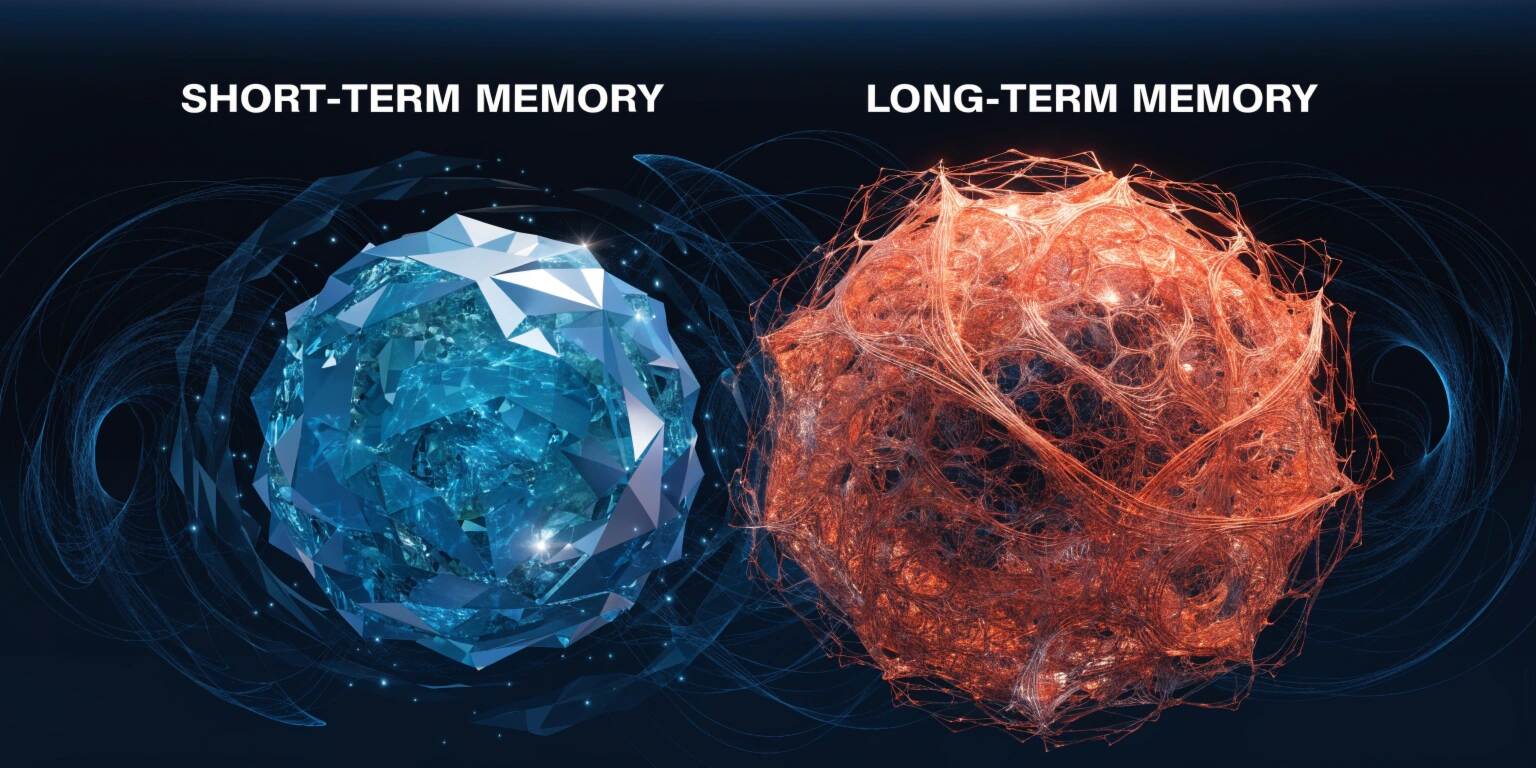
Short-Term Memory (Context Memory)
Short-term memory lives inside the model’s context window.
It contains:
- recent conversation
- immediate instructions
- current task
Example:
If you say:
“Write an email to a client about a delayed delivery.”
And then:
“Make it more formal.”
The agent understands “it” because the instruction exists inside context.
Characteristics:
- Fast
- Temporary
- Automatically handled by the model
- Limited capacity
The limitation is important.
Even powerful models cannot process infinite context.
This creates the need for structured memory storage.
Long-Term Memory (Persistent Memory)
Long-term memory allows AI agents to recall information across sessions.
This is not stored inside the LLM itself.
Instead, it is stored externally using databases.
Common stored items:
- user preferences
- past conversations
- company knowledge base
- documents
- product information
- task history
The agent retrieves this information whenever needed.
This is how an AI assistant can say:
“Last time you asked for a Node.js architecture — should I continue with that?”
Now the system behaves like it remembers.
Because architecturally — it does.
How Long-Term Memory Works (Embeddings + Retrieval)
The key technology enabling this is embeddings.
Step 1: Convert text into vectors
Every piece of information (conversation, document, note) is transformed into a numeric representation called an embedding.
Step 2: Store in a vector database
Examples:
- Pinecone
- Weaviate
- Chroma
Instead of keyword search, the system uses semantic search.
Step 3: Retrieve relevant memory
When the user asks something new, the system:
- searches similar past data
- injects it into the prompt
This process is called:
Retrieval Augmented Generation (RAG).
The model now answers using both:
current conversation + remembered knowledge.
Memory Types in AI Agents
Modern AI agents typically use multiple memory layers:
1. Conversational Memory
Recent chat history inside context window.
2. Episodic Memory
Past interactions with the user (previous sessions).
3. Semantic Memory
General knowledge stored in documents or databases.
4. Procedural Memory
Instructions on how the agent should behave (system prompts, policies, workflows).
This architecture closely resembles human cognition models.
Practical Example
Consider an AI sales assistant.
Without memory:
Every session starts from zero.
With memory:
- remembers client industry
- recalls previous meeting notes
- suggests follow-ups
- references prior proposals
Now it becomes a productivity tool instead of a novelty chatbot.
Challenges in AI Memory Design
Building memory is not simple.
Developers must solve:
1. Relevance
Retrieving too much information confuses the model.
2. Recency vs Importance
Recent data may not be the most important data.
3. Cost
Long context windows are expensive.
4. Privacy
Sensitive user data must be secured and filtered.
5. Hallucination Control
Incorrect memories can produce confident but wrong outputs.
Therefore memory requires ranking, filtering, and validation logic.
Advanced Techniques
Modern agent frameworks add:
- memory summarization
- conversation compression
- importance scoring
- time-weighted retrieval
- reflection loops
Instead of storing every message, the agent stores knowledge extracted from messages.
This dramatically improves performance and cost.
Why Memory Is the Future of AI
Early AI tools answered questions.
Next-generation AI agents perform tasks.
Task execution requires continuity.
Continuity requires memory.
The most powerful AI systems in the coming years will not be the ones with the largest models — but the ones with the best memory architecture.
A smaller model with excellent memory often outperforms a larger model without it.
Final Thoughts
Memory architecture is the missing layer between chatbots and intelligent agents.
Short-term memory enables conversation.
Long-term memory enables relationships.
Together they allow AI to:
- learn user preferences
- maintain context
- automate workflows
- provide personalized assistance
AI is evolving from a tool you use
to a system that knows how you work.
And that transformation is made possible by memory.