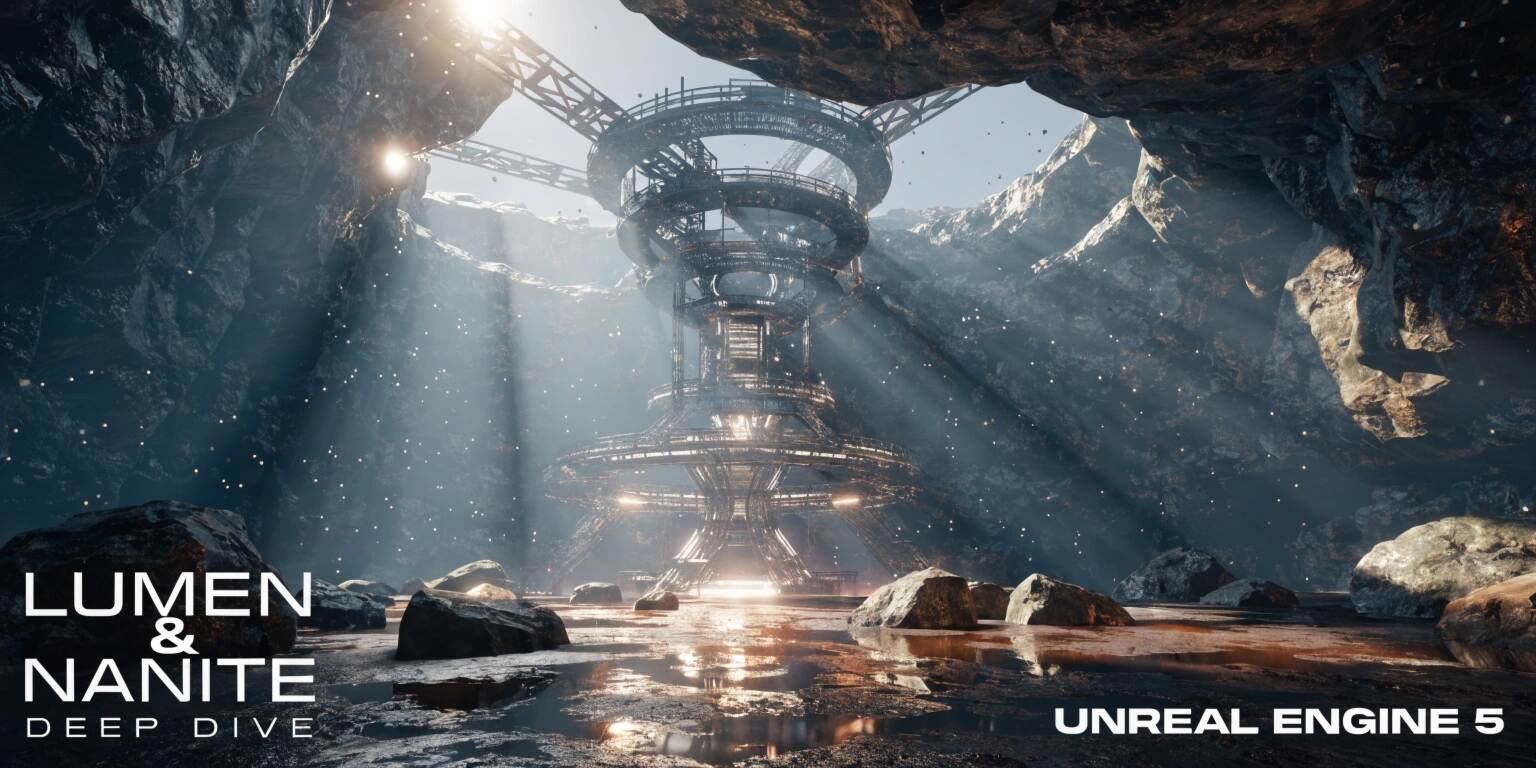
The introduction of Unreal Engine 5 marked a turning point in the evolution of real-time graphics. With the arrival of Lumen and Nanite, developers can now achieve levels of realism that were once limited to pre-rendered cinematics.
These two technologies fundamentally change how lighting and geometry are handled, removing many of the technical barriers that previously constrained artists and engineers.
Understanding Lumen: Dynamic Global Illumination
Lumen is Unreal Engine 5’s fully dynamic global illumination (GI) system. Unlike traditional approaches that rely on baked lighting, Lumen calculates light interactions in real time.
This allows light to bounce naturally across surfaces, creating realistic indirect lighting and reflections.
Key Features of Lumen:
- Real-time global illumination
- Infinite light bounces
- Dynamic reflections
- No need for lightmap baking
This dynamic approach means that any change in the scene—such as moving objects or altering light sources—immediately affects the lighting.
For example:
- Opening a door lets light spill into a dark room
- Turning off a light changes the entire scene atmosphere
- Explosions illuminate nearby surfaces dynamically
How Lumen Works Under the Hood
Lumen uses a hybrid system combining:
- Screen-space tracing
- Software ray tracing
- Hardware ray tracing (on supported GPUs)
It constructs a simplified representation of the scene using distance fields and surface caching. This allows it to approximate global illumination efficiently without relying entirely on expensive ray tracing.
The result is a scalable system that balances visual quality and performance.
Understanding Nanite: Virtualized Geometry
Nanite is a revolutionary geometry system that allows developers to use extremely high-polygon assets directly in the engine.
Traditionally, developers had to:
- Reduce polygon counts
- Create multiple Levels of Detail (LODs)
- Optimize meshes manually
Nanite eliminates these steps.
It allows artists to import film-quality assets—often containing millions of polygons—without worrying about performance constraints.
How Nanite Works
Nanite uses a virtualized geometry system that breaks meshes into small clusters. These clusters are streamed and rendered based on visibility and camera distance.
Key benefits include:
- Automatic Level of Detail management
- Rendering only visible geometry
- Efficient GPU utilization
- Reduced memory overhead
This means that objects far from the camera are rendered with fewer details, while close objects retain full fidelity—all handled automatically.
The Power of Lumen and Nanite Together
While Lumen handles lighting, Nanite handles geometry. Together, they create a powerful rendering pipeline.
Nanite provides:
- Highly detailed environments
Lumen ensures:
- Realistic lighting interactions across those environments
This combination allows developers to build dense, photorealistic worlds in real time.
A great example is The Matrix Awakens, which showcases a massive city with cinematic lighting and incredible geometric detail—all rendered live.
Benefits for Game Development
1. Faster Development Workflow
- No need for manual LOD creation
- No light baking
- Faster iteration cycles
Developers can focus more on creativity rather than optimization.
2. Higher Visual Quality
- Film-quality assets can be used directly
- Realistic lighting enhances immersion
- Consistent visuals across environments
3. Simplified Asset Pipeline
Traditional pipelines required:
- Retopology
- UV mapping for lightmaps
- LOD generation
Lumen and Nanite significantly reduce or eliminate these steps.
Performance Considerations
Despite their advantages, these systems are not without challenges.
Lumen Limitations:
- High computational cost
- May require tuning for lower-end systems
Nanite Limitations:
- Limited support for skeletal meshes
- Not ideal for transparent materials
- Works best with static geometry
Developers often use scalability settings and hybrid approaches to maintain performance across platforms.
Best Use Cases
Lumen and Nanite are ideal for:
- Open-world games
- Cinematic storytelling experiences
- High-detail environments
- Next-gen PC and console titles
They are less suitable for:
- Mobile games
- Low-end hardware
- Stylized or minimalistic art styles
Industry Impact
Lumen and Nanite are redefining expectations in game development.
Studios can now:
- Reduce production time
- Increase visual fidelity
- Deliver more immersive experiences
These technologies are pushing real-time rendering closer to film-quality visuals, setting new standards for the industry.
Final Thoughts
Lumen and Nanite are not just features—they represent a shift in how games are built. By removing traditional limitations in lighting and geometry, they empower developers to create richer, more dynamic worlds.
As hardware continues to evolve, these systems will become even more powerful and widely adopted.
For developers aiming to stay ahead in modern game development, mastering Lumen and Nanite in Unreal Engine 5 is essential.