Main Content :-
In today’s digital landscape, where millions of users access applications simultaneously, ensuring smooth performance and availability is critical. This is where load balancing comes into play. Load balancing is the process of distributing incoming network traffic across multiple servers to ensure no single server becomes overwhelmed. But how exactly does this distribution happen? The answer lies in load balancing algorithms.
Let’s break down the most commonly used algorithms and understand them through real-world scenarios.
1. Round Robin Algorithm
The Round Robin algorithm is one of the simplest and most widely used methods. It distributes incoming requests sequentially across a pool of servers.
How it works:
If there are three servers (A, B, C), the requests will be assigned in order: A → B → C → A → B → C, and so on.
Real-world scenario:
Imagine a customer support call center where calls are assigned to agents one by one in sequence. Each agent gets a turn regardless of workload.
Use case:
Best suited for systems where all servers have equal capacity and similar workloads.
Limitation:
It doesn’t consider server load or performance, which may lead to inefficiencies if servers have different capabilities.
2. Least Connections Algorithm
This algorithm assigns incoming requests to the server with the fewest active connections.
How it works:
The load balancer continuously monitors server connections and directs traffic to the least busy server.
Real-world scenario:
Think of a supermarket with multiple billing counters. Customers naturally move to the counter with the shortest queue.
Use case:
Ideal for applications where sessions last longer, such as database connections or live streaming services.
Advantage:
Efficiently balances uneven workloads and improves response time.
3. IP Hash Algorithm
The IP Hash algorithm uses the client’s IP address to determine which server will handle the request.
How it works:
A hash function is applied to the client’s IP address, mapping it consistently to a specific server.
Real-world scenario:
Consider a regular customer visiting their favorite barber. They are always assigned the same barber for consistency.
Use case:
Useful for session persistence, where a user must interact with the same server during a session (e.g., login sessions).
Limitation:
If a server goes down, the mapping may change, affecting user experience.
4. Weighted Round Robin
This is an advanced version of the Round Robin algorithm where each server is assigned a weight based on its capacity.
How it works:
Servers with higher capacity receive more requests compared to lower-capacity servers.
Real-world scenario:
In a delivery system, larger trucks carry more packages than smaller vehicles.
Use case:
Best for environments where servers have different processing powers.
Advantage:
Optimizes resource utilization by considering server capabilities.
5. Least Response Time Algorithm
This algorithm directs traffic to the server with the lowest response time and the fewest active connections.
How it works:
It evaluates both speed and load to determine the best server.
Real-world scenario:
When choosing a ride-hailing service, users often pick the driver who can reach them fastest.
Use case:
Highly effective for real-time applications such as gaming or financial transactions.
Why Load Balancing Matters
Load balancing is essential for:
- High Availability: Prevents system downtime by distributing traffic
- Scalability: Supports growing user demand
- Improved Performance: Reduces response time
- Fault Tolerance: Automatically reroutes traffic if a server fails
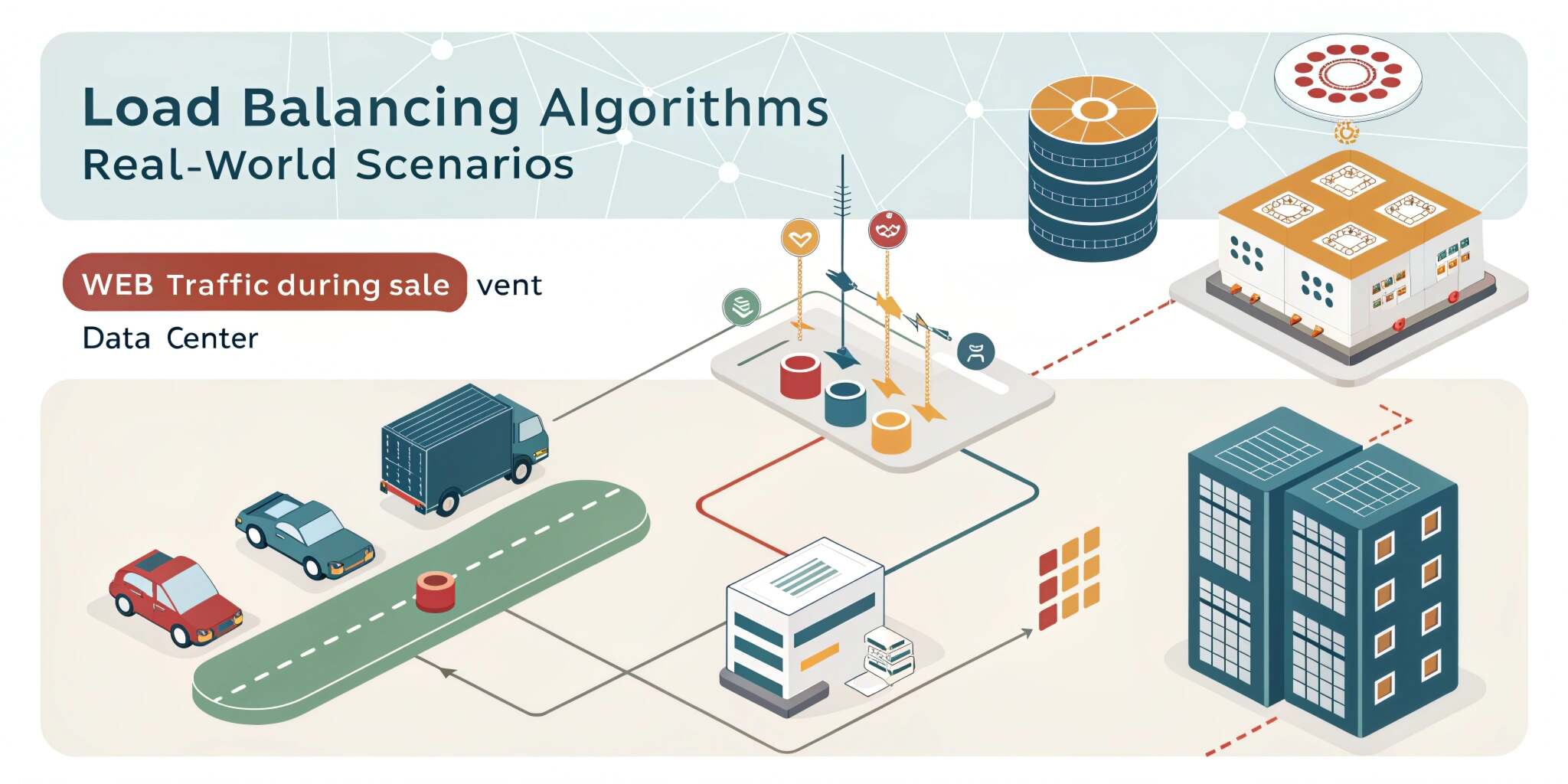
For example, large platforms like e-commerce websites use load balancing to handle traffic spikes during sales events. Without it, servers could crash under pressure.
Choosing the Right Algorithm
Selecting the right load balancing algorithm depends on your system requirements:
- Use Round Robin for simplicity
- Use Least Connections for dynamic workloads
- Use IP Hash for session consistency
- Use Weighted Round Robin for varied server capacities
- Use Least Response Time for performance-critical applications
Conclusion
Load balancing algorithms are the backbone of modern scalable systems. By intelligently distributing traffic, they ensure reliability, efficiency, and seamless user experiences. Understanding these algorithms with real-world scenarios makes it easier for developers and IT professionals to design robust systems that can handle high demand.
Whether you're building a startup application or managing enterprise infrastructure, choosing the right load balancing strategy can make all the difference.