Lag Compensation Techniques in FPS Games: Building Fair and Responsive Multiplayer Experiences
Fast-paced First-Person Shooter (FPS) games demand precision, speed, and fairness. Every millisecond matters when players are aiming, shooting, or reacting to opponents. However, internet latency, packet loss, and varying network conditions can introduce delays that negatively impact gameplay. Without effective lag compensation, players may experience delayed hit registration, rubber-banding, inaccurate player positions, or frustrating inconsistencies.
Lag compensation is a collection of networking techniques designed to minimize the impact of latency while maintaining synchronized gameplay between players and servers. These methods help ensure that online matches remain responsive and competitive, regardless of geographical distance or network quality.
In this article, we'll explore the core lag compensation techniques used in modern FPS games and why they are essential for creating high-quality multiplayer experiences.
What Is Lag Compensation?
Lag compensation refers to methods that reduce the perceived effects of network latency during online gameplay. Instead of eliminating latency—which is impossible due to the physical limits of internet communication—it predicts, corrects, or reconstructs player actions to provide a smoother experience.
The primary goals are to:
- Improve hit registration
- Reduce input delay
- Synchronize player positions
- Maintain fair competition
- Minimize visual inconsistencies
- Handle varying network conditions gracefully
These techniques are commonly used in competitive FPS titles where even slight delays can determine the outcome of a match.
Understanding Network Latency
Latency is the time required for data to travel between a player's device and the game server. It is typically measured in milliseconds (ms).
General latency ranges include:
- 0–30 ms: Excellent
- 30–60 ms: Very good
- 60–100 ms: Acceptable
- 100–150 ms: Noticeable delay
- 150+ ms: Significant gameplay impact
Higher latency can lead to delayed shooting, inaccurate enemy positions, and slower reaction times.
Client-Side Prediction
Client-side prediction is one of the most important lag compensation techniques.
Instead of waiting for the server to confirm every movement, the game immediately predicts the player's actions locally.
For example:
- A player presses the forward key.
- The character moves instantly on the player's screen.
- The movement request is simultaneously sent to the server.
- The server later validates the action.
This approach eliminates the feeling of input lag and makes controls feel highly responsive.
Benefits
- Immediate player feedback
- Smooth movement
- Reduced perceived latency
- Better gameplay responsiveness
Server Reconciliation
Prediction is not always accurate. The server remains the authoritative source of truth and may determine that the client's predicted position differs from the actual game state.
Server reconciliation corrects these differences.
The process works as follows:
- Client predicts movement.
- Input commands are sent to the server.
- Server processes movement.
- Updated position is returned.
- Client adjusts smoothly if discrepancies exist.
Instead of teleporting players, modern games gradually interpolate corrections to avoid noticeable jumps.
Interpolation
Players rarely receive updates every frame. Instead, position updates arrive at regular network intervals.
Interpolation fills the gaps between updates by smoothly transitioning objects from one known position to another.
Advantages include:
- Smooth animations
- Reduced jitter
- Natural enemy movement
- Stable visuals
Without interpolation, characters would appear to "jump" between positions as updates arrive.
Extrapolation
When updates are delayed or temporarily lost, extrapolation predicts future movement based on previous velocity and direction.
For example:
If an opponent is running in a straight line and a packet is delayed, the game estimates where that player should be until the next update arrives.
Extrapolation works well for predictable movement but becomes less accurate when players suddenly change direction.
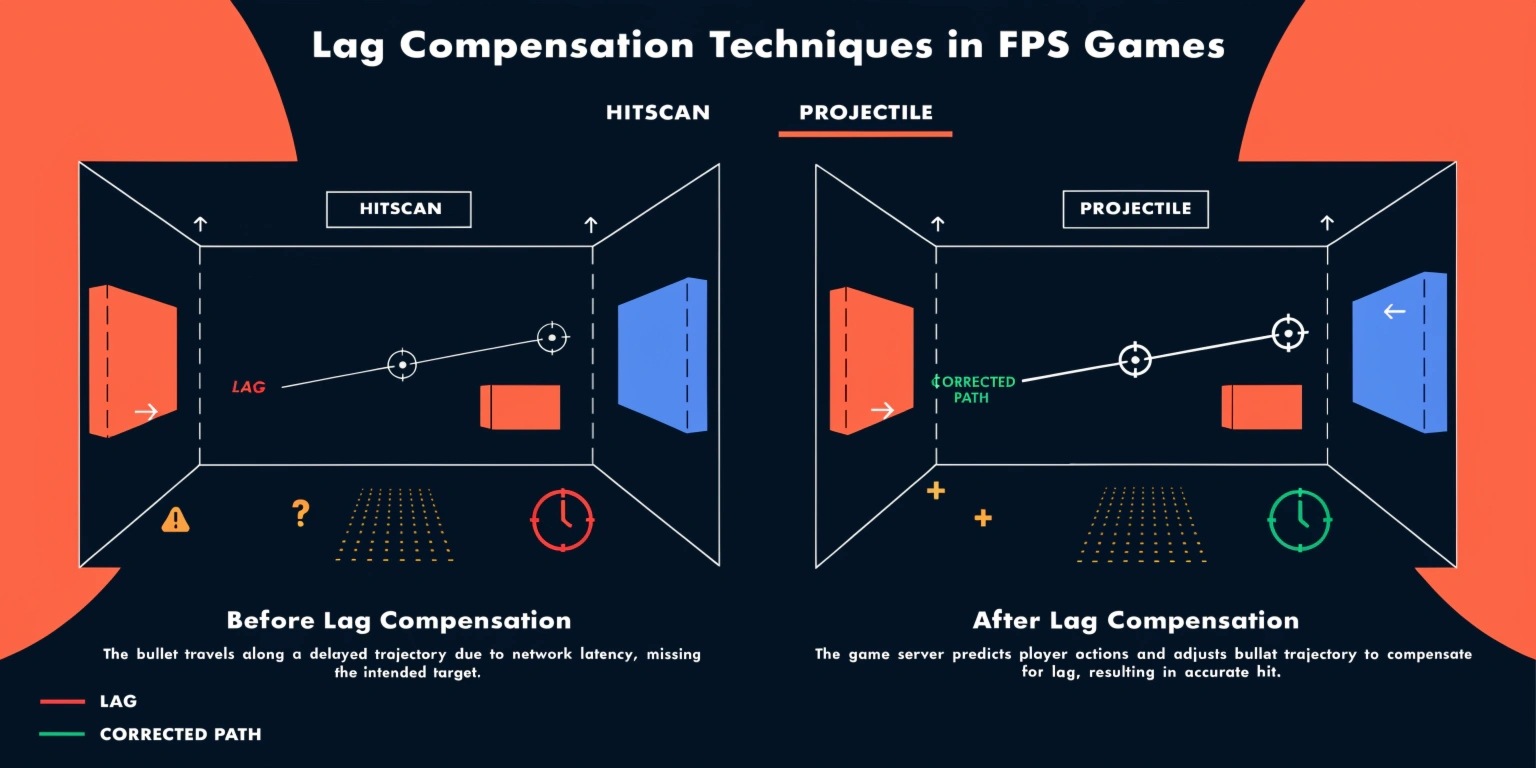
Server-Side Hit Validation (Lag Compensation)
One of the most critical techniques in FPS games is server-side hit validation with historical state rewinding.
Here's how it works:
- A player fires at an enemy.
- The firing command reaches the server after network delay.
- The server rewinds the game state to match the shooter's perspective at the moment the shot was fired.
- The hit is evaluated using historical player positions.
- Damage is applied if the shot was valid.
This ensures fairness for players with moderate latency and improves hit registration accuracy.
Tick Rate and Update Frequency
A server's tick rate determines how often it updates the game world.
Common tick rates include:
- 30 Hz
- 60 Hz
- 64 Hz
- 120 Hz
- 128 Hz
Higher tick rates provide:
- More accurate hit detection
- Faster response times
- Better movement synchronization
- Improved competitive gameplay
However, they also require greater server resources and bandwidth.
Handling Packet Loss
Packet loss occurs when network packets fail to reach their destination.
To minimize its impact, games use:
- Packet retransmission (where appropriate)
- State synchronization
- Delta compression
- Reliable UDP protocols
- Snapshot buffering
These methods help maintain gameplay stability even under poor network conditions.
Best Practices for FPS Networking
Developers should follow several best practices:
- Use dedicated authoritative servers.
- Minimize bandwidth usage with compressed updates.
- Optimize tick rates for competitive play.
- Smooth movement corrections instead of teleporting.
- Continuously monitor latency and packet loss.
- Prioritize critical gameplay packets.
- Test under simulated high-latency conditions.
- Balance fairness for both low- and high-ping players.
Emerging Trends in Multiplayer Networking
As networking technology evolves, new approaches are improving multiplayer performance.
These include:
- Edge computing for lower latency
- AI-assisted lag prediction
- Dynamic server scaling
- Rollback networking improvements
- Cloud-based multiplayer infrastructure
- 5G-powered mobile multiplayer
- Machine learning for network optimization
- Adaptive tick rates based on server load
These innovations promise even smoother and more reliable online experiences.
Conclusion
Lag compensation is a cornerstone of modern FPS game development. Techniques such as client-side prediction, server reconciliation, interpolation, extrapolation, and server-side hit validation work together to overcome the challenges posed by network latency. By carefully implementing these strategies, developers can deliver multiplayer experiences that feel responsive, accurate, and fair—even when players connect from different regions with varying network conditions.
As online gaming continues to grow, mastering lag compensation will remain essential for building competitive FPS titles that meet players' expectations for precision, performance, and reliability.