Kubernetes is widely used to orchestrate containerized applications, but its scheduling process involves much more than simply choosing an available server. The control plane continuously evaluates workloads, cluster resources, and scheduling constraints to determine where pods should run.
Understanding these internals helps developers and platform engineers diagnose pending pods, improve resource utilization, and design resilient production environments.
1. Understanding the Kubernetes Control Plane
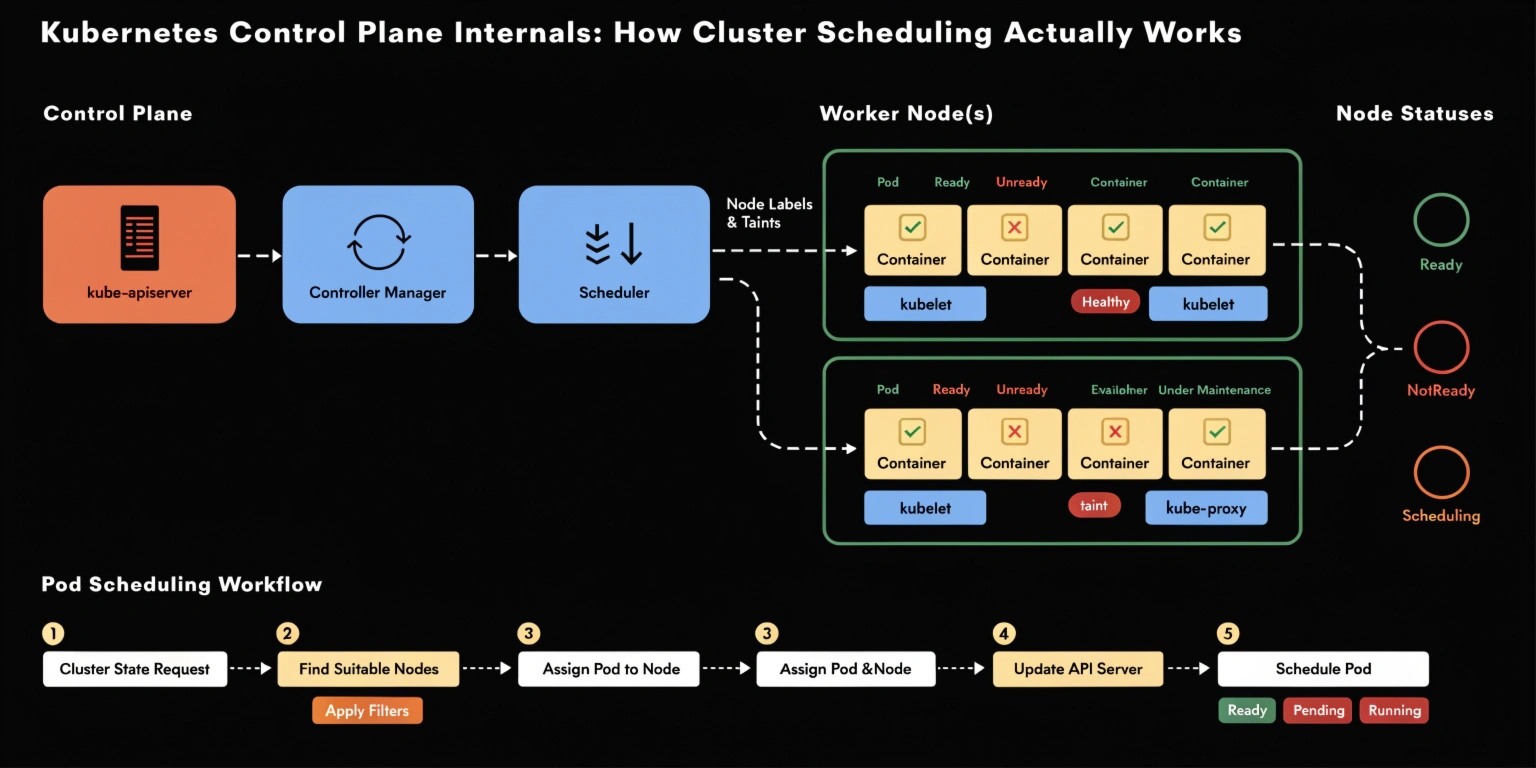
The Kubernetes control plane manages the cluster's desired state and coordinates workload placement. Its core components include the API server, etcd, scheduler, and controller manager.
The API server exposes the Kubernetes API and validates requests from users, controllers, and cluster components. etcd stores the cluster's persistent state, including pod specifications and node information. The scheduler selects suitable nodes for newly created pods, while controllers continuously reconcile the actual cluster state with the desired state.
These components have separate responsibilities but work together through the Kubernetes API. The scheduler does not directly start containers; it determines placement and records the selected node so that the appropriate node-level components can act.
2. What Happens When a Pod Is Created?
When a developer submits a Deployment manifest, the API server validates and stores the requested configuration.
A Deployment controller notices the new desired replica count and creates the necessary ReplicaSet or updates the relevant workload state. The ReplicaSet controller then creates Pod objects.
Initially, these pods may not have a node assigned. The scheduler detects eligible unscheduled pods through its scheduling queues and begins evaluating possible placement.
After a node is selected, the scheduler records the binding through the API server. The kubelet on that node observes the assigned pod, retrieves the required container images when necessary, and works with the container runtime to start the workload.
This process separates workload definition, scheduling decisions, and actual execution.
3. How the Scheduler Evaluates Nodes
The Kubernetes scheduler uses a framework of scheduling stages and plugins rather than a single fixed algorithm.
Conceptually, scheduling involves two major decisions: filtering and scoring.
Filtering eliminates nodes that cannot satisfy a pod's requirements. For example, a node may lack sufficient available resources, violate an affinity rule, or have a taint that the pod does not tolerate.
Scoring ranks the remaining feasible nodes using configured scheduling plugins and policies. These plugins can consider factors such as resource distribution, affinity preferences, topology, and other placement objectives.
The scheduler selects a node from the feasible candidates based on the resulting scores and applicable configuration. If no node qualifies, the pod remains unscheduled and the scheduler reports relevant reasons.
4. Resource Requests and Capacity Management
Resource requests are central to scheduling decisions.
A pod can request CPU and memory, allowing the scheduler to determine whether a node has sufficient allocatable capacity for the workload. The scheduler considers the resource requests of containers in the pod, along with relevant scheduling constraints and existing allocations.
For example, if a node has limited allocatable CPU remaining, a pod requesting more CPU than the available schedulable capacity will not fit—even if current CPU usage appears low.
This distinction matters because scheduling generally uses declared requests rather than simply measuring instantaneous consumption.
Limits serve a different purpose: they constrain resource usage at runtime. CPU limits can throttle workloads, while memory limits can lead to termination if a container exceeds its allowed memory.
Accurate resource requests help avoid inefficient placement, resource contention, and unnecessary scaling.
5. Node Affinity, Pod Affinity, and Taints
Not every workload should run on every node. Kubernetes provides scheduling constraints to control placement.
Node affinity attracts or restricts pods to nodes with specific labels. For example, a machine-learning workload might prefer nodes labeled for GPU availability.
Pod affinity and anti-affinity express preferences or requirements based on the placement of other pods. Anti-affinity can help distribute replicas across separate nodes to improve resilience.
Taints and tolerations control which pods may be scheduled onto particular nodes. A node taint can repel workloads unless a pod has a matching toleration.
These features support specialized hardware, workload isolation, fault-domain distribution, and operational policies. However, overly restrictive combinations can leave pods pending even when the cluster appears to have spare capacity.
6. Scheduler Queues and Scheduling Plugins
The scheduler maintains queues for pods awaiting scheduling and responds to relevant cluster changes.
When a pod cannot be scheduled, it may be retried after conditions change, such as when a node is added or resources become available. Queueing and retry behavior help the scheduler react to a dynamic cluster without requiring users to recreate pods manually.
Scheduling plugins extend the scheduler framework with logic for different stages, including filtering, scoring, binding, and other scheduling-related operations.
Organizations can configure supported plugins or implement custom scheduling behavior when standard policies do not meet specialized requirements. However, custom scheduling logic introduces complexity and should be tested carefully to avoid poor placement decisions or reduced scheduling throughput.
7. Preemption and Unschedulable Pods
When a high-priority pod cannot fit on any node, Kubernetes may attempt preemption if suitable lower-priority pods can be removed to make room.
Preemption is not guaranteed to solve every scheduling problem. It may not help when the issue involves incompatible node selectors, untolerated taints, unavailable hardware, or other constraints that cannot be resolved by freeing resources.
Common reasons for pending pods include insufficient CPU or memory, persistent volume constraints, affinity conflicts, untolerated taints, and topology requirements.
Engineers can begin troubleshooting with commands such as:
- kubectl get pods -A to identify pending workloads.
- kubectl describe pod <pod-name> to inspect scheduling events.
- kubectl get nodes to review node availability.
- kubectl describe node <node-name> to inspect allocatable resources, labels, and taints.
Scheduling events often provide the most direct explanation of why a pod cannot be placed.
8. Optimizing Scheduling in Production
Production scheduling requires balancing reliability, utilization, performance, and operational cost.
Set realistic CPU and memory requests based on observed workloads. Use topology spread constraints or anti-affinity where replica distribution is important. Reserve suitable nodes for specialized workloads through labels and taints, and monitor pending pods and scheduling latency.
Cluster autoscaling can add or remove nodes depending on configuration and demand, but it does not automatically resolve every scheduling constraint. Incorrect resource requests, unavailable instance types, or restrictive placement rules may still prevent workloads from running.
Review scheduling events, resource utilization, node capacity, and workload distribution regularly. Test changes under realistic load before applying them to critical clusters.
Conclusion
Kubernetes cluster scheduling is a coordinated process involving the control plane, scheduling queues, resource evaluation, placement constraints, and node-level execution.
The scheduler filters unsuitable nodes, scores feasible candidates, and assigns pods according to resource availability and configured policies. Controllers and kubelets then help ensure that workloads reach their desired state.
By understanding these internals, engineers can diagnose scheduling failures, improve cluster efficiency, and build more reliable cloud-native infrastructure. Effective scheduling begins with accurate resource requests, carefully designed placement rules, and continuous monitoring of real production behavior.