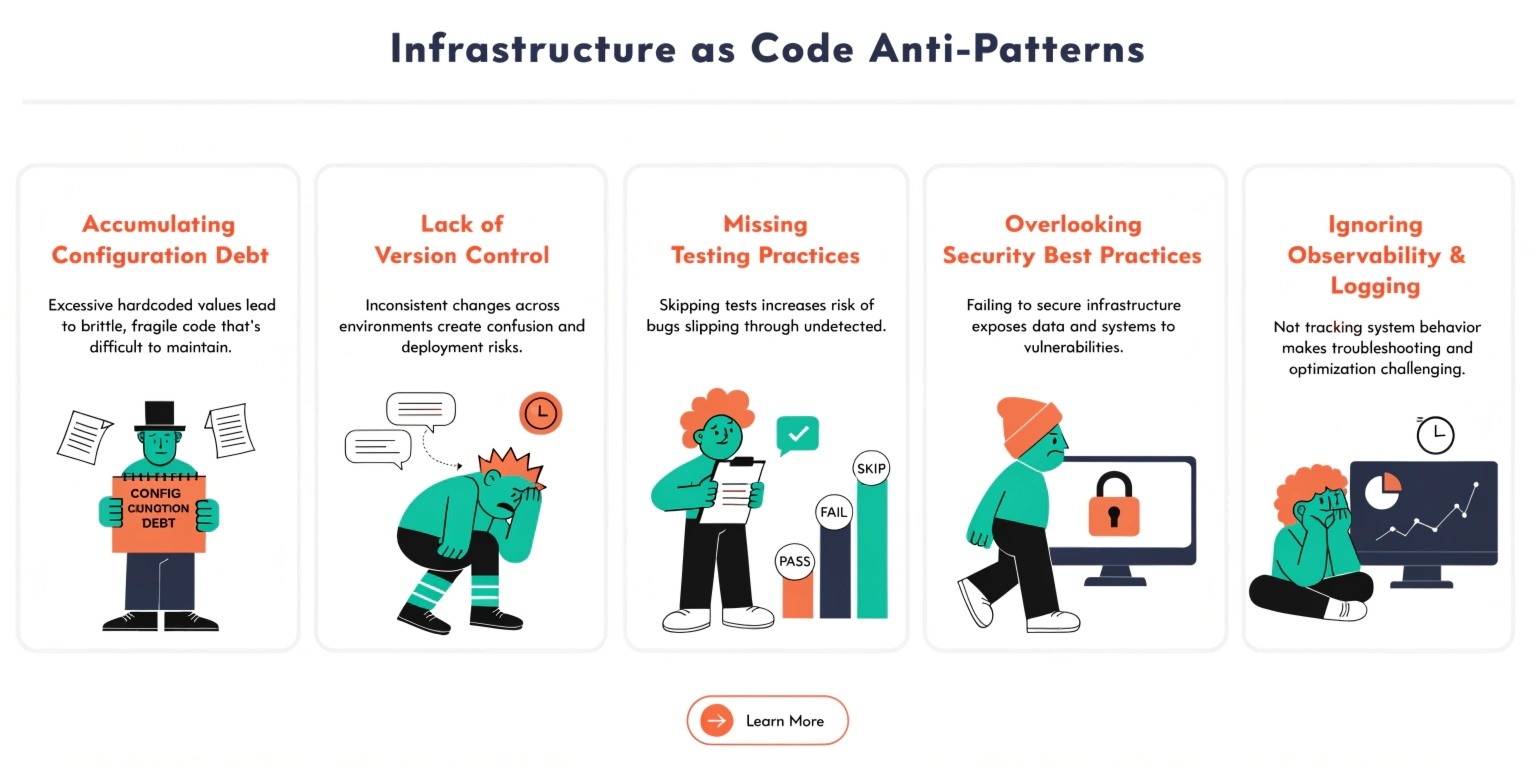
Infrastructure as Code (IaC) has revolutionized how organizations manage and provision infrastructure. By treating infrastructure like software, teams can automate deployments, ensure consistency, and scale efficiently. However, poorly implemented IaC can introduce risks, inefficiencies, and technical debt. These mistakes—known as anti-patterns—can severely impact system reliability and team productivity.
Understanding these anti-patterns is essential for building robust, scalable, and secure infrastructure.
1. Hardcoding Configuration Values
One of the most common IaC anti-patterns is hardcoding values such as IP addresses, credentials, or environment-specific configurations directly into code. This reduces flexibility and makes it difficult to reuse templates across environments.
Why it’s harmful:
- Limits scalability
- Increases risk of errors
- Complicates environment management
Solution:
Use variables, environment files, or secret management tools to externalize configuration.
2. Lack of Modularization
Large, monolithic IaC scripts are difficult to maintain and reuse. When all resources are defined in a single file, even small changes become risky and time-consuming.
Why it’s harmful:
- Poor code readability
- Reduced reusability
- Increased maintenance complexity
Solution:
Break infrastructure into reusable modules. For example, separate networking, compute, and storage components.
3. Ignoring State Management
Tools like Terraform rely heavily on state files to track infrastructure. Mismanaging state—such as storing it locally or failing to secure it—can lead to inconsistencies.
Why it’s harmful:
- Configuration drift
- Deployment conflicts
- Security vulnerabilities
Solution:
Use remote state backends with locking mechanisms and encryption.
4. Configuration Drift
Configuration drift occurs when manual changes are made outside IaC tools, causing a mismatch between declared and actual infrastructure.
Why it’s harmful:
- Loss of consistency
- Unexpected failures
- Difficult debugging
Solution:
Enforce strict policies to prevent manual changes and regularly run drift detection tools.
5. Overusing Provisioners
Provisioners (like scripts executed during deployment) are often misused to handle configuration tasks that should be managed elsewhere.
Why it’s harmful:
- Breaks declarative model
- Leads to unpredictable results
- Hard to debug failures
Solution:
Use configuration management tools or containerization instead of provisioners.
6. No Version Control Practices
Treating IaC differently from application code—such as skipping version control or code reviews—is a major anti-pattern.
Why it’s harmful:
- Lack of traceability
- Increased risk of errors
- Poor collaboration
Solution:
Store IaC in version control systems, implement pull requests, and enforce code reviews.
7. Poor Naming Conventions
Inconsistent or unclear naming of resources makes infrastructure difficult to understand and manage.
Why it’s harmful:
- Confusion across teams
- Increased onboarding time
- Difficult troubleshooting
Solution:
Adopt standardized naming conventions that reflect environment, purpose, and ownership.
8. Skipping Testing and Validation
Many teams deploy IaC changes directly without testing, assuming scripts will work as expected.
Why it’s harmful:
- Deployment failures
- Increased downtime
- Reduced confidence in automation
Solution:
Use automated testing, linting tools, and staging environments to validate changes before production.
9. Lack of Security Considerations
Embedding secrets in code or ignoring access controls can expose infrastructure to security threats.
Why it’s harmful:
- Data breaches
- Compliance issues
- Unauthorized access
Solution:
Use secret management tools, role-based access control (RBAC), and encryption.
10. Not Following Immutable Infrastructure Principles
Updating existing resources instead of replacing them can introduce inconsistencies.
Why it’s harmful:
- Hard-to-track changes
- Increased bugs
- Reduced reliability
Solution:
Adopt immutable infrastructure practices where resources are replaced rather than modified.
Conclusion
Infrastructure as Code is powerful, but only when implemented correctly. Avoiding these anti-patterns ensures that your infrastructure remains scalable, secure, and maintainable. By following best practices such as modularization, proper state management, and automated testing, teams can fully leverage IaC to streamline operations and accelerate innovation.
As cloud environments grow more complex, disciplined IaC practices are no longer optional—they are essential for long-term success.