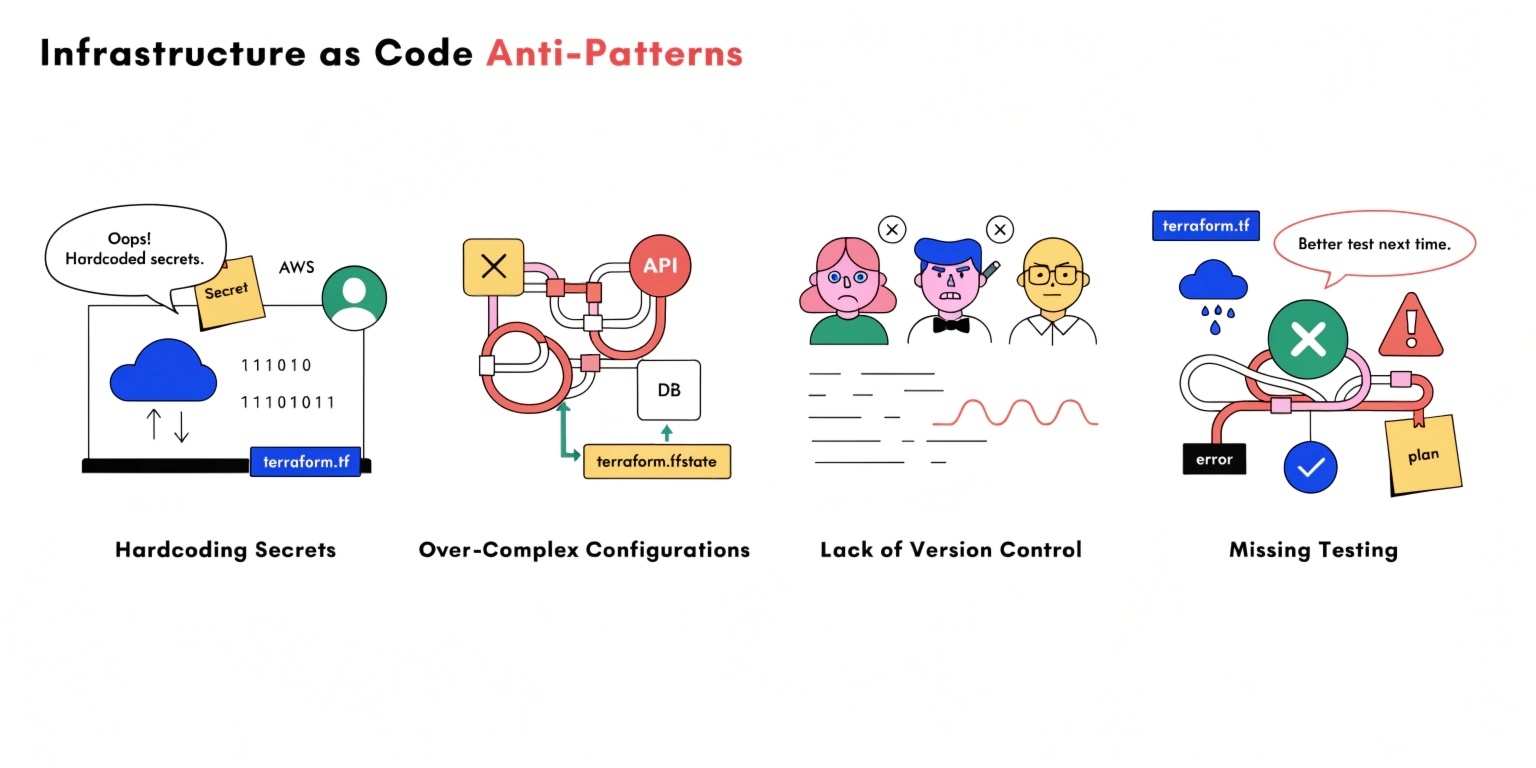
Infrastructure as Code enables scalable cloud automation—but misuse can create fragile, insecure systems. Learn the most dangerous IaC anti-patterns and how to avoid them while building resilient, production-ready infrastructure.
Infrastructure as Code (IaC) transformed cloud engineering. Instead of manually configuring servers, teams now define infrastructure using declarative templates and version-controlled scripts.
Tools like Terraform, AWS CloudFormation, and Pulumi enable repeatable deployments, automated provisioning, and scalable cloud environments.
But as adoption grows, so do architectural mistakes.
IaC promises reliability and consistency—but implemented poorly, it introduces fragility, security vulnerabilities, and operational chaos.
Let’s explore the most dangerous Infrastructure as Code anti-patterns and how to avoid them.
1. The “Big Ball of YAML” Anti-Pattern
One of the most common mistakes is creating massive, monolithic infrastructure templates.
Instead of modular design, teams write thousands of lines of tightly coupled configuration. The result:
- Hard-to-debug deployments
- Slow CI/CD pipelines
- Risky changes with large blast radius
- Poor reusability
Infrastructure should follow the same principles as software engineering:
- Modularity
- Reusability
- Separation of concerns
Break templates into composable modules. Parameterize environments (dev, staging, prod) rather than duplicating configurations.
2. Hardcoding Secrets in Code
This is not just bad practice—it’s dangerous.
Embedding API keys, database passwords, or cloud credentials directly into IaC templates exposes critical secrets in version control.
Even private repositories are not safe long term.
Instead:
- Use dedicated secret managers
- Encrypt sensitive values
- Implement role-based access control
- Rotate credentials regularly
IaC should define infrastructure—not expose it.
3. Ignoring State Management
Many IaC tools rely on state files to track deployed infrastructure. Poor state management leads to:
- Drift between code and reality
- Broken deployments
- Orphaned resources
- Accidental deletions
Storing state locally is an anti-pattern in team environments.
Best practices include:
- Remote state storage
- State locking
- Versioned state backups
- Strict access controls
State is the backbone of reliable automation. Treat it as production data.
4. Configuration Drift Tolerance
IaC aims to eliminate configuration drift—but teams often reintroduce it manually.
Engineers “quick fix” production servers directly in the cloud console. The infrastructure code is never updated.
Over time:
- The actual environment no longer matches source control
- Redeployments fail
- Debugging becomes complex
The rule is simple:
If it’s not in code, it doesn’t exist.
All changes must flow through version control and CI/CD pipelines.
5. Over-Automation Without Governance
Automation is powerful—but ungoverned automation is risky.
Examples:
- Automatically provisioning unlimited resources
- No cost monitoring
- No security policy enforcement
- No tagging standards
This leads to:
- Cloud cost explosions
- Compliance violations
- Security gaps
IaC must integrate with governance systems:
- Policy as Code
- Budget alerts
- Resource tagging enforcement
- Security scanning in pipelines
Automation without guardrails is chaos at scale.
6. Environment Duplication Instead of Parameterization
Many teams copy entire infrastructure stacks for staging and production.
This creates:
- Code duplication
- Inconsistent configurations
- Deployment divergence
Instead of duplication, use:
- Variable files
- Environment-based configuration
- Shared modules
- Feature flags
Infrastructure should scale logically—not by copy-paste.
7. Treating IaC as a DevOps-Only Responsibility
Another major anti-pattern is isolating infrastructure from developers.
When only DevOps engineers understand IaC:
- Knowledge silos form
- Delivery slows
- Ownership confusion increases
Infrastructure definitions should be part of the application lifecycle.
Modern approaches like GitOps promote:
- Infrastructure changes via pull requests
- Peer review
- Version tracking
- Automated validation
Infrastructure is software. Treat it accordingly.
8. Lack of Testing for Infrastructure Code
Many teams test application code thoroughly—but skip infrastructure testing.
Risks include:
- Broken networking rules
- Incorrect IAM policies
- Misconfigured load balancers
- Security group exposure
IaC should include:
- Static analysis
- Security scanning
- Policy validation
- Pre-deployment testing
Infrastructure bugs are often more expensive than application bugs.
9. Tool Proliferation Without Standardization
Using multiple IaC tools without clear strategy introduces fragmentation.
Different teams adopting different tools leads to:
- Inconsistent workflows
- Complex onboarding
- Reduced maintainability
Standardization reduces cognitive load and improves operational maturity.
Choose tools deliberately—not experimentally.
10. Designing for Today Instead of Scale
Some infrastructures are coded for current traffic only.
Then scale happens.
Without modular design and horizontal scalability planning, refactoring becomes expensive.
Infrastructure must anticipate:
- Load growth
- Multi-region deployment
- Disaster recovery
- Observability
IaC should encode scalability patterns—not just resource creation.
The Real Cost of IaC Anti-Patterns
Poorly implemented Infrastructure as Code doesn’t just cause technical debt. It leads to:
- Downtime
- Security breaches
- Compliance failures
- Financial waste
- Team burnout
IaC is powerful—but power requires discipline.
Final Thoughts
Infrastructure as Code is not merely automation. It is infrastructure engineering expressed as software discipline.
Avoid:
- Monolithic templates
- Hardcoded secrets
- Configuration drift
- Weak state management
- Governance gaps
Embrace:
- Modularity
- Version control
- Testing
- Observability
- Security-first thinking
IaC anti-patterns often start as shortcuts. Over time, they become systemic risks.
Build infrastructure the way you build production software—with design principles, code reviews, and long-term scalability in mind.
Because in modern systems, infrastructure is the product.
We build scalable web, mobile, and game products for clients worldwide — combining modern frameworks, cloud infrastructure, and best engineering practices.
.jpg)
.jpg)
.jpg)