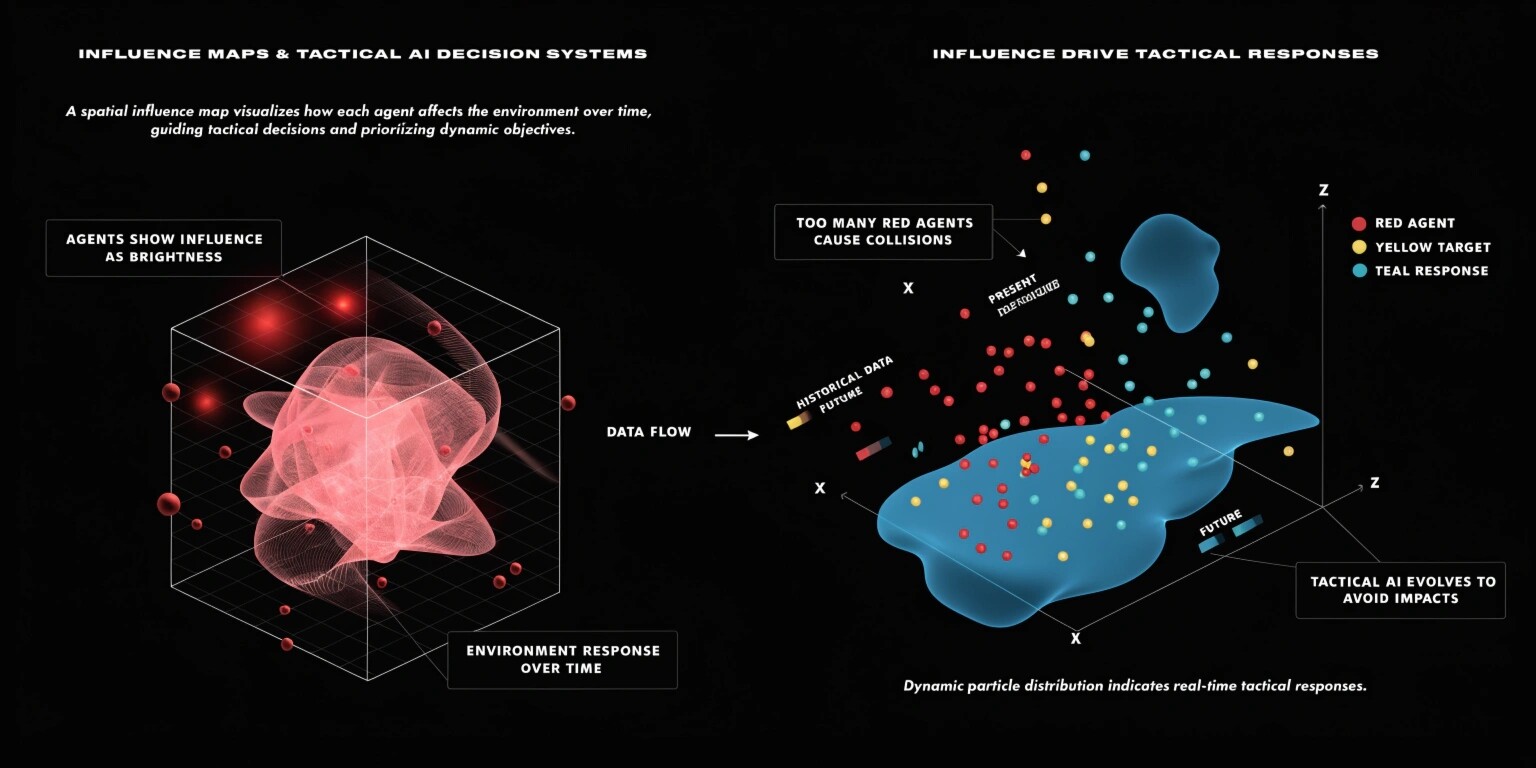
Modern games demand intelligent and believable AI behavior. Players expect enemies and allies to react strategically, adapt to situations, and make realistic decisions. One of the most powerful techniques used to achieve this is influence maps, combined with tactical AI decision systems.
These systems enable AI to evaluate the game world dynamically and make decisions based on spatial awareness, threat levels, and strategic goals.
What Are Influence Maps?
An influence map is a grid or spatial representation of the game world where each cell stores a value representing influence—such as danger, control, or opportunity.
These values are typically influenced by:
- Enemy positions
- Friendly units
- Objectives or resources
- Environmental factors
The AI uses these values to determine the best course of action.
How Influence Maps Work
- The game world is divided into a grid or navigation mesh
- Each entity (player, enemy, object) contributes influence values
- Influence spreads across nearby cells (often using decay functions)
- The AI evaluates the map to make decisions
For example:
- High enemy influence → Avoid area
- High friendly influence → Move or attack
- Neutral zones → Explore
Types of Influence Maps
1. Threat Maps
Show dangerous areas based on enemy presence and strength.
2. Control Maps
Indicate which team controls specific regions.
3. Resource Maps
Highlight valuable areas like health packs or objectives.
4. Visibility Maps
Track line-of-sight and fog-of-war information.
Tactical AI Decision Systems
While influence maps provide data, decision systems determine how AI acts on that data.
Common approaches include:
1. Finite State Machines (FSMs)
Simple state-based systems (attack, defend, retreat).
2. Behavior Trees
Hierarchical decision-making systems widely used in modern games.
3. Utility AI
Assigns scores to possible actions and selects the highest-value option.
4. Goal-Oriented Action Planning (GOAP)
AI plans sequences of actions to achieve specific goals.
Combining Influence Maps with Decision Systems
The real power comes from integrating influence maps with decision-making systems.
Example Workflow:
- Influence map identifies a high-threat area
- AI evaluates options (attack, retreat, flank)
- Decision system selects the best action based on context
This combination creates adaptive and intelligent behavior.
Real-World Game Applications
- Real-Time Strategy (RTS) Games – AI evaluates battlefield control and unit positioning
- First-Person Shooters (FPS) – Enemies take cover, flank, or retreat
- Open-World Games – NPCs react dynamically to player actions
- Stealth Games – AI detects and responds to player visibility and noise
These systems enhance realism and player engagement.
Advantages of Influence Maps
- Scalable for large environments
- Flexible across different game genres
- Efficient for real-time decision-making
- Easy to visualize and debug
Challenges in Implementation
1. Performance Overhead
Updating large maps in real time can be computationally expensive.
2. Balancing Influence Values
Incorrect tuning can lead to unrealistic behavior.
3. Complexity in Large Systems
Combining multiple maps and decision systems increases complexity.
Optimization Techniques
- Use lower-resolution grids for large maps
- Update influence maps selectively (not every frame)
- Use GPU acceleration for large-scale calculations
- Cache frequently used values
Best Practices for Developers
- Start with simple influence maps and expand gradually
- Combine multiple map types for richer behavior
- Use visualization tools for debugging
- Integrate with existing AI systems like behavior trees
- Continuously test and tune values
Future Trends in Game AI
- Integration with machine learning for adaptive behavior
- Hybrid systems combining rule-based and learning-based AI
- More realistic simulations in large-scale environments
- Improved tools for AI visualization and debugging
Influence maps will continue to be a core component of advanced game AI systems.
Conclusion
Influence maps and tactical AI decision systems are powerful tools for creating intelligent and dynamic game behavior. By combining spatial awareness with strategic decision-making, developers can build AI that feels realistic, responsive, and engaging.
While implementation can be complex, the benefits in gameplay quality and player immersion make these systems essential for modern game development. Mastering these techniques is a significant step toward building smarter and more compelling game worlds.