Building a powerful AI model is only part of the machine learning journey. Once a model is trained, it must be deployed efficiently to deliver fast and accurate predictions in real-world environments. Whether powering recommendation systems, autonomous vehicles, chatbots, medical imaging platforms, or computer vision applications, inference speed directly impacts user experience and operational performance.
Many organizations discover that trained models perform well during development but struggle when deployed at scale due to latency, hardware limitations, and resource consumption. This challenge has led to the growing importance of inference optimization.
Two technologies that have become central to modern AI deployment are TensorRT and ONNX (Open Neural Network Exchange). Together, they help developers transform trained models into highly optimized inference engines capable of delivering maximum performance across various hardware environments.
What Is AI Inference?
Inference is the process of using a trained machine learning model to make predictions on new data.
Examples include:
- Image classification
- Speech recognition
- Fraud detection
- Recommendation engines
- Natural language processing
- Autonomous navigation
- Predictive analytics
Unlike training, which may take hours or days, inference often needs to occur in milliseconds.
The faster the inference process, the better the user experience and system responsiveness.
Why Inference Optimization Matters
As AI applications become more widespread, performance requirements continue to increase.
Businesses need:
- Lower latency
- Higher throughput
- Reduced infrastructure costs
- Better scalability
- Efficient GPU utilization
- Real-time decision-making
Without optimization, even powerful AI models can become bottlenecks in production systems.
Inference optimization ensures models operate efficiently while maintaining accuracy.
Understanding ONNX
ONNX (Open Neural Network Exchange) is an open-source framework designed to improve interoperability between machine learning platforms.
Traditionally, AI models trained in one framework often required significant effort to deploy in another environment.
ONNX solves this challenge by providing a standardized model format.
Benefits of ONNX include:
Framework Independence
Models trained using:
- PyTorch
- TensorFlow
- Keras
- Scikit-learn
- MXNet
can be exported into ONNX format and deployed across multiple platforms.
Simplified Deployment
Developers can build models using their preferred framework while maintaining deployment flexibility.
Hardware Compatibility
ONNX supports execution across:
- CPUs
- GPUs
- Edge devices
- Cloud infrastructure
This portability significantly reduces deployment complexity.
What Is TensorRT?
TensorRT is NVIDIA's high-performance deep learning inference optimization framework.
It is specifically designed to maximize inference performance on NVIDIA GPUs.
TensorRT improves AI workloads through:
- Layer fusion
- Precision calibration
- Kernel optimization
- Memory optimization
- Dynamic tensor management
These optimizations reduce execution time and improve throughput.
How TensorRT Optimizes AI Models
Layer Fusion
Neural networks often contain multiple sequential operations.
TensorRT combines compatible layers into a single optimized operation, reducing computational overhead.
Precision Optimization
TensorRT supports multiple precision formats:
- FP32 (32-bit floating point)
- FP16 (16-bit floating point)
- INT8 (8-bit integer)
Lower precision calculations significantly improve performance while maintaining acceptable accuracy.
Kernel Auto-Tuning
TensorRT automatically selects the most efficient GPU kernels for each operation.
This ensures optimal hardware utilization.
Memory Optimization
Efficient memory allocation reduces bottlenecks and improves execution speed.
Dynamic Shape Support
TensorRT can optimize models that process varying input sizes, making deployment more flexible.
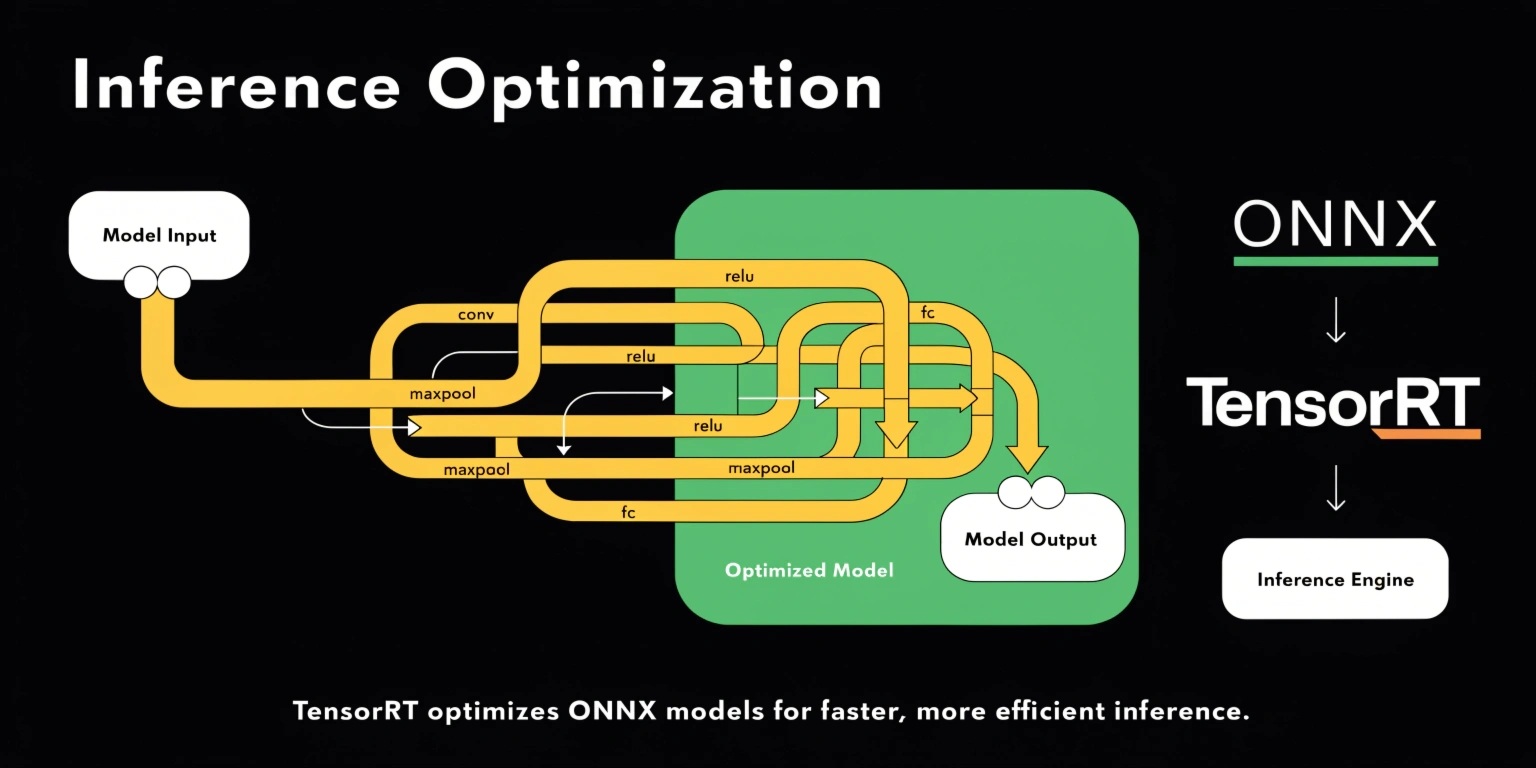
The ONNX and TensorRT Workflow
A typical deployment pipeline includes:
Step 1: Train the Model
Developers create and train the model using frameworks such as PyTorch or TensorFlow.
Step 2: Export to ONNX
The trained model is converted into ONNX format.
Step 3: Import into TensorRT
TensorRT reads the ONNX model and performs optimization passes.
Step 4: Build an Optimized Engine
The framework generates a highly optimized inference engine tailored to the target GPU.
Step 5: Deploy in Production
The optimized model is deployed for real-time inference.
This workflow combines portability and performance.
Benefits of Using TensorRT and ONNX Together
Faster Inference
Organizations often achieve significant reductions in prediction latency.
Higher Throughput
More requests can be processed simultaneously.
Better GPU Utilization
TensorRT maximizes available hardware resources.
Lower Operational Costs
Efficient inference reduces cloud infrastructure requirements.
Scalability
Applications can handle larger workloads without proportional increases in hardware costs.
Real-World Applications
Computer Vision
Applications include:
- Facial recognition
- Object detection
- Quality inspection systems
- Medical imaging
Natural Language Processing
Optimized inference improves:
- Chatbots
- Virtual assistants
- Language translation systems
- Text classification models
Autonomous Systems
Real-time inference is essential for:
- Self-driving vehicles
- Robotics
- Industrial automation
Edge AI
Resource-constrained devices benefit significantly from optimized inference engines.
Examples include:
- Smart cameras
- IoT devices
- Embedded systems
Challenges in Inference Optimization
Despite its advantages, optimization requires careful planning.
Accuracy Trade-Offs
Lower precision formats may slightly affect model accuracy.
Hardware Dependencies
TensorRT primarily targets NVIDIA GPUs.
Complex Architectures
Some custom neural network layers may require additional implementation work.
Continuous Maintenance
As models evolve, optimization pipelines must be updated regularly.
Best Practices for AI Inference Optimization
- Use ONNX as a standard deployment format.
- Benchmark performance before and after optimization.
- Test multiple precision modes.
- Validate model accuracy thoroughly.
- Monitor production performance continuously.
- Optimize batch sizes based on workload requirements.
- Leverage GPU profiling tools for deeper insights.
Future Trends
Inference optimization continues to evolve alongside AI technology.
Emerging developments include:
- Automated model compression
- AI-driven optimization engines
- Edge-native deployment frameworks
- Hybrid cloud-edge inference systems
- Advanced quantization techniques
- Multi-GPU inference orchestration
These innovations will further improve performance while reducing deployment costs.
Conclusion
Inference optimization has become a critical component of modern AI deployment strategies. While powerful models can deliver impressive results, their true value depends on how efficiently they perform in production environments.
By combining ONNX's portability with TensorRT's GPU-specific optimization capabilities, organizations can achieve faster inference, lower latency, higher throughput, and better scalability. Whether deploying AI in cloud environments, enterprise applications, autonomous systems, or edge devices, TensorRT and ONNX provide a proven foundation for building high-performance, production-ready machine learning solutions.
As AI adoption continues to accelerate across industries, mastering inference optimization will remain essential for delivering responsive, scalable, and cost-effective intelligent systems.