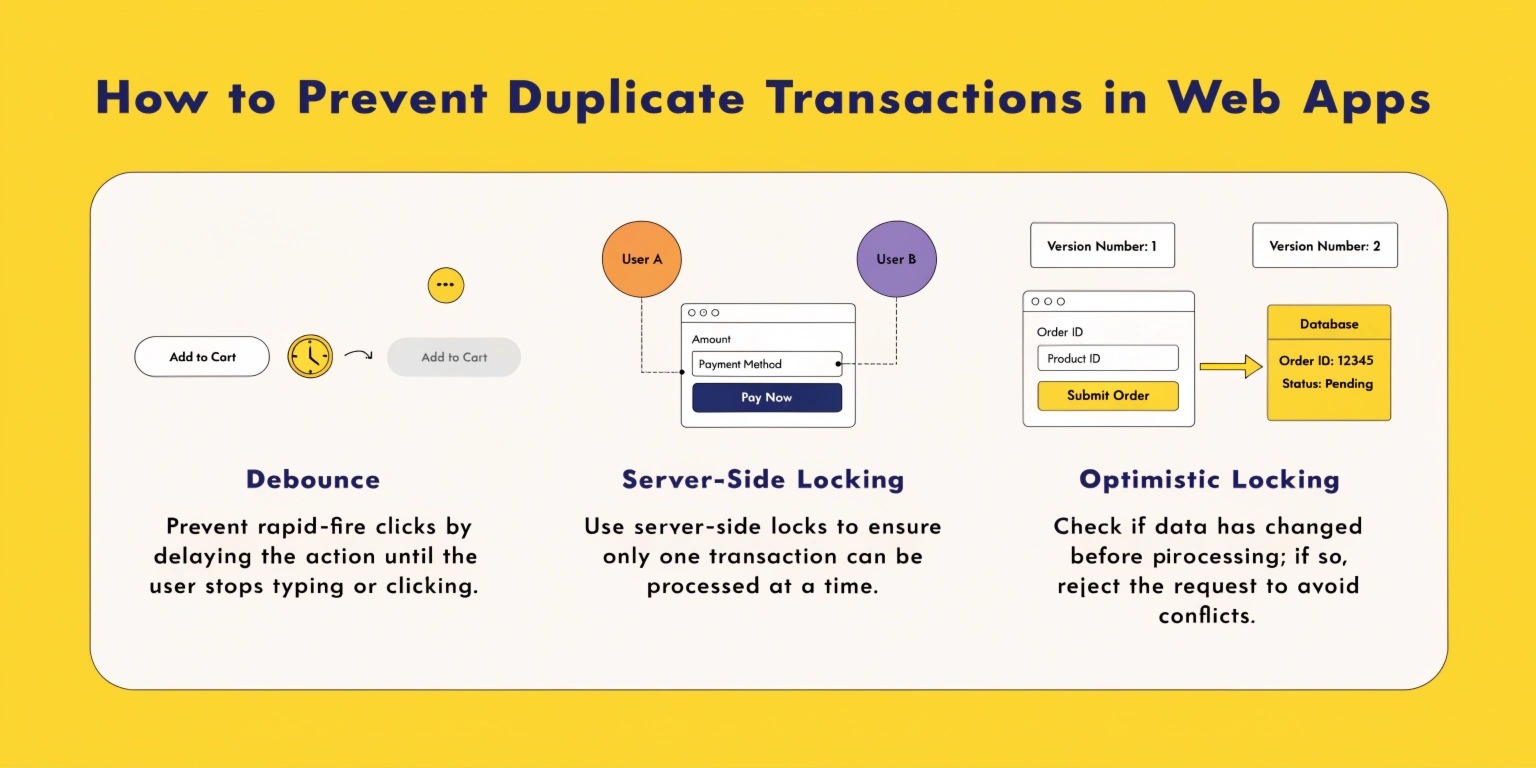
Duplicate transactions can occur because of double clicks, network retries, concurrent requests, payment callbacks, or distributed-system failures. Idempotency keys, unique database constraints, atomic operations, locking, and reliable webhook processing help web applications ensure that one business operation produces only one valid transaction.
Duplicate transactions are one of the most serious problems a web application can encounter, especially when handling payments, orders, wallet balances, subscriptions, invoices, or financial records. A duplicate transaction can result in customers being charged twice, inventory being reduced incorrectly, or account balances becoming inconsistent.
The problem is often more complicated than simply disabling a button after a user clicks it. Duplicate requests can originate from browsers, mobile clients, network retries, payment providers, background workers, or distributed services. Preventing them requires protection across the entire transaction workflow.
Why Duplicate Transactions Happen
There are several common causes.
A user may click a payment button twice because the interface appears slow. A browser may resend a request after a timeout. A mobile application may retry an API call when the network connection changes.
Payment gateways can also send webhook notifications more than once. Background queues may retry failed jobs. Multiple application servers may process the same request simultaneously.
A critical principle is therefore:
Never assume that a request will arrive exactly once.
Backend systems should be designed to tolerate repeated requests safely.
Use Idempotency Keys
One of the most effective techniques is idempotency.
An idempotent operation produces the same business result when the same request is processed multiple times.
For example, a client generating an order request can create a unique idempotency key:
payment_8f92a7c1
The server stores that key together with the transaction result.
If the same request arrives again with the same key, the server does not create another payment. Instead, it returns the previously stored result.
This is particularly useful for payment APIs and order-creation endpoints.
Enforce Unique Database Constraints
Application-level checks alone are not enough.
Consider this logic:
if transaction does not exist:
create transaction
Two requests arriving simultaneously could both check the database before either creates the record. Both may see that the transaction does not exist and then create duplicates.
A unique database constraint provides a stronger guarantee.
For example, a transaction table might enforce uniqueness on:
user_id + client_transaction_id
The database then becomes the final protection against duplicate records.
Use Database Transactions
Multiple related database operations should often execute inside a database transaction.
Suppose an application processes an order by:
- Creating an order.
- Recording payment.
- Reducing inventory.
- Updating account balance.
If these operations execute independently, a failure between steps can leave the system in an inconsistent state.
A database transaction can ensure that related operations either complete together or roll back together, depending on the database and workflow design.
However, database transactions alone do not automatically make external payment operations idempotent. External systems require their own safeguards.
Handle Race Conditions
Race conditions occur when multiple requests access or modify the same resource simultaneously.
For example, two requests may attempt to purchase the final available item at exactly the same time.
Possible approaches include:
- Unique constraints
- Row-level locking
- Optimistic concurrency control
- Atomic update operations
- Serializable transactions where appropriate
The correct approach depends on the database and workload.
For high-throughput applications, developers should avoid unnecessarily locking large portions of the database because excessive locking can reduce scalability.
Make Payment APIs Retry-Safe
Network failures are unavoidable.
Imagine that a payment request reaches the server successfully, but the response is lost because the user's network disconnects. The client cannot determine whether the payment succeeded.
The client may retry.
Without idempotency, the retry could create another payment.
With an idempotency key, the server can recognize that the retry represents the same operation and return the original result.
This pattern is essential for reliable payment processing.
Protect Webhook Processing
Payment providers and other external services commonly use webhooks to notify applications about events.
A webhook may be delivered more than once.
Therefore, webhook handlers should also be idempotent.
A webhook event can have a unique event ID. The application can store processed event IDs and reject or safely ignore duplicates.
For example:
receive webhook
↓
check event ID
↓
already processed?
/ \
yes no
↓ ↓
return process event
↓
store event ID
The exact implementation should also consider concurrency, so two workers cannot process the same event simultaneously.
Avoid Relying Only on Frontend Protection
Disabling a button after clicking can improve user experience, but it is not a security mechanism.
Requests can still be duplicated through:
- Browser retries
- Network failures
- API clients
- Mobile applications
- Automated systems
- Background workers
The backend must always enforce transaction uniqueness.
Frontend controls should be treated as an additional user-experience layer rather than the primary protection.
Use Transaction States
A robust transaction system can use explicit states such as:
CREATED
PROCESSING
SUCCESS
FAILED
CANCELLED
This makes it easier to understand what happened when requests are retried.
For example, if a payment is already in PROCESSING, another request using the same transaction identity should not create a new payment.
State transitions should also be validated so that invalid transitions cannot occur.
Distributed Systems Require Additional Protection
Large web applications may have multiple servers, services, queues, and databases.
A request could pass through:
Client
↓
API Gateway
↓
Order Service
↓
Payment Service
↓
Message Queue
↓
Worker
↓
Database
Every stage introduces opportunities for retries and duplication.
Message queues should therefore use appropriate delivery and deduplication strategies. Consumers should be designed to process messages safely more than once when the infrastructure provides at-least-once delivery.
Monitor Duplicate Attempts
Prevention should be combined with monitoring.
Applications can track:
- Repeated idempotency keys
- Duplicate webhook events
- Failed transaction retries
- Database constraint violations
- Multiple requests for the same order
- Unusual payment patterns
Alerts can help engineering teams identify bugs or infrastructure problems before they affect many users.
Building Reliable Transaction Workflows
Preventing duplicate transactions requires multiple layers of protection rather than one technique.
A strong architecture generally combines idempotency keys, database uniqueness constraints, atomic operations, transaction-state management, concurrency control, retry-safe APIs, and webhook deduplication.
The most important principle is to design for failure. Requests can be duplicated, responses can be lost, users can click multiple times, services can restart, and external providers can retry notifications.
When a web application assumes these events are normal rather than exceptional, transaction processing becomes significantly more reliable.
For payment systems, e-commerce platforms, subscription services, financial applications, and other transaction-heavy products, duplicate prevention should be considered an architectural requirement from the beginning—not a patch added after the first production incident.
We build scalable web, mobile, and game products for clients worldwide — combining modern frameworks, cloud infrastructure, and best engineering practices.
.jpg)
.jpg)
.jpg)